🏭 Factory Guide - Hiring Workers
You already have factories running. But while you sleep, work, or simply aren't in the game, they sit idle — unless you hire workers.
This is the next step after building your productive base: understanding how the hiring system works and how to use it to your advantage.
⚠️ Note: the information in this article was gathered from experienced players and cross-referenced with the official game wiki. Treat numerical values as references — market prices fluctuate, but the strategic logic holds.
🧱 How work in a factory functions
In War Era, a factory accumulates Production Points (PP) in three different ways:
Automated Engine — generates PP passively per hour, consuming nothing from the player. Can be upgraded with Steel up to level 7 (maximum 7 PP/hour).
Self-work — the owner works in their own factory, consuming Entrepreneurship. The most efficient method, since it scales with your skills.
Hired workers — other players work for you, consuming their own Energy. Each work session uses 10 Energy from the worker and generates PP for your factory.
All three systems run simultaneously. An active owner takes advantage of self-work when online and workers to keep production going while offline.
📋 Creating a job offer
To hire, you need to create a job offer directly from your company. The offer specifies a wage in Coins per Production Point (Coins/PP).
Once created, the offer automatically appears in the Job Market — and any player can accept it and start working for you.
Payment is handled automatically:
Total wage = PP produced × Coins/PP
This amount is debited from your account after each work session. If your balance is insufficient to cover the payment, the work session fails — the worker cannot work and you receive no PP.
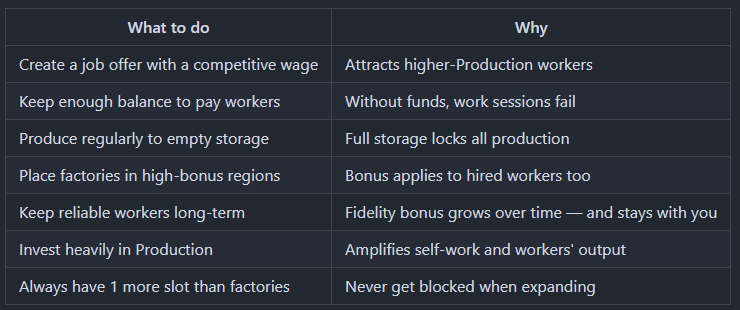
⚠️ Critical tip: always keep enough balance in your account. A factory that can't pay its workers is a factory that doesn't produce.
Additionally, the income tax of the country where the factory is located is applied to the wage. This goes to the national treasury — and if the region is occupied by another country, a portion may be diverted to the occupier. The worker always receives the wage already net of tax.
⚡ What determines how much each worker produces
When a player works in your factory, the PP generated per session depend on the worker's Production skill. With zero points invested in Production, each session yields 12 PP per 10 Energy.
Workers with more Production skill points generate more PP per session — and cost the same wage per PP.
A more efficient worker is literally a better deal for both sides: they earn more per session (more PP = higher payout), and you receive more production for the same cost.
🏅 The fidelity bonus
Beyond the worker's Production skill, there is a fidelity bonus — granted to workers who remain at the same company for an extended period.
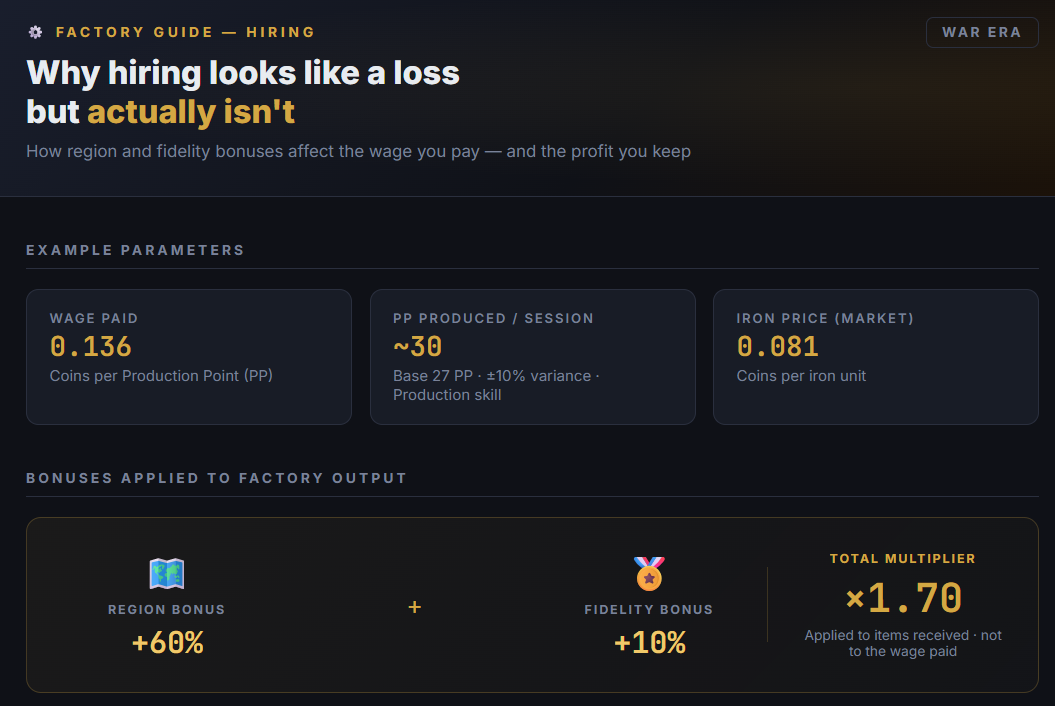
The maximum fidelity bonus is +10% on top of production. This bonus:
Is cumulative with the region production bonus
Grows as the worker stays at the company
Means more production that you receive without paying any extra for it
This creates a clear incentive to retain good workers: the longer they stay, the more they produce for you — and the wage per PP never changes.
Tip for owners: offer a competitive wage from the start. Workers who stay are worth more than new workers who need to rebuild their fidelity bonus from scratch.
💰 The secret behind the wage: bonuses stay with you
Here is the counter-intuitive part of the system — and probably the most important point in this guide:
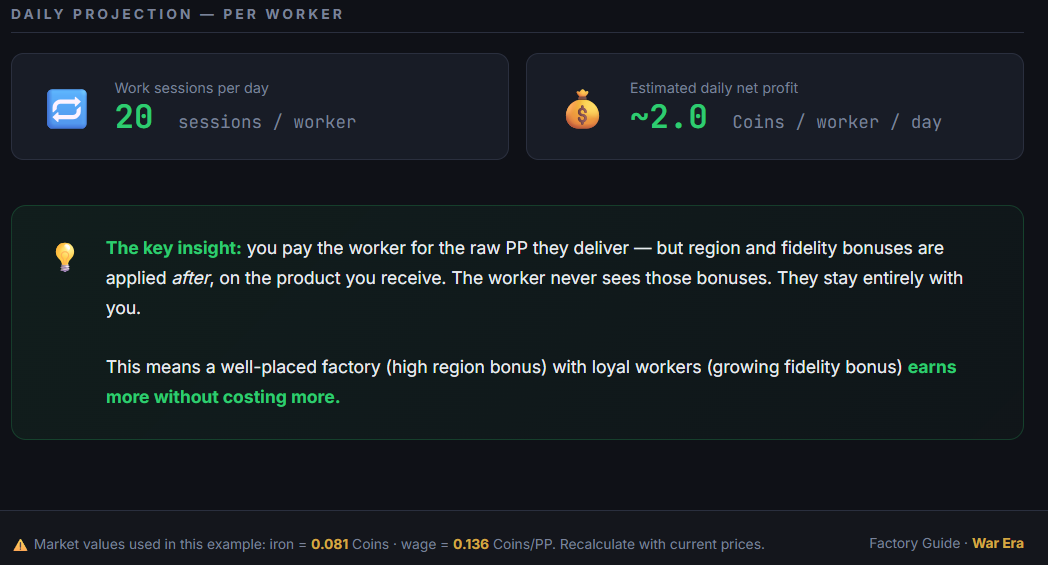
You pay the worker for the PP they produce. But the production bonuses (region and fidelity) are applied afterwards — and stay entirely with you.
This means the worker delivers, say, 30 PP. You pay for 30 PP. But what goes into your factory's storage is not 30 PP — it's 30 PP multiplied by your bonuses.
The real math (iron mine example)
Using real numbers shared by an experienced player:
Wage: 0.136 Coins/PP
Worker with Production skill: produces ~30 PP per session (base 27 ±10%)
Iron price on the market: 0.081 Coins per unit
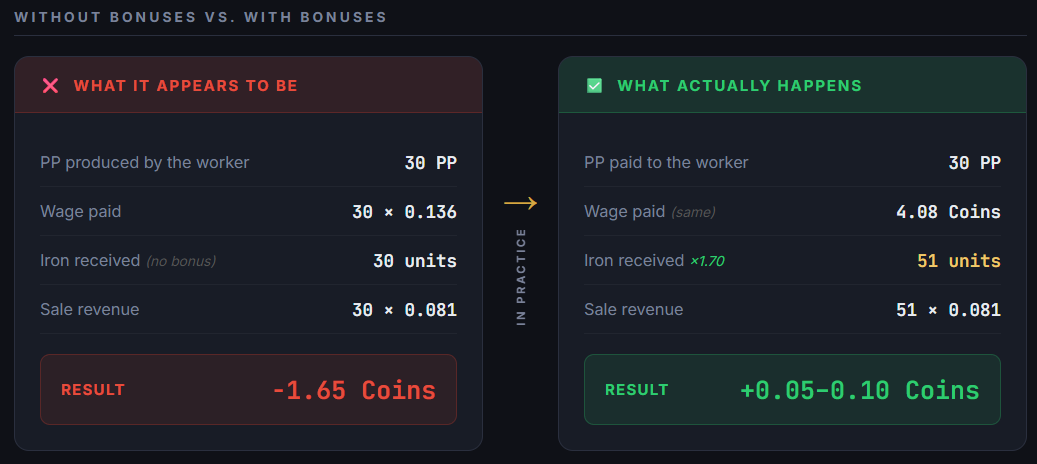
What it looks like at first glance:
You pay:          30 × 0.136 = 4.08 Coins
Without bonus:    30 iron × 0.081 = 2.43 Coins
Appears to be:    −1.65 Coins loss per session
With bonuses applied:
PP paid to the worker:       30
Region bonus:               +60%
Fidelity bonus (max):       +10%
────────────────────────────────
PP you actually receive:     30 × 1.70 = 51 iron

Real revenue:  51 × 0.081 = 4.13 Coins
Cost:                        4.08 Coins
Profit per session:         ~0.05–0.10 Coins
With one worker doing 20 sessions per day, that's roughly 2 Coins/day in profit — even with high wages and low market prices.
⚠️ Note: these values reflect a specific market snapshot. Prices change, but the logic doesn't: bonuses always stay with the owner.
📊 How much should you pay?
Real revenue = (PP paid × (1 + region bonus + fidelity bonus)) × item price
Cost         = PP paid × wage/PP

Profit = Real revenue − Cost
What you need to calculate before setting a wage:
What is your factory's region bonus? (visible in the company info)
What is the current market price for your product?
What is the maximum wage that still leaves a positive margin?
Rule of thumb: check the job market frequently. A wage slightly above average attracts workers with higher Production skill — and those workers maximize the return on your bonuses.
🔄 Storage: the invisible bottleneck
Storage can be upgraded with Steel up to level 7, for a maximum of 1400 PP. When storage is full, the factory stops accepting any work — from the engine, from you, and from hired workers.
To free up space, click "Produce" to convert stored PP into items.
Storage full → no production happens → workers cannot work
Rule of thumb: log in regularly to hit "Produce" and clear storage. A full warehouse locks every system in the factory.
💡 Extra tips
🔢 Skill distribution (owner's perspective)
"Put 20% of points into self-work, 30% into energy, and the rest into production. With the money from working you'll be able to get companies more easily."
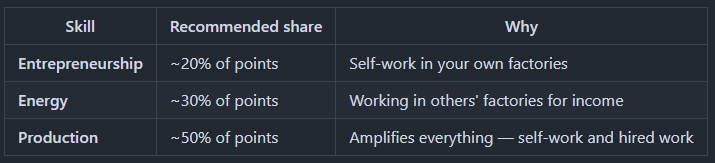
Early in the game you'll have more Energy than Entrepreneurship, so it makes sense to work in other factories for external income while building your own. Production is the most universally valuable skill at every stage.
For a full breakdown of skill allocation based on factory count, see the skills guide.
📏 Companies: always keep 1 extra slot
Always have one more company slot than the number of factories you operate.
Example: 5 factories → keep 6 slots unlocked. This prevents being blocked when building the next factory. With the 7-day skill reset, you can unlock the slot at the right moment without wasting points in advance.
🔥 Quick summary