A Pale Blue Dot
Our World is Just A Pale Blue Dot
Voyager 1 was launched on September 5, 1977, with the initial purpose of studying the outer Solar System. After fulfilling its primary mission, as it ventured out of the Solar System, the decision was made to turn its camera around and capture one last image of Earth, It was Carl Sagan's proposition.
Voyager 1 was about 6.4 billion kilometers (4 billion miles) away, and approximately 32 degrees above the ecliptic plane, when it captured this portrait of our world. Caught in the center of scattered light rays (a result of taking the picture so close to the Sun), the Earth appears as a tiny BLUE point of light, a crescent only 0.12 pixel in size.
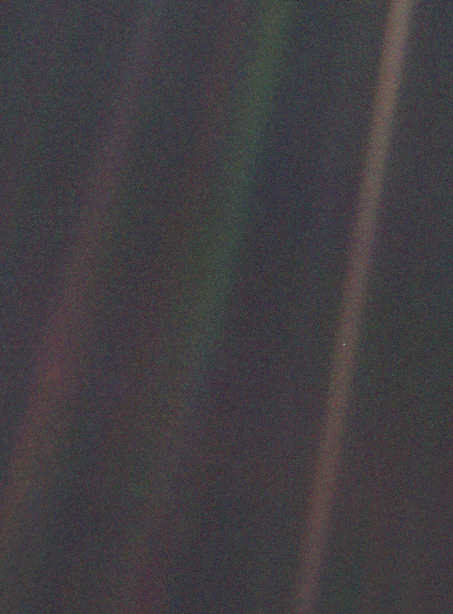
Look again at that dot. That's here. That's home. That's us. On it, everyone you love, everyone you know, everyone you ever heard of, every human being who ever was, lived out their lives. The aggregate of our joy and suffering, thousands of religions, ideologies, and economic doctrines, every hunter and forager, every hero and coward, every creator and destroyer of civilization, every king and peasant, every young couple in love, every mother and father, hopeful child, inventor and explorer, every teacher of morals, every corrupt politician, every "superstar," every "supreme leader," every saint and sinner in the history of our species lived there--on a mote of BLUE dust suspended in a sunbeam.
Look again at that dot. What? You can`t find it?
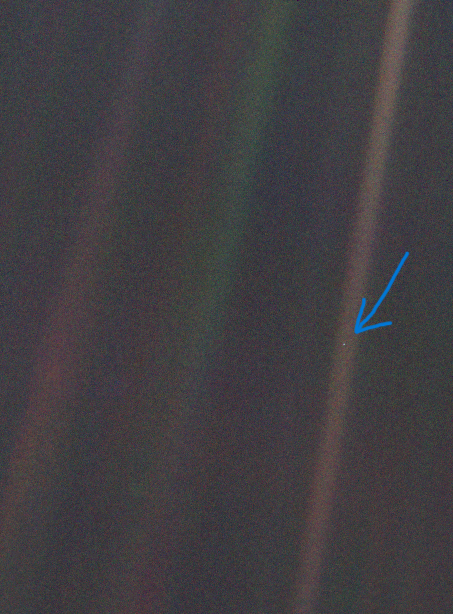
There you go.
Our posturings, our imagined self-importance, the delusion that we have some privileged position in the Universe, are challenged by this point of pale BLUE light. Our planet is a lonely speck in the great enveloping cosmic dark. In our obscurity, in all this vastness, there is no hint that help will come from elsewhere to save us from ourselves.
Credits : The Planetary Society, Carl Sagan, NASA