European legends #1: Manneken piss
So, I am planning to write European legends for fun, and today im starting with Mannelen piss:
First off, what is Manneken Piss?
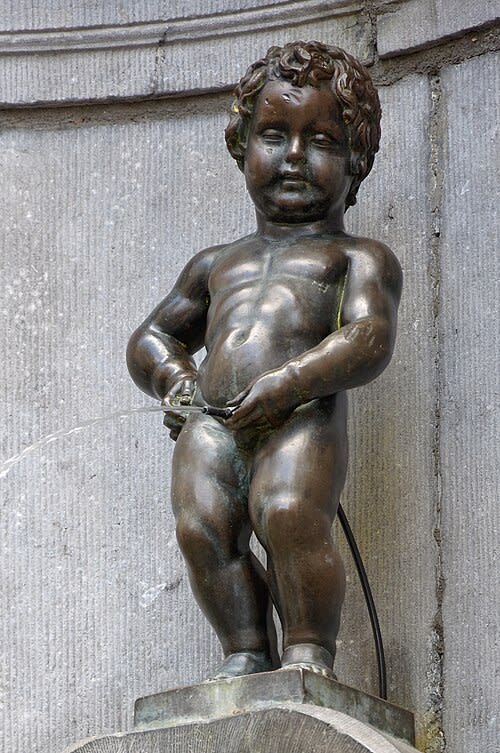
Manneken Pis (Dutch for 'Little Pissing Man') is a landmark 55.5 cm (21.9 in) bronze fountain sculpture in central Brussels, Belgium, depicting a puer mingens: a nude boy urinating into the fountain's basin. Though its existence is attested as early as the mid-15th century, Manneken Pis was redesigned by the Brabantine sculptor Jérôme Duquesnoy the Elder and put in place in 1619. Its blue stone niche in rocaille style dates from 1770. The statue has been repeatedly stolen or damaged throughout its history. Since 1965, a replica has been displayed on site, with the original stored in the Brussels City Museum.
Manneken Pis is one of the best-known symbols of Brussels and Belgium, inspiring several legends, as well as numerous imitations and similar statues, both nationally and abroad. The figure is regularly dressed up and its wardrobe consists of around one thousand different costumes. Since 2017, they have been exhibited in a dedicated museum called GardeRobe MannekenPis, located on the same street. Owing to its self-derisive nature, Manneken Pis is also an example of belgitude (French; lit. 'Belgianness'), as well as of folk humour (zwanze) popular in Brussels.
Why is it called that?
The statue's original name was Menneke(n) Pis or Menneke(n) Pist. In fact, in the Brabantian dialect of Brussels (known as Brusselian, and also sometimes referred to as Marollian),een manneke means a small man, whereas een menneke means a little boy (it is the diminutive of men, meaning boy), though in modern Flemish (the local variant of Dutch), menneke also means a small man (it is synonymous to mannetje). Nowadays, the name Manneken Pis, usually translated as "Little Pissing Man" or "Little Peeing Man" in English, is official in both French and Dutch.
Manneken Pis is sometimes given the nickname of Petit Julien in French or Julianske in Dutch (both meaning "Little Julian"), which in fact refers to a now-disappeared fountain of the "Little Julian" (Juliaenkensborre). This stems from a confusion by the 19th-century historians Alexandre Henne and Alphonse Wauters, who mistook the two distinct fountains because of their proximity. Due to its long history, the statue is also sometimes dubbed le plus vieux bourgeois de Bruxelles in French or de oudste burger van Brussel in Dutch ("the oldest bourgeois of Brussels").
History
The earliest mention of the existence of Manneken Pis dates from the mid-15th century, and can be found in an administrative document from 1451–52 about the water lines supplying the fountains of Brussels. From the beginning, the fountain played an essential role in the distribution of drinking water. It stood on a column and poured water into a double rectangular basin of stone. The only representations of this first statue can be found, very schematically, on a map by the cartographers Georg Braun and Frans Hogenberg, in which the fountain appeared to be installed directly on the street and not on a corner as it is today. Manneken Pis is depicted again in a painting from 1616 by the court painters Denis Van Alsloot and Antoon Sallaert representing Brussels' Ommegang of 1615, as well as in a preparatory drawing to this painting, in which it is dressed as a shepherd.
The first statue was replaced with a new bronze version, commissioned in 1619 by the Brussels City Council. This 55.5-centimetre-tall (21.9 in) bronze statue, on the corner of the Rue de l'Étuve/Stoofstraat and the Rue des Grands Carmes/Lievevrouwbroerstraat, was conceived by the Brabantine sculptor Jérôme Duquesnoy the Elder, father of the architect and sculptor Jérôme Duquesnoy the Younger and the famous sculptor François Duquesnoy. It was probably cast and installed in 1620. During that time, the column supporting the statue and the double rectangular basin collecting water were completely remodelled by the stone cutter Daniel Raessens.
During its history, Manneken Pis faced many hazards. It survived undamaged the bombardment of Brussels of 1695 by the French army, but the pipes having been affected, it could not deliver its water for some time. A pamphlet published the same year recounts this episode. This text is the oldest attesting that Manneken Pis had become "an object of glory appreciated by all and renowned throughout the world". It is also the first time that it served as a symbol for the people of Brussels. It is also traditionally said that after the bombardment, it was triumphantly placed again on its pedestal. On that occasion, the following passage from the Bible was inscribed above its head: In petra exaltavit me, et nunc exaltavi caput meum super inimicos meos ("The Lord placed me on a stone base, and now I raise my head above my enemies").
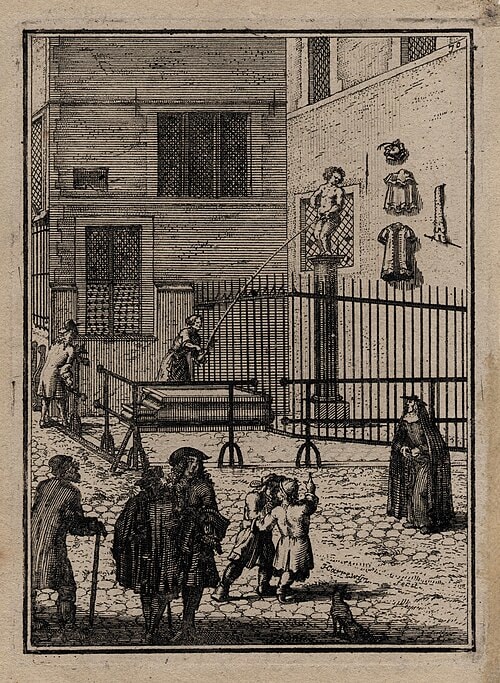
As shown by an engraving by Jacobus Harrewijn, dating from 1697, the fountain was no longer located on the street, but in a recess at the corner of the Rue du Chêne/Eikstraat and the Rue de l'Étuve/Stoofstraat and was protected by a gate. In 1770, the column and the double rectangular basin disappeared; the statue was integrated into a new decor, in the form of a blue stone niche in rocaille style, originating from another dismantled fountain of Brussels. The water simply flowed through a grating in the ground, which was replaced with a basin in the 19th century. In its new setting, Manneken Pis gives the impression of being smaller than in its original layout.
The whole structure is protected by wrought iron railings, the last version of which dates from 1851. The latter prevented access to water, relegating the fountain to a decorative and symbolic role. It is also the case, around the same time, of the other fountains in Brussels. This correlates with efforts by the City of Brussels, starting in 1855, to allow for the distribution of drinking water in homes.
The figure has repeatedly been the object of theft or attempted theft. Legend has it that the statue was removed in 1745 by English soldiers and found in the Flemish town of Geraardsbergen (French: Grammont). As a sign of their appreciation, the people of Brussels gave this city a replica of the statue. A second attempted theft was allegedly made in 1747 by a group of French grenadiers stationed in Brussels. The population rebelled against this deed and threatened a bloody revenge. To calm things down, the King of France, Louis XV, offered a gentleman's gown of brocade, embroidered with gold, to Manneken Pis. He also authorised the statue to carry the sword, and decorated it with the Cross of St. Louis.
The statue was stolen in 1817 by the freed convict Antoine Licas or Lycas. The perpetrator was heavily punished; he was condemned to forced labour for life, and was first tied for an hour to stocks on the Grand-Place/Grote Markt. The original statue was broken into eleven pieces during this abduction and was restored by a specialised welder, under the supervision of sculptor Gilles-Lambert Godecharle. The pieces were matched and used to make a mould in which the bronze statue was poured. The statue was then screwed onto a new copper base marked "1620 – REST 1817".
Manneken Pis experienced similar misadventures in the 20th century. Two attempted thefts occurred in 1955 and 1957. Some accounts say that it has been stolen up to seven times. Notably, in January 1963, students of the Antwerp student's association "De Wikings" of the Sint-Ignatius Handelshogeschool (Higher Business Education), now part of the University of Antwerp, "hijacked" the statue for five days before handing it over to the Antwerp authorities. The local and international press covered the story, contributing to the students' collection of funds donated to two orphanages. The case did go further, however, and the base was replaced identically by the Compagnie des Bronzes de Bruxelles, to which the statue was anchored by a reinforced bronze attachment.
Things were more serious when it disappeared in 1965; the statue had been broken by the thief and only the feet and ankles remained. In June 1966, the Antwerp magazine De Post received an anonymous phone call, signalling that the "body" was in the Charleroi Canal. It was found there by divers, sent by the magazine, and was brought back to Brussels on 27 June. Restored once again, the statue was sheltered and the original version is now kept and displayed on the second floor of the Brussels City Museum, at the King's House, on the Grand-Place. In the meantime, a replica of the statue had already been commissioned by Brussels' authorities and cast by the Compagnie des Bronzes. The new statue was thus installed in place of the old one and this version still adorns the niche on the Rue du Chêne to this day.
In late 2018, city technician Régis Callens discovered that the basin of the statue had developed a leak, leading to a reported 1,000–1,500 litres (220–330 imp gal; 260–400 US gal) of water being used per day.The leak occurred for an unknown number of years, unnoticed among the several hundred water features in the City of Brussels and was only later discovered with the help of Shayp water monitoring technology. The statue received a temporary fix in March 2019, with a permanent recirculating system set to be installed. The solution was announced during Brussels Water Week where city officials cited the situation as motivation to check for similar problems in other fountains.
Legends
There are several legends behind Manneken Pis, but the most famous is one involving Duke Godfrey III of Leuven. In 1142, the troops of this two-year-old lord were battling against the troops of the Berthouts, the lords of Grimbergen, in Ransbeek (now Neder-Over-Heembeek, a northern part of the City of Brussels). To give themselves courage, the soldiers placed the infant lord in a basket which they hung from a large oak tree overlooking the battlefield. While his men were in dire straits, the little duke rose up in the basket, and from his perch, urinated onto the troops of the Berthouts, who eventually lost the battle. The fountain perpetuates the memory of this victory. The name of the Rue du Chêne/Eikstraat ("Oak Tree Street"), at the corner of which the statue is located, recalls the famous tree.
Another legend suggests that, in the 14th century, Brussels was under siege by a foreign power. The city had held its ground for some time, so the attackers conceived of a plan to place explosive charges at the city walls. A little boy named Julianske happened to be spying on them, as they were preparing. He urinated on the burning fuse and thus saved the city. There was, at the time (middle of the 15th century, perhaps as early as 1388), a similar statue made of stone. The statue was stolen several times.
Another story tells of a wealthy merchant who, during a visit to the city with his family, had his beloved young son go missing. The merchant hastily formed a search party, which scoured all corners of the city, until the boy was found happily urinating in a small garden. The merchant, as a gift of gratitude to the locals who helped out during the search, had the fountain built.
Another legend tells that a small boy went missing from his mother, when shopping in the centre of the city. The woman, panic-stricken by the loss of her child, called upon everyone she came across, including the mayor of the city. A citywide search began, and when at last the child was found, he was urinating on the corner of a small street. The story was passed down over time and the statue was erected as a tribute to the well-known legend.
Another legend tells of the young boy who was awoken by a fire and was able to put out the fire with his urine. In the end, this helped stop the king's castle from burning down.
Here, I finished.
Source: Wikipedia.