🏭 Factory Guide — Upgrade or Build a New One?
If you've ever been torn between opening a new factory or upgrading an existing one, you're not alone. The decision seems simple, but this is exactly where most players slow down without even realizing it.
This guide won't just give you answers. It'll teach you how to think about the game the right way — with logic you can apply at any time, regardless of current market prices.
⚠️ Note: all numerical values used here reflect the market prices at the time this guide was written. Prices change. The reasoning doesn't.
🧠 First things first: what is energy and why does it matter
In War Era, your factory produces work energy every day. That energy is what you use to manufacture products — and products turn into coins.
To understand any investment decision in the game, you first need to understand how much each energy point is worth.
Let's use bread as an example, since it's one of the most common products:
To make 1 bread, you need 10 energy and 10 wheat
Wheat can be bought on the market, currently at 0.07 coins each
Bread sells for 1.7 coins
So the profit from producing 1 bread is:
Revenue:  1.7 coins
Cost:     10 × 0.07 = 0.7 coins (wheat)
Profit:   1.7 - 0.7 = 1.0 coin per bread
Since each bread consumes 10 energy, we arrive at a fundamental relationship:
10 energy → 1 coin of profit 1 energy = 0.1 coins per day
💡 This means energy isn't just a resource — it's passive income. Every extra energy point you generate per day turns into money in your pocket.
Note: the same logic applies to any product, as long as you calculate the difference between selling price and raw material cost.
⚖️ The question that defines everything
Now that we know energy = money, any investment decision in the game comes down to a single question:
How much does it cost to generate more energy?
And that gives us the most important rule in the game:
total investment cost / energy generated = cost per energy
The lower that number, the better the investment. It's that simple.
Now let's apply this to the two options you'll face.
🔍 Comparing the options in practice
Let's say you already have a factory at level 4. You have two choices:
Option A: Upgrade to level 5
Upgrading from level 4 to level 5 costs 160 steel.
With steel currently at 1.62 coins:
160 × 1.62 = 259.2 coinsEach upgrade level adds +24 energy per day. So:
Cost per energy: 259.2 ÷ 24 = 10.8 coins per energyOption B: Open a new factory
Here's the mistake most players make: comparing the "raw" factory cost with the upgrade. A factory sitting at level 1 doesn't represent your real production potential.
The right way to compare is to consider the factory already developed to level 4 — that's the point where it will actually work for you.
Base factory cost:
Before calculating, it's important to understand how factory costs work in War Era: each new factory costs 50 more concrete than the previous one. The more you expand, the more expensive the next unit gets.
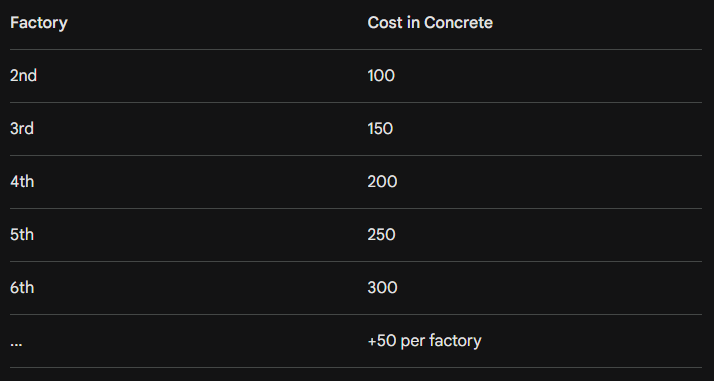
In this example, we're calculating the fifth factory, which costs 250 concrete, currently at 1.63 coins each:
250 × 1.63 = 407.5 coinsUpgrade costs from level 1 to level 4:
One important detail: the factory is already purchased at level 1 — it starts producing 24 energy on the same day you buy it, at no extra cost. What you'll pay are the 3 upgrades to take it from level 1 to level 4.
The cost of each upgrade doubles from the previous one. Knowing that level 5 costs 160 steel, we can calculate the earlier ones by halving:
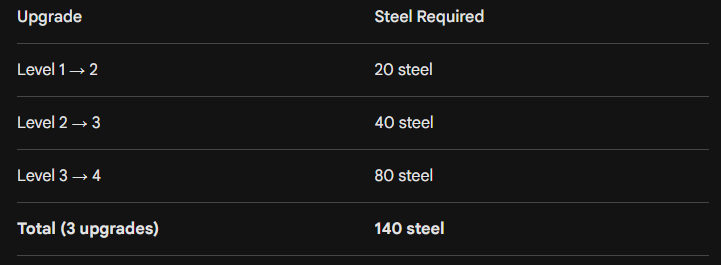
With steel at 1.62:
140 × 1.62 = 226.8 coinsTotal cost (factory + upgrades to level 4):
407.5 + 226.8 = 634.3 coinsNew factory production at level 4:
Each level adds +24 energy:

Cost per energy: 634.3 ÷ 96 = 6.61 coins per energyOne factor that makes these numbers even better: the region bonus.
Your factory's location directly affects how much it produces. Regions with production bonuses increase the energy generated — currently, for example, some regions offer +20% production. When natural resources are discovered in certain regions, that bonus can be even higher for a period.
With a 20% bonus, the level 4 factory goes from 96 to:
96 × 1.20 = 115.2 energy per dayThis improves the cost per energy:
634.3 ÷ 115.2 = 5.51 coins per energyAlways factor in the region bonus when choosing where to build. A well-placed factory produces more without costing anything extra.
📊 Comparison results
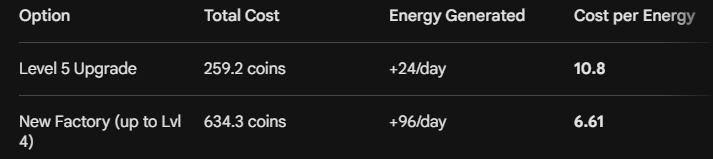
Even though it costs more upfront, the new factory delivers energy at a much lower cost. The efficiency advantage is nearly 40%.
⏱️ But what about time? The factory takes time to develop
Here's a key point most players overlook when making this comparison:
The factory starts producing the moment you buy it.
You don't need to wait until level 4 to start making profit. From day one, it's generating energy — and that profit chips away at the investment while you're still paying for upgrades.
Let's see this in practice, assuming you use all the factory's profit to fund the next upgrades:
Phase 1 — Level 1 (right after purchase):
Production: 24 energy → 2.4 coins per day
To upgrade to level 2, you need 20 steel = 32.4 coins
32.4 ÷ 2.4 = 13.5 days to save up
Profit generated during that period: 2.4 × 13.5 = 32.4 coins
Phase 2 — Level 2:
Production: 48 energy → 4.8 coins per day
Upgrade to level 3: 40 steel = 64.8 coins
64.8 ÷ 4.8 = ~13.5 days
Profit: 4.8 × 13.5 = 64.8 coins
Phase 3 — Level 3:
Production: 72 energy → 7.2 coins per day
Upgrade to level 4: 80 steel = 129.6 coins
129.6 ÷ 7.2 = ~18 days
Profit: 7.2 × 18 = 129.6 coins
Total profit during development:
32.4 + 64.8 + 129.6 = 226.8 coins generatedNotice: this number is exactly equal to the total upgrade cost (226.8 coins). In other words, the factory funds its own upgrades with the profit it generates along the way. By the time you reach level 4, the upgrades are already paid for — what's left to recover is just the base factory cost.
634.3 (total investment) - 226.8 (upgrades already paid) = 407.5 coins remainingWith the factory now at level 4, generating 9.6 coins per day:
407.5 ÷ 9.6 = ~42.4 days to recover the restTotal return time:
Development: ~45 days
Final payback: ~42 days
Total: ~87 days
Compared to the standalone level 5 upgrade:
Fixed return time: 259.2 ÷ 2.4 = ~108 days
Even accounting for development time, opening a new factory and developing it to level 4 pays for itself in approximately 87 days, versus 108 days for the standalone upgrade.
The factory isn't just more efficient — it pays for itself faster, because it generates profit while it's still growing.
🧱 The factor that shifts as you progress: rising factory costs
Up to this point, it seems like the answer is always "open a factory." But as you've already seen, each new factory costs 50 more concrete than the previous one — and that adds up over time.
To see the full picture, let's calculate the cost per energy for every factory, always assuming each one is developed to level 4 (upgrades always cost the same 226.8 coins):
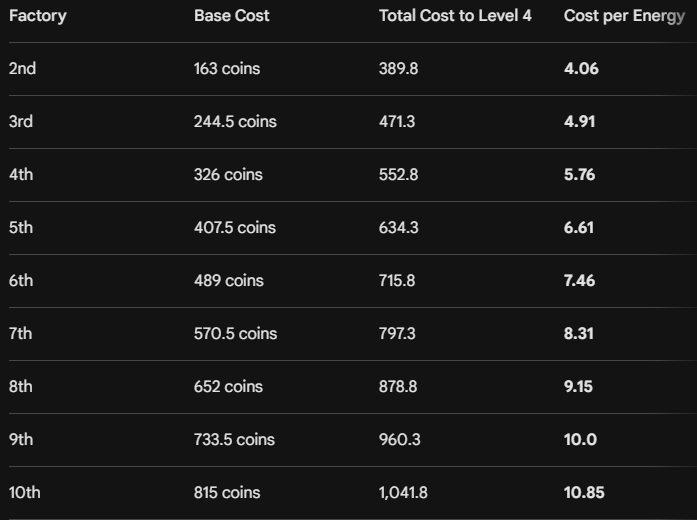
Remember that the level 5 upgrade costs 10.8 per energy?
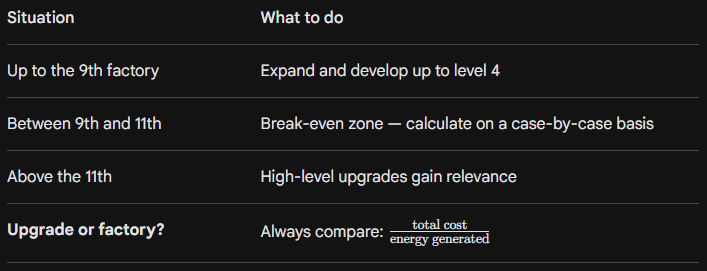
Starting from the 10th factory, the cost per energy begins to match — and then exceed — the cost of upgrading.
🚨 The exact tipping point
We can calculate this mathematically. We want to find when:
(factory cost + 226.8) ÷ 96 = 10.8Solving:
factory cost + 226.8 = 1036.8
factory cost = 810 coins
810 ÷ 1.63 = ~497 concrete
When the cost of a new factory approaches 500 concrete, it stops being more efficient than upgrading to level 5. This happens around the 9th or 10th factory.
This number will vary as market prices change — but the calculation above can be redone at any time with current values.
🎮 Skills, slots, and entrepreneurship
Before getting into phase-based strategy, there are two game systems that directly affect how much you can grow — and that need to be considered when distributing your skill points.
Factory slots
The game allows up to 12 factories, but those slots don't come automatically. They're unlocked with skill points, which you earn by leveling up as a player.
The cost to unlock each slot increases progressively:
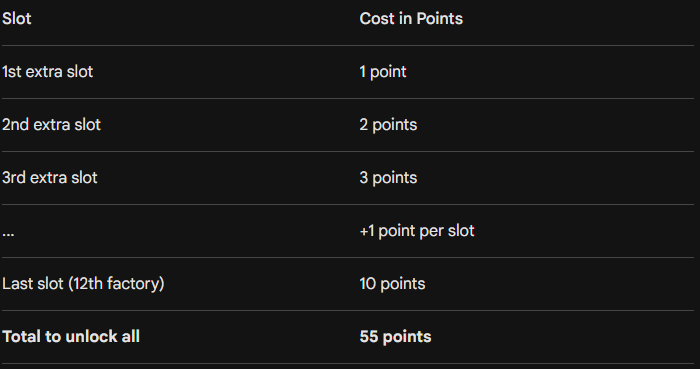
These points compete with other skills in the game — like production and energy ones. One important detail: these skills don't just increase your storage cap — since the hourly gain is always 10% of maximum storage, raising the cap directly means more income per hour.
Entrepreneurship and why it matters
Beyond passive income from factories, your profile accumulates two resources over time: work energy (for working in other people's factories) and entrepreneurship (for your own work in your factories). The hourly gain for each is always 10% of maximum storage — so a higher cap means more income per hour, not just a higher ceiling.
Entrepreneurship represents you actively working in your own company — and each accumulated point can be converted into 1 work energy point, which goes straight into production (in our example, every 10 points you produce 1 bread).
Since the gain is always 10% of the cap, storage always takes exactly 10 hours to fill, regardless of size. This means a higher cap doesn't protect against overflow if you're offline for more than 10 hours — it would fill up either way. The real benefit of investing in these skills is the higher absolute value accumulated per hour when you're active and consuming resources before they cap out.
⚡ Side note: what skill points actually do for energy and entrepreneurship
⚠️ Update: this section was added after the original publication, based on information shared by other players.
The original article described entrepreneurship solely as a storage mechanic — a cap that, once filled, stops accumulation. That's true, but the system has an extra layer.
What was discovered: the hourly gain is always 10% of maximum storage. In other words, raising the cap doesn't just prevent overflow — it directly increases how much you accumulate per hour.
With current in-game values:
Entrepreneurship: storage of 45 → gain of 4.5 per hour (45 × 10%)
Work energy: storage of 50 → gain of 5 per hour (50 × 10%)
One important detail: since the gain is always 10% of the cap, the time to fill storage is always fixed at 10 hours — regardless of the cap. This means the skill doesn't help players who are offline for more than 10 hours (storage would fill up either way). The real benefit is the higher absolute value accumulated per hour when you're active and consuming resources regularly.
The practical impact: raising entrepreneurship from 45 to 55 increases hourly gain from 4.5 to 5.5 — +2.4 coins per day in permanent extra income, as long as you spend resources before hitting the cap.
See the secondary article for the full comparison with factory slot returns and the skill point distribution strategy.
The decision: slots, entrepreneurship, or energy?
There's one element of the skill system that completely changes this equation: skills can be redistributed every 7 days. This turns point allocation from a permanent decision into an adaptive strategy based on your current phase.
The straightforward conclusion: there's no point locking skill points into factory slots you won't use in the coming days. If your next factory is 3 weeks away, unlock the slot on the reset right before you build — until then, those points generate more value in Entrepreneurship, Energy, or Production.
Which of the two passive income skills to prioritize depends on how many factories you have:
Few factories: you spend more time working in other people's factories to generate income. Invest in Work energy.
Many factories: you spend more time doing your own work. Invest in Entrepreneurship.
Always: the Production skill (points per work action) boosts any activity — your own or external — and should be maxed out at every stage.
The ideal balance shifts every week. The right question at each reset is: given what I'll be doing over the next 7 days, which allocation delivers the most return per point?
📈 Strategy by game phase
With all of that in mind, the ideal strategy becomes clear:
🟢 Early game (first factories)
Factories are cheap. The second factory, for example, costs just 100 concrete — less than a quarter of what it would cost later. The cost per energy is very low, and expanding is an incredibly good deal.
→ Expand without hesitation. Every new factory is a great investment.
Skill tip: unlock slots only when you're about to build — not before. With the 7-day reset, you can redistribute points sitting idle in future slots toward Work energy and Production, which pay off immediately. Since you have few factories at this stage, Work energy is the most valuable passive income skill.
🟡 Mid game (3 to ~9 factories)
Factories are still more efficient than upgrades, but the gap is narrowing. You already have a base income that accelerates your investments.
→ Keep expanding, but develop each factory to level 4 before opening the next one.
Skill tip: with several factories running, you'll spend more time on your own work. Shift focus from Work energy to Entrepreneurship. For slots: only unlock the next one on the reset immediately before you build.
🔴 Late game (9th factory and beyond)
From here, the cost of new factories starts approaching the efficiency of upgrades. The decision gets more nuanced and depends on current market prices.
Keep in mind that the game has two hard limits: 12 factories total and upgrades up to level 7. As you approach those ceilings, the expansion logic shifts — not by choice, but out of necessity. At this stage, optimizing existing factories with higher-level upgrades naturally becomes the way forward.
→ Recalculate before every decision. At some points, higher-level upgrades will be the better play.
Skill tip: as you approach the slot limit, points that used to go toward Company slots now go entirely into Entrepreneurship, Work energy, and Production. These three skills become the main lever for skill-point-driven growth at this stage.
🎯 Why level 4 is the sweet spot
You may have noticed that throughout this analysis, we always used "up to level 4" as the reference. That's not a coincidence.
Level 4 is the perfect balance between cost and output:
Upgrades to levels 2, 3, and 4 are relatively affordable (20, 40, and 80 steel)
Production grows quickly (24 → 48 → 72 → 96 energy)
The return is fast, and the factory funds its own upgrades
Level 5, on the other hand, costs 160 steel — double level 4 — to gain just 24 more energy. Efficiency drops sharply. At that point, it usually makes more sense to put that money toward a new expansion instead.
🔁 The snowball effect
There's another dimension that raw numbers alone don't fully capture: the compounding effect of having multiple factories running at the same time.
When you're developing your second factory, your first is already generating income — and that income speeds up the new one's upgrades. When you're on your third, the first and second are both funding its development.
Here's how development time decreases:
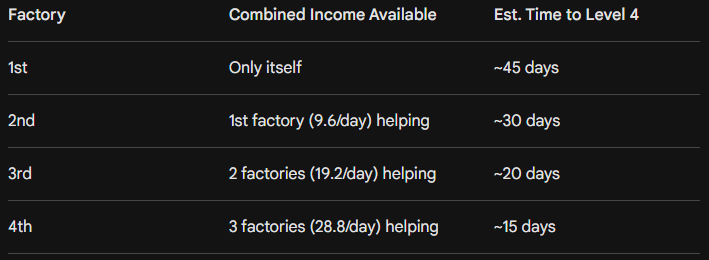
Each cycle is faster than the last. The system funds itself and accelerates on its own.
🧠 The mindset shift
The most common mistake isn't about math — it's about perspective.
Players who grow slowly think:
"What's the cheapest investment?"
Players who grow fast think:
"Which investment accelerates my system?"
The difference seems subtle, but it completely changes the decisions you make.
🔥 Quick summary
💬 Conclusion
In the early game, you grow by building factories. Later, you grow by making smarter investment choices. And always — at every stage — the right decision is the one that delivers the most energy at the lowest cost, considering not just the purchase price, but what the investment generates while it's still growing.
"You're not waiting for the investment to pay off. You're building something that pays for itself while it grows."