Fundamentals of Production. Part 1. Fundamental Concepts.
Fundamentals of Production
Part 1
Fundamental Concepts of Work and Production
Introduction
One of the fundamental mechanics of WarEra's economy is hiring employees for our companies. However, a fact that is both surprising and understandable is that many of the job offers that enter the labor market result in losses for the employer. That is, many employers are producing at a cost higher than the market price. This is particularly significant at lower levels, as it considerably slows down player growth.
Regardless of the reasons for this behavior (I may write an article about this later), it is essential to have clarity on the reasoning required to identify when hiring employees is profitable. An employee is profitable when the (monetary) value they generate is greater than their costs. This means that when selling on the market, production costs are lower than the current market price. In cases where the product is not sold on the market, the logic is exactly the same — if producing one unit costs me more than the market price, wouldn't it be better to simply buy it directly on the market?
Knowing when it is worth having employees is not trivial, and unfortunately the calculator the game provides as a hiring guide can sometimes be misleading. Knowing how to calculate production costs allows you to make better decisions within the game and boost your growth. For this reason, I have decided to create the Fundamentals of Production article series, with which I hope readers gain a deep understanding of the game's production mechanics. I hope you find it useful.
Production Points and Energy Points
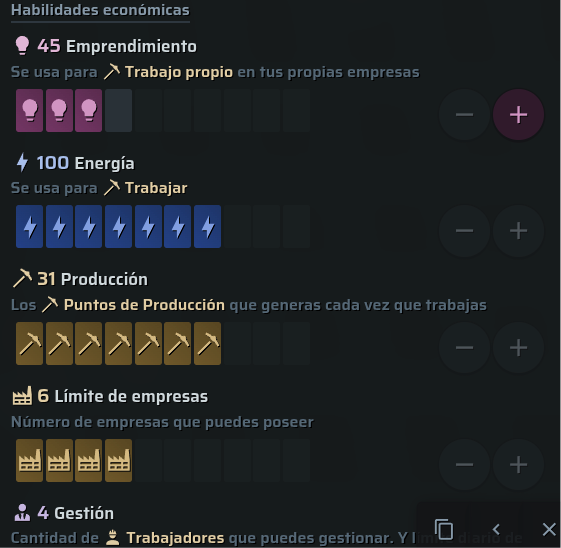
Each player has four economic statistics:
Entrepreneurship Points (EP): Resource used to work in your own companies.
Energy Points (EnP): Resource used to work in other players' companies.
Production Points (PP): The average amount of PP generated each time you work, whether for your own companies or for others. According to a moderator, each time you work, the PP generated will be within a +/- 10% range — for a given PP value you set, you will be producing roughly between X−3 and X+3 PP.
Company Limit: How many companies you can own.
Management Points: How many employees you can have.
These statistics are assigned in your skills section, allocated at the player's discretion, and become available in greater quantities as you level up. Below I show my statistics at the time of writing this article.
The main concept to understand is how Production Points (PP) work. The game provides a clear explanation:
Company Production WarehouseIt is filled with ⛏ Production Points when employees work and thanks to the automatic engine.
Only the company owner can spend them to produce items.
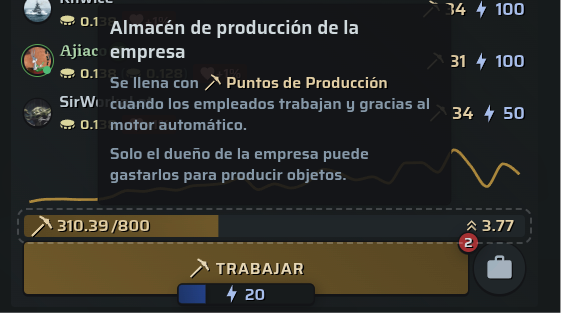
So, when you tap the Work button, what happens is that based on the number of PP you have assigned in your skills, the company's Warehouse begins to fill:
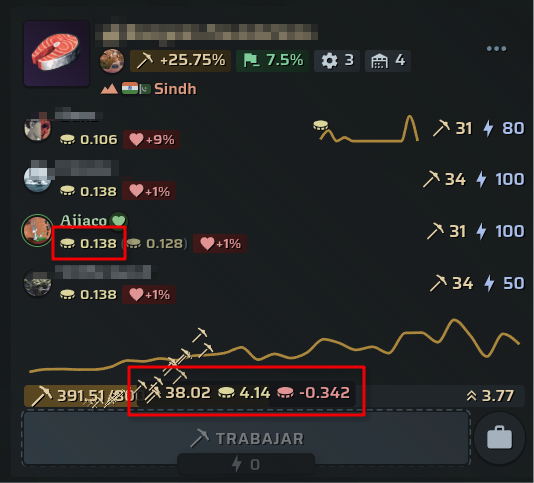
In this case, I have 31 PP. But at the moment of production, 38.02 appears! Additionally, 4.14 BTC appears, which is what you are paying the worker — or from the worker's perspective, what they are being paid. The number shown in red is the amount deducted in taxes. How were those numbers calculated? Let's break it down.
If you go to the transaction history, you will see the following:
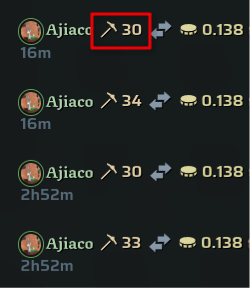
For this guide I had 20 Energy available, or two work taps (we will explain this in more detail in another guide). Notice the variability in PP across each tap. The last tap corresponds to what was produced in the image immediately before this one. So, to answer where the 4.14 came from — the answer is to take this value and multiply it by the gross wage:
30 * 0.138 = 4.14
The number in red is what is deducted for taxes in the country where the company is located. If the country has the Imperialist ethic, an additional 10% is charged on top of the tax rate established by the country. If it has Imperialist Fanatic, 30% more. For this case, the country has the Imperialist ethic; the calculation of what we pay in taxes is as follows:
4.14*(1 + 0.1)*0.075 = 4.14*(1.1)*0.075 = 0.34155
Rounding to three decimal places we get the expected value, 0.342.For the value of 38.02, the Effective Production Points were calculated as follows:

Production bonus: This is a percentage of additional PP that the employer receives for each tap the worker performs, contributed by the country where the company is located. This includes Resource Deposits, the country's Production Specialization Bonus, the ruling party's Ethics (Industrialist or Agrarian), and Strategic Resources. The details of this bonus are beyond the scope of this guide — we are only interested in its total value, which the game helpfully provides.
Loyalty bonus: This is the percentage of additional PP that the employer receives based on the number of consecutive days the same employee remains in the company. Its values range from 1% to 10%. Each day the employee stays in the company adds 1% to the loyalty bonus. It is therefore important to try to retain employees for as many days as possible, as we will see later.
With the above definitions in mind, the calculation is carried out as follows. For 30 PP (recall that in that tap I worked for a value of 30 PP), the effective PP are:
30 * ( 1 + 0.2575 + 0.01) = 38.025
This correctly matches what the game displays. This mechanic is interesting because, from the employer's perspective, you only pay for the worker's PP before the production and loyalty bonuses are added. The country's taxes are only charged to the worker, so the employer's only concern is whether the cost of producing something is lower than the market price — otherwise, they will incur losses.
The concepts presented here are fundamental to understanding the production process in the game. In part two of this series, we will discuss Unit Cost, a central concept for understanding the production process that will also allow us to decide whether hiring is worthwhile or not.