Global War Comedy - Part 1
The invitation went out quietly at first. An urgent, all-caps message stamped with importance and a faint hint of desperation:
“GLOBAL MEETING: IRAN SITUATION. ALL NATIONS REQUIRED. PLEASE RSVP.”
And, against all expectations, the world actually showed up.
Not in formation. Not in unity. But in ... Character.
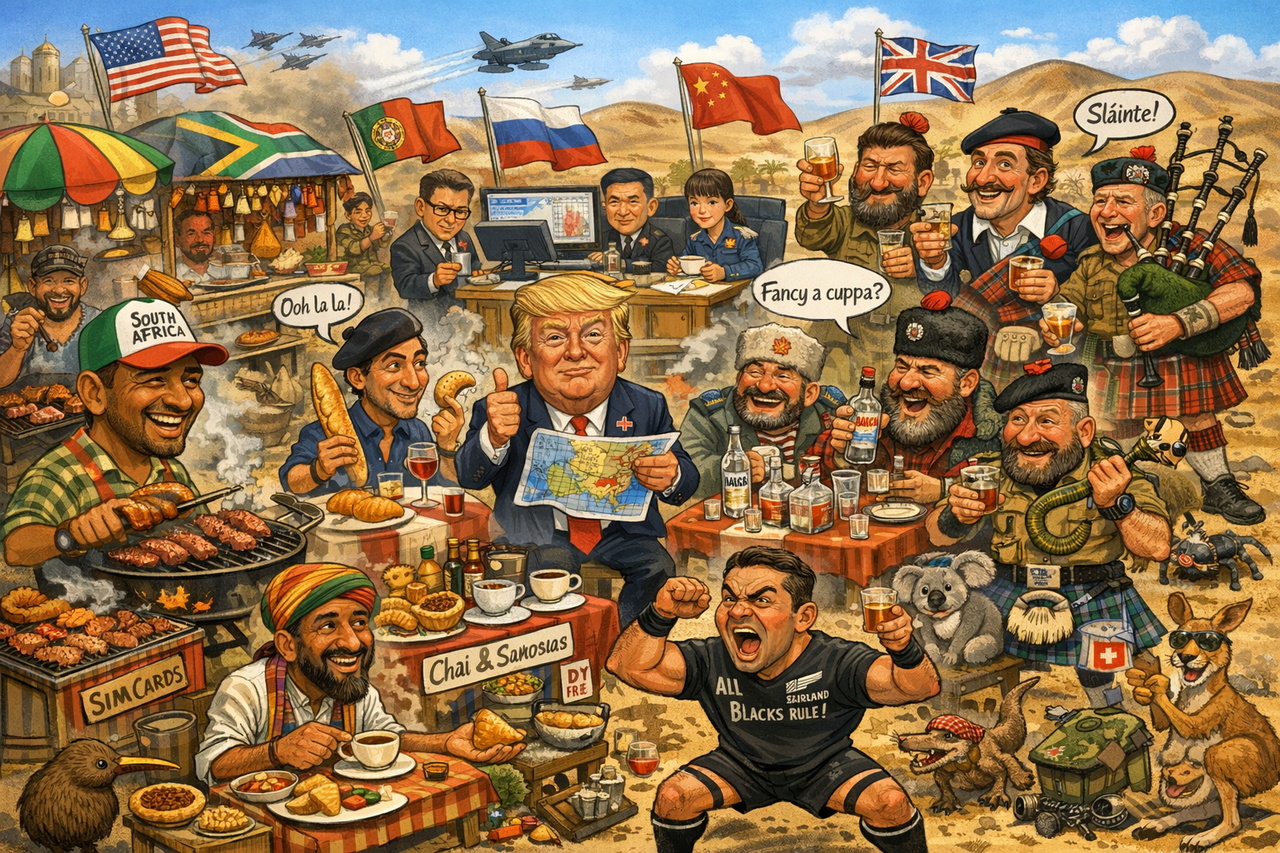
The first to arrive, obviously, were the Americans, led by a convoy that looked suspiciously like a movie set. At the center of it all was Donald Trump, declaring victory over problems that hadn’t even started yet, gesturing at maps upside down and insisting everything was “going incredibly well, the best war meeting anyone’s ever seen.”
Before anyone could respond, a cloud of fragrant smoke drifted lazily across the staging area.
“Ah, the South Africans are here,” someone muttered.
Within seconds, a full braai operation was underway. A group of South Africans stood proudly around sizzling grills, brandy & coke in hand, debating marinades with the seriousness of nuclear strategy and someone arguing about wood versus charcoal like it was a UN resolution.
“Listen,” one of them said, flipping a steak with precision, “we’re not saying we’ll solve the conflict, but morale? Sorted.” “War is complicated,” one South African said, handing a plate to a confused diplomat. “But have you tried this boerewors?”
Within minutes, soldiers from half a dozen countries had plates with steaks, marinated chicken, boerewors, skilpadjies and braaibroodjies in hand.
The delegation from India arrived next, but not as expected. No tanks. No formations. They didn't march in, they unfolded.
An entire marketplace unfolded like magic. Bright fabrics, spice-laden air, street food, and a row of small shops selling everything from tea to phone chargers.
“You never know what you’ll need” one shopkeeper explained calmly, handing a confused general a samosa and a SIM card.
“War or not, business must go on.”
The delegation from France arrived fashionably late, as expected.
They stepped out carrying baskets like they were attending a picnic instead of a war summit.
Within minutes: a pop-up café. Baguettes stacked like ammunition. Croissants arranged with military precision.
“Strategy?” one French officer scoffed. “First, we eat.”
“War is unfortunate,” one sighed, sipping espresso. “But one must not rush these things.”
They refused to discuss anything until everyone acknowledged the superiority of their pastries.
Most people agreed.
Then came the New Zealanders.
You heard them before you saw them. “We’re just saying,” one began, already mid-conversation, “if this turns into a rugby match, it’s basically over.”
Another nodded solemnly. “We brought our boots. Just in case.”
The team from New Zealand performed a haka so intense that three diplomats reconsidered their life choices and one French delegate dropped his coffee.
The Australians didn’t arrive so much as stroll in casually, like this was just another Tuesday.
A soldier from Australia poked at something in the sand with a stick. “Yeah nah, this place is fine,” he said. “Seen worse. Back home we’ve got spiders that would’ve ended this war already.”
Someone asked if they were concerned about the conflict.
“Mate,” he replied, “everything in our country is trying to kill us. This? This is a holiday.”
From China came something far more structured.
An entire command center appeared almost instantly efficient, silent, coordinated. Screens lit up, logistics mapped out, supply chains optimized before anyone else had found a chair.
A Chinese official looked around calmly. “We have already planned the next ten steps,” he said.
“Also, we brought everything.” No one knew exactly what “everything” meant, but it was slightly intimidating.
From Germany came efficiency.
Clipboards. Schedules. Color-coded charts.
Within an hour, they had created a 72-step plan to resolve the conflict, optimize logistics, and improve snack distribution.
No one followed it, but everyone agreed it looked impressive.
The Portuguese arrived with a more relaxed energy.
They set up near the South Africans, drawn naturally to the food.
“Listen,” one of them said, sipping something suspiciously strong, “we’re not saying we’ll lead, but we’ll definitely enjoy the process.”
Someone mentioned custard tarts. They nodded proudly.
The British delegation arrived carrying tea. Naturally.
“Well,” one officer said, pouring a cup while explosions echoed faintly in the distance, “this is all a bit awkward, isn’t it?”
They offered tea to everyone, including both sides of the conflict, and apologized repeatedly for things no one could quite identify.
Then came the Russians.
You didn’t see them arrive ... you felt them.
The delegation from Russia set up quickly, placing bottles of vodka on the table like diplomatic tools.
No speeches. Just a slow pour.
“Talk,” one of them said simply. Within minutes, negotiations began and also ended ... and also restarted again for reasons no one could fully remember.
And then, quietly, almost unnoticed, the Swiss arrived.
They set up chairs. Neutral chairs. And waited.
The delegation from Scotland arrived proudly in their kilts, completely unfazed by the desert heat or the global tension.
One of them planted a flag, looked around, and said: “If there’s going to be a fight, we’ll do it properly.”
Another raised a bottle. “Or we’ll just have a drink first.”
No one argued with the kilts. No one.
As the sun dipped lower, the so-called “war meeting” looked less like a strategic alliance and more like a global festival.
There was food. Debate. Rugby challenges. Someone started a cricket match. The Australians tried to pet something they absolutely shouldn’t have.
And through it all, the original purpose of the meeting, strategy, coordination and conflict, began to dissolve into something far more human.
A South African raised a drink.
An Indian shopkeeper gave a discount “for international cooperation.”
A New Zealander challenged an American to a friendly match.
Even Donald Trump paused, looking around at the unlikely gathering of cultures, chaos, and camaraderie.
For a brief, absurd moment the world wasn’t united by war. It was united by its quirks.
And somewhere in the distance, a voice called out: “Who’s in charge here?!”
No one answered. Complete silence.
Then a Portuguese voice broke the silence: “Not sure, but have you tried the food?”
And just like that, the world ... loud, chaotic and ridiculous, just carried on. As normal.