Guide: Hiring Your First Worker
A working manufacturer's guide to wages, bonuses, and hidden numbers
Issued by the Central African Revolutionary Assembly
The Spectator - Manufacturer's Guide
So you want to hire your first worker? Most new manufacturers chase one number. They open the map, find the region with the fattest production bonus, plant a factory there, and call it strategy. For a factory that runs itself, they are right. For a factory that hires people, they are about to lose money politely.There are three levers on the cost of a manufactured good, not one. The production bonus, which decides how much you get per action. The wage, which decides what each action costs you. And for finished goods, the raw bill underneath them. Manufactured goods, ammunition, and foodstuff consume raw resources. Ignore any one of the three and your spreadsheet lies to you.
In this guide, we will price one block of concrete from start to finish, the honest way, and end with a single graph you can read at a glance. Follow the steps with your own market tools open.
Step one
Inspect the raw resource market first
Before wages, before bonuses, learn what the stone costs. Open the limestone market with you favorite tool and read the seven day history. As of writing it looks like this.
limestone · 7 dayCurrent 0.0825 · Average 0.0804 · Low 0.0789 · High 0.0825 · Change +4.44%
One concrete swallows ten limestone, so multiply by ten. Every block you press carries between 0.789 and 0.825 of stone inside it, around 0.804 on an average day. That figure is fixed by the market, not by you. It is the floor your labor cost sits on top of.
Step two
Pick a spot for your company
Ask the game where to build and it points you to the highest production bonus available. In our example that is a bonus of 60.75%, before any worker fidelity is counted. For an automated factory this advice is perfect. An automated line pays no wage, so the only terms in the sum are the bonus and the raw bill. Highest bonus wins every time. Nothing else is in the equation.
But you are not automating. You are hiring your first worker. The moment a wage enters the sum, the highest bonus stops being the only thing that matters, and the question quietly changes from where is the bonus largest to where does a paid worker cost me the least.
Step three
Read the job market
Switch to the job board before you post anything. The competitive offers sit at least at 0.119 net, while the best offers exceed 0.123 net. And workers do not stay still. As they gain fidelity they expect a raise, and a worker who can earn more next door will take the walk. Post a stingy wage and you might find more loyal workers, but staff slowly. Post a high wage, perhaps at a loss, and watch your trained hands leave the moment they are worth keeping. Such is life in the trenches.
For this guide, we will aim for 0.120 net. That keeps you in the running on the board and gives you a little room to reward fidelity later.
Step four
Turn the net wage into a gross wage
Here is the first place the suggested region bites you. Check its income tax. In our example it is whopping 12%! The worker is promised a net figure, but you pay the gross, and the tax is carved out in between. To deliver a chosen net wage you scale it up.
gross = net ÷ (1 − tax)gross = 0.120 ÷ (1 − 0.12) = 0.120 ÷ 0.88 = 0.13636…
Wow. A measly 0.120 costs you, the employer, 0.136! One quirk to know. The game rounds the displayed net to three decimal places, so when you type a gross of 0.136 the job offer shows the job hunters0.136 → 12% → 0.120
Step five
Hidden net benefit numbers
The game informs you a freshly hired worker does not arrive at full strength. They start at 1% fidelity, which adds to your region bonus. So on day one the real bonus working for you is the base plus one, 61.75%, and it climbs as the worker matures toward the base plus ten, 70.75%, at full fidelity. Their profitability improves as your workers gain experience.
But ask the game what a concrete costs in labor and it will quote you the wage times the required production points. Ten production points for concrete, ten wage payments, 1.36. That number is wrong. It ignores the bonus, which multiplies what every action produces. You buy ten points of production, but each action hands you more than one point.
The real labor cost to manufacture one concrete is the wage stretched across that bonus, which is hidden behind the net benefit calculation.
REAL LABOR COSTformula = (wage × production points) ÷ [ (100 + bonus + fidelity) ÷ 100 ]1% fidelity = .136 × 10 ÷ ( 1 + .6075 + .01 )1% fidelity = 1.36 ÷ 1.6175 = 0.841
So the labor the game called 1.36 actually costs you 0.841 while the worker is first hired, falling to 0.797 once they reach full fidelity. Add the raw limestone price back on top and you have the whole block.
new hire 0.841 labor + 0.804 limestone = 1.645_matured 0.797 labor + 0.804 limestone = 1.600
Step six
Is the best bonus the best option?
Is concrete profitable at these costs? Maybe, but the margins are tight and market fluctuations are perilous. And this is exactly where tax can ruin safe margins. A 12% region forced a gross wage of 0.136 to deliver a modest 0.120 net, and that inflated wage flowed straight into every block. So before you commit, ask the heretical question. What if you choose a region with a smaller bonus but a far smaller tax?
Let's take a region in Africa with a 2.5% income tax and a base production bonus of 55%, lower than the 60.75% the game waved at you, and run the same arithmetic.
WORKER WAGEgross wage = 0.120 ÷ (1 − 0.025) = 0.120 ÷ 0.975 = 0.12308advertised = 0.123 → 2.5% → 0.120
REAL LABOR COST_1% fidelity = 1.23 ÷ 1.56 = 0.78810% fidelity = 1.23 ÷ 1.65 = 0.745
MANUFACTURING COSTnew hire 0.788 labor + 0.804 limestone = 1.592_matured 0.745 labor + 0.804 limestone = 1.549
The smaller bonus loses you a little on the multiplier. The smaller tax wins you far more on the wage. The two do not cancel. The low tax wins outright, and it wins by enough that the untrained worker, at 1.592 per concrete block, undercuts the suggested region's seasoned veteran at 1.600. Your rookie beats their professional.
The end result
One graph, both options
Now lets plot it. Total cost is the wage cost plus ten times the limestone price, and both pieces are flat and additive, so we do not need a surface. We will put the limestone price along the bottom, and the cost of one finished concrete up the side. We will then shade the band each region occupies between a new hire bonus at the top edge and a fully matured worker at the bottom edge. Lower is cheaper
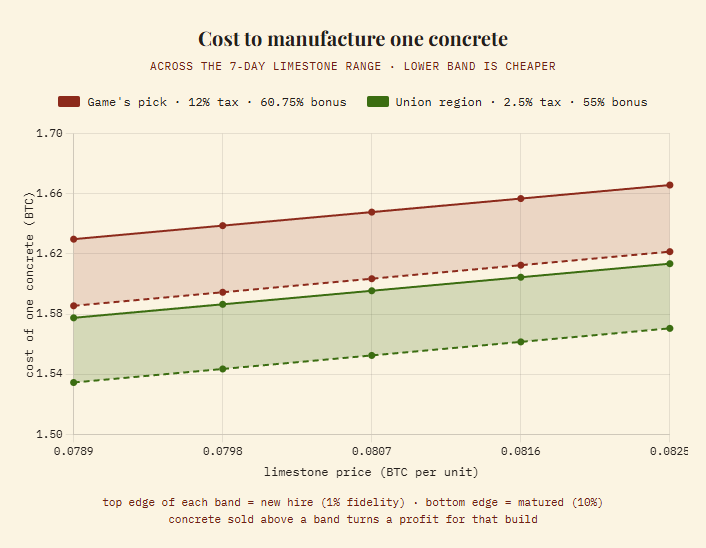
Equatorial Guinea and the African Prosperity Union's band sits beneath the game's pick at every limestone price on the chart, untrained or veteran, cheap stone or dear. Remember, low cost to manufacture, is more profit per worker. The gap you see in this chart is the effect of tax, made visible. It is also the reason we hold our rate where we do.
Build where a paid worker costs the least, not where the game expects you to place an empty automated factory. Set your wage to a net wage the job market respects, gross it up for the tax, and price your block on the bonus, not the wage times ten. Do that and the numbers will always tell you the full truth that a simple game interface might obscure. That way you can hire your first worker with the right tools to prosper!
UPDATE: You can now make your own graph and compare tax rates in The Spectator's Production Cost Studio