GUIDE | WHY YOU SHOULD VISIT EGYPT BEFORE YOU DIE | PART II: LUXOR & ASWAN
PART II — LUXOR & ASWAN: THE WORLD'S GREATEST OPEN-AIR MUSEUM
“If Cairo tells you how Egypt became a civilization, Luxor and Aswan show you what that civilization was capable of.”
Leave Cairo behind.
The traffic slowly disappears. The buildings become fewer. The Nile grows wider, the landscape becomes quieter, and the desert begins creeping closer to the green ribbon of farmland.
Then something changes.
Egypt stops feeling like a modern country with ancient monuments.
It begins to feel like an ancient civilization that never truly left.
Welcome to Upper Egypt — the land of Thebes, the pharaohs, royal tombs, colossal temples, Nubian culture and monuments that have watched the Nile flow for thousands of years.

And this time, we're not simply going sightseeing.
We're following the footsteps of the ancient Egyptians.
☀️ LUXOR — WHERE THE PHARAOHS LEFT THE DOORS OPEN
There are cities where you enter a museum and see history behind glass.
Then there is Luxor.

Here, history is standing in the open air.
The modern city occupies the area of what was once Thebes, one of the most important cities of ancient Egypt and a political and religious center during some of the civilization's most powerful periods.
And the Nile divides the ancient city into two worlds.
On the East Bank, the sun rises over temples dedicated to the gods.
On the West Bank, the sun sets over the land of the dead.
To the ancient Egyptians, this wasn't a coincidence.
The rising sun represented life.
The setting sun represented death — and the journey toward rebirth.
So before we even visit the monuments, Luxor has already given us a map of the ancient Egyptian imagination.
Life on one side of the river. Eternity on the other.
🏛️ KARNAK — WALKING INTO THE MIND OF AN EMPIRE
Our first stop is Karnak.

And don't expect a single temple.
Karnak is an enormous religious complex that developed over more than a thousand years, with successive rulers adding temples, statues, gateways and monuments to the sacred landscape.


Kings came.
Kings died.
Dynasties rose and disappeared.
And Karnak kept growing.
Then you enter the Great Hypostyle Hall.

Around you stand 134 enormous columns, creating what feels like a stone forest.

Look upward.
The scale is almost difficult to process.

Imagine priests moving through these columns.
Imagine ceremonies taking place beneath them.
Imagine music, incense, processions and thousands of people gathering here while Egypt was one of the most powerful civilizations on Earth.

And then remember:
The people who built this weren't working with modern machinery.

They were working with stone, mathematics, organization, manpower and an extraordinary belief in what they were creating.


Karnak isn't just a temple.
It's a civilization's ambition carved into stone.
🌅 LUXOR TEMPLE — WHEN THE CITY BECOMES A TIME MACHINE
Not far away stands Luxor Temple.

And this temple tells a different story.
Visit during the evening, when the modern city begins to disappear beneath the darkness and the illuminated columns rise dramatically above you.

Thousands of years ago, Luxor Temple was associated with the ancient Opet Festival, when sacred images of the gods were ceremonially transported between Karnak and Luxor.
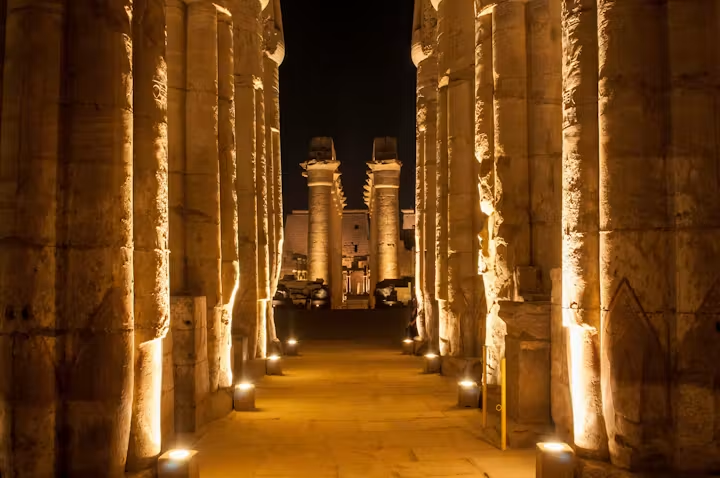
Think about what that must have looked like.
Boats on the Nile.
Priests carrying sacred images.
Music.
Crowds.
Ceremonies.

The entire city becoming part of a religious celebration.
Ancient Egypt wasn't simply a collection of temples.
It was a civilization where religion, government, architecture and daily life were deeply connected.
Today, you can stand in the same place where those ceremonies once unfolded.
The people are gone.
The empire is gone.
But the stones are still waiting.

🌄 CROSSING INTO THE LAND OF THE DEAD
Now cross the Nile.
The atmosphere changes.
The temples of the living give way to mountains, cliffs and monuments dedicated to eternity.
This is the West Bank of Luxor.
And somewhere inside these mountains, ancient Egypt hid its most powerful people.
Kings.
Queens.
Nobles.
Generals.
Their bodies were placed here with treasures, rituals and instructions for what they believed came next.
But one valley became particularly famous.
⚰️ THE VALLEY OF THE KINGS — THE PHARAOHS' LAST SECRET
For centuries, Egyptian rulers had been buried in enormous monuments.
Then the strategy changed.
During the New Kingdom, pharaohs began hiding their tombs deep inside the mountains of the West Bank.

Welcome to the Valley of the Kings & Queens.
More than sixty known tombs and chambers have been discovered here.

But these aren't simply underground graves.
They are journeys.
Long corridors descend into the earth.


Walls are covered with gods, stars, rituals and religious texts intended to guide the deceased king through the afterlife.


The further you walk, the stranger it becomes.
You realize you're standing inside a place designed for someone who believed that death wasn't the end.
It was another beginning.

And then there is the young king whose tomb changed modern archaeology forever:
Tutankhamun.
His reign was relatively short.
His political achievements were not what made him famous.
Yet when his tomb was discovered in 1922, its extraordinary preservation and treasures captured the imagination of the entire world.
The Valley of the Kings teaches you something fascinating:
Sometimes history remembers the greatest kings.
And sometimes...
it remembers the tomb that survived.

🏺 MEDINET HABU — THE PHARAOH'S FORTRESS OF ETERNITY
Not far from the Valley of the Kings stands a monument that often gets overlooked by visitors rushing between Luxor's most famous sites.
But Medinet Habu is anything but ordinary.

This enormous mortuary temple was built by Ramses III, one of the last great pharaohs of the New Kingdom, and it feels less like a temple and more like a fortress guarding the memory of a king.
Enter through its massive fortified gateway and look at the walls.

They are covered with scenes of battles, religious ceremonies, offerings and royal victories. Ramses III used the temple to record his military achievements, including his conflicts with the Sea Peoples, a mysterious group of invaders who challenged Egypt during a turbulent period of the ancient Mediterranean world.

The walls almost read like an ancient war chronicle.
Armies march.
Ships clash.
Enemies fall.
The pharaoh stands victorious.
But Medinet Habu wasn't built only to celebrate war.
Beyond the military imagery are enormous courtyards, columns and sacred spaces dedicated to the gods and to the eternal cult of Ramses III.
And this is what makes the place so fascinating.
Medinet Habu is simultaneously a temple, a memorial and a statement of power.

Walk through its courtyards and imagine what it must have looked like when its colors were fresh, its reliefs brightly painted and priests moved through its sacred spaces.
Then look closely at the surviving details.
Some of the colors are still visible after more than 3,000 years.
The walls are not simply ruins.
They are fragments of a message from a pharaoh who wanted future generations to know:
“I was here. I fought. I ruled. Remember me.”

And standing inside Medinet Habu, you realize that Ramses III got exactly what he wanted.
Thousands of years later...
we are still reading his story.
👑 HATSHEPSUT — THE QUEEN WHO REFUSED TO DISAPPEAR
From the valley, the mountains lead you toward one of Luxor's most spectacular monuments.
The temple of Hatshepsut.


Its terraces rise dramatically against the cliffs, almost as if the architecture was carved directly out of the mountain.

Hatshepsut was one of ancient Egypt's most remarkable rulers.
A woman who became pharaoh.
A ruler of a prosperous Egypt.
A builder who understood the power of architecture and symbolism.


Her temple tells stories of her reign, including the famous expedition to the mysterious land of Punt, from which Egypt received exotic goods and plants.


Stand there long enough and the message becomes obvious.
Hatshepsut wanted her reign remembered.

And although later generations attempted to erase parts of her legacy...
the monument survived.
She left her answer in stone.

🗿 THE COLOSSI OF MEMNON — TWO GIANTS WATCHING THE WORLD
Before leaving the West Bank, stop before two enormous seated figures.
The Colossi of Memnon.

They once stood at the entrance of a vast mortuary temple built for Amenhotep III.
The temple itself largely disappeared.
The statues remained.
For centuries, travelers came to see these giants standing in the landscape.
Earthquakes came.
Floods came.
Kingdoms came and disappeared.
The Nile kept flowing.
And the two giants kept watching.
Today, modern Luxor moves around them.
Cars pass.
Tourists arrive.
Farmers work nearby.
And the statues remain where they have stood for thousands of years.

🎈 THE SUNRISE ABOVE LUXOR
Now set your alarm before sunrise.
Not because someone told you to.
Because this is one of those mornings worth waking up for.
A hot-air balloon rises over the West Bank as the first light appears.

Below you is a landscape that almost looks unreal.
The Nile.

The green fields.
The desert.
The Valley of the Kings.
The temples.
Luxor.

From the ground, the monuments seem enormous.
From the sky, you finally understand the bigger picture.
Civilization exists here because of a thin green line surrounded by desert.
That line is the Nile.
And we're about to follow it.
🚢 THE NILE — THE ROAD THAT NEVER NEEDED A ROAD
Eventually, leave Luxor by boat.
For thousands of years, the Nile was Egypt's great highway.
Today, a Nile cruise between Luxor and Aswan allows you to experience the same geography from the river itself.

And suddenly, the monuments begin to feel connected.
Luxor was not an isolated city.
The temples were not random structures scattered across the desert.

The Nile connected them.
The river carries you south.
Palm trees pass by.
Villages appear along the banks.
Farmers work the same fertile valley that helped make ancient Egyptian civilization possible.
Then, somewhere ahead...
another temple appears.

🦅 EDFU — THE TEMPLE OF THE FALCON
At Edfu, the story takes another turn.
Here stands one of the best-preserved temples of ancient Egypt, dedicated to Horus, the falcon god.

Its enormous gateway dominates the landscape.
Walk inside.
The walls are covered with reliefs and inscriptions.


The temple preserves stories surrounding Horus and his legendary conflict with Seth.

And suddenly mythology stops being something you read in a textbook.

It surrounds you.
It's on the walls.

It's above your head.
It's underneath your feet.
The ancient Egyptians didn't simply believe their gods existed.
They built entire worlds around them.

🐊 KOM OMBO — THE TEMPLE OF TWO WORLDS
Then the Nile reveals one of its strangest surprises.
Kom Ombo.
A temple dedicated to two divine traditions:
🐊 Sobek, the crocodile god
🦅 Horus the Elder
Two gods.

Two sets of sacred spaces.
One extraordinary temple.

Sobek's connection with the Nile, fertility and royal power was particularly important in a world where the river determined whether communities prospered or suffered.
And crocodiles were very real inhabitants of that river.
Today, Kom Ombo gives you a glimpse into how complex ancient Egyptian religion actually was.

It wasn't a single frozen belief system.
It evolved.
It absorbed local traditions.
It created new stories.
And somehow, thousands of years later, we can still trace those stories through the walls.
🌴 ASWAN — WHERE EGYPT MEETS NUBIA
Eventually, the Nile carries you to Aswan.
And something changes again.
The landscape becomes warmer.
The river widens.

Granite islands rise from the water.
Palm trees frame the banks.
And the influence of Nubian culture becomes increasingly visible.

Aswan feels different from Cairo.
Different from Luxor.
The pace slows down.
The colors become brighter.
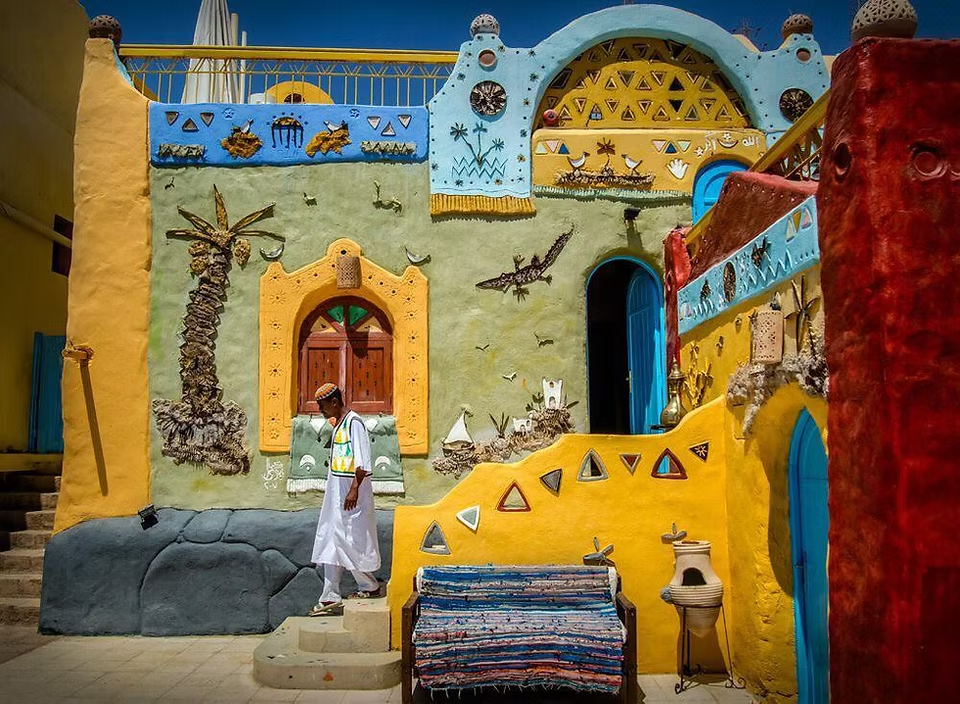


The river becomes the center of everything.
And now our journey enters another chapter of Egyptian history.
🏝️ PHILAE — THE TEMPLE THAT REFUSED TO DROWN
Take a boat across the Nile.
Ahead, surrounded by water, appears Philae.


The temple complex is primarily associated with Isis, one of the most important goddesses of ancient Egypt.

But the temple has another story.
A modern one.
When the construction of the Aswan High Dam threatened to submerge the ancient monuments, an international rescue campaign was launched.
The temples were dismantled.
Piece by piece.
Block by block.
Then rebuilt on higher ground at nearby Agilkia Island.

Think about what happened.
A monument built thousands of years ago survived the rise and fall of kingdoms.
Then, in the twentieth century, it faced a new enemy:
the water.
Humanity decided it wasn't going to let the temple disappear.
So they moved it.
And today, Philae still stands on its island.

🧱 THE UNFINISHED OBELISK — SEE THE PHARAOHS' WORK IN PROGRESS
Next, enter the ancient granite quarries.
Here lies something incredibly valuable precisely because it was never completed.
The Unfinished Obelisk of Hambi.
It gives us a rare glimpse into the ancient Egyptian building process before the finished monument ever left the quarry.
The workers began carving one of the largest obelisks ever attempted.
Then they discovered a flaw in the stone.
The project was abandoned.

And thousands of years later, their unfinished work became an archaeological treasure.
There is something strangely beautiful about that.
The greatest civilization can show you its masterpieces...
but sometimes its unfinished work tells you even more.
🌊 THE HIGH DAM — WHEN MODERN EGYPT CHALLENGED THE NILE
Then comes a monument from a completely different era.
The Aswan High Dam.

For ancient Egypt, controlling and benefiting from the Nile was a matter of survival.
Modern Egypt faced the same fundamental challenge — but with twentieth-century engineering.
The High Dam dramatically changed Egypt's relationship with the river, helping regulate water resources and generating hydroelectric power.
Behind it stretches Lake Nasser, one of the world's great artificial lakes.

But progress came with an extraordinary challenge.
Ancient monuments were suddenly threatened by the rising waters.
Some had to be moved.
Some were lost.
And one of the most famous rescue operations in archaeological history began.
Because somewhere far to the south stood a pair of temples that Egypt simply couldn't allow the Nile to swallow.
☀️ ABU SIMBEL — WHEN THE SUN REMEMBERS A PHARAOH
Travel south from Aswan.
Far south.
The green Nile Valley gradually gives way to immense desert.
Then suddenly...
four colossal figures emerge from the rock.
Abu Simbel and Temples of Hathor and Nefertari

Built by Ramses II, the temples were designed to project power, religious devotion and royal authority.

Four enormous statues of Ramses dominate the façade.

But the real story is hidden inside.
And it begins with the sun in The Sun Festival.
Twice every year, on February 22 and October 22, sunlight enters the temple at sunrise and travels deep into the sanctuary.
The sun illuminates the sacred statues within, including Ramses II.

These dates are traditionally associated with Ramses' birth and coronation.
Think about the precision.

Thousands of years ago, Egyptian architects created a temple where, twice every year, the rising sun would make a carefully timed journey through the darkness and illuminate the sanctuary.
The pharaoh's appointment with the sun.
Twice a year.
Every year.

And then history almost interrupted it.
When the Aswan High Dam was constructed, the rising waters of Lake Nasser threatened to bury Abu Simbel.
An enormous international operation was launched.
The temples were carefully dismantled and reconstructed on higher ground.
The mountain was recreated.
The temples were saved.
And remarkably, the solar phenomenon was preserved in the new location.
The world changed.
The temple moved.
The desert changed.
But the sun still knows where to go.
On February 22.
On October 22.
It enters the darkness.
Crosses the sanctuary.
And illuminates the ancient king once again.
As if Ramses II never left.


🛶 THE NUBIAN SOUL OF ASWAN
But Upper Egypt isn't only about ancient stones.
Because eventually you have to put the camera down.
Meet the people.
Listen to the music.
Walk through Nubian villages.
See the colorful architecture.
Sit beside the Nile.
And eat.
Southern Egyptian and Nubian cuisine has its own character — hearty, generous and deeply connected to local traditions.
🍽️ THE TASTE OF UPPER EGYPT
Ancient temples aren't the only treasures waiting in Upper Egypt. Sit down, order a plate, and let the Nile tell you a different kind of story.
🥘 FATTAH — A CELEBRATION ON A PLATE
A classic Egyptian dish of crispy bread, rice, garlic-vinegar sauce and tender meat, layered together and usually served on special occasions. Rich, filling and unapologetically Egyptian — the kind of meal that makes you understand why nobody leaves the table hungry.

🍲 TAJIN BAMIA — OKRA, BUT MAKE IT EGYPTIAN
Slow-cooked okra in a rich tomato and garlic sauce, traditionally baked in a clay tagine, often with chunks of meat. Comfort food at its finest — simple ingredients transformed into something incredibly flavorful.

🌿 MOLOKHIA — THE GREEN LEGEND
A beloved Egyptian classic made from finely chopped molokhia leaves, cooked into a fragrant soup with garlic and coriander and traditionally served alongside rice and chicken or rabbit. The texture may surprise you — but the flavor is unmistakably Egyptian.

🐟 NUBIAN FISH — STRAIGHT FROM THE NILE
In Aswan and Nubian villages, fresh Nile fish is a local favorite, often seasoned with spices and grilled or cooked over fire. Enjoy it beside the river, surrounded by Nubian hospitality, and suddenly dinner becomes part of the journey.

🍚 NUBIAN GAT — A TASTE OF SOUTHERN EGYPT
A traditional Nubian dish based around rice, vegetables and local ingredients, with variations depending on the household and village. It represents something important about Nubian cuisine: food is deeply connected to community, family and the Nile.
🍞 AYSH SHAMSI — BREAD UNDER THE SOUTHERN SUN
One of the traditional breads associated with Upper Egypt and Nubian regions. Thick, hearty and traditionally fermented, it pairs perfectly with local dishes and is a reminder that Egyptian food isn't just about what's on the plate — it's about what gets shared around it.


And if you're invited to share a meal or tea, accept it.
Because hospitality isn't simply something you photograph.
It's something you experience.
The temples tell you what Egypt was.
The people show you what Egypt still is.
🌙 WHEN THE NILE GOES QUIET
Eventually, the day ends.
Sit beside the river.
No museum.
No tour guide.
No crowds.
Just the Nile.
The same river that carried pharaohs, priests, farmers, merchants and armies.
The same river that made civilization possible between two deserts.
A traditional boat moves slowly across the water.
The lights of Aswan shimmer on the surface.
Somewhere behind you is a temple built thousands of years ago.
Far to the south stands Abu Simbel.
Far to the north lies Luxor.
And the Nile connects them all.
Suddenly, you understand what this journey was really about.
You didn't travel to Luxor and Aswan simply to see ancient Egypt.
You came to understand why Egypt existed here in the first place.
The Nile created the possibility.
The Egyptians turned that possibility into civilization.
The pharaohs turned civilization into stone.
And thousands of years later...
the Nile is still flowing.
🇪🇬 Egypt is still here.
🧭 PART II — THE JOURNEY AT A GLANCE
🏺 LUXOR
Karnak Temple
Luxor Temple
Valley of the Kings
Hatshepsut's Temple
Colossi of Memnon
Hot-air balloon experience
🚢 THE NILE
Nile cruise between Luxor & Aswan
Edfu Temple
Kom Ombo Temple
Villages and landscapes along the river
🌴 ASWAN
Philae Temple
Unfinished Obelisk of Hambi
Aswan High Dam
Nubian villages & culture
Nubian food and traditions
Abu Simbel
🌊 BUT THE JOURNEY ISN'T OVER...
We've followed the Nile from the heart of ancient Thebes to the southern frontier.
We've walked through tombs built for eternity.
We've stood beneath colossal pharaohs.
We've watched the sun enter a temple exactly as ancient architects intended.
We've sailed the river that gave Egypt life.
But now...
we turn north.
The desert gives way to the Mediterranean.
The Nile reaches the sea.
And ahead lies a city with a completely different identity.
A city where pharaohs, Greeks, Romans and later civilizations would leave their mark.
A city whose ancient skyline once contained a monument so famous that it became one of the Seven Wonders of the Ancient World.
A city where knowledge itself became a monument.
And somewhere beneath its streets and waters, pieces of forgotten history are still waiting.
We are leaving the world of the pharaohs...
and entering the city where Egypt meets the Mediterranean.
🌊 PART III — ALEXANDRIA
The city of vanished wonders, forgotten empires, legendary knowledge and secrets beneath the sea.
And this time...
the Nile isn't taking us deeper into Egypt.
It's taking us to the edge of the ancient world.
RELATED ARTICLES:
https://app.warera.io/article/6a865528a22b08cc6a4e55f2
https://app.warera.io/article/6a90cec16a7915bb2ef8aee1
