Hamlet's Paralysis: A Sentinel Philosophy Look at Choice, Kierkegaard, and Nietzsche

Søren Kierkegaard
Should you do it or not? Is it better to act or not? To be or not to be, that is the question. In any given day, we're presented with thousands of decisions, from the trivial (choosing what socks to wear) to the momentous (deciding to get married or not). Every choice matters, and every choice is painful.
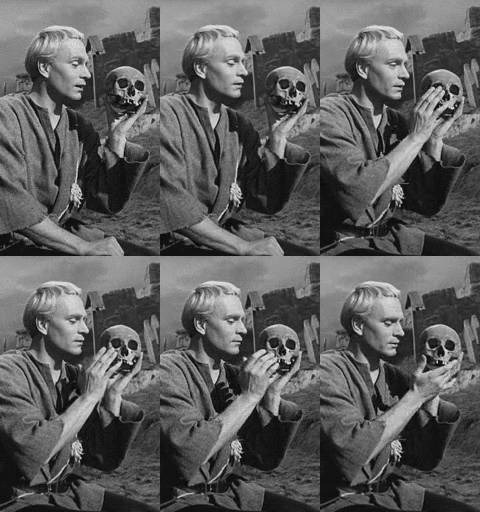
In Shakespeare's Hamlet, we meet a character torn by indecision and inner conflict, the same conflicts that you and I feel all of the time. But there's something a bit excessive about Hamlet and his thoughts. They seem to get caught up in themselves, and there's a sense that he's crippled by his own indecision. As the play goes on, it becomes clear that he's delaying, putting off his need to choose. He debates with himself to avoid choosing.
Hamlet is caught in what Kierkegaard calls being "lost in the infinite." It's a paralysis that comes on when we realise the scale of the choices available to us, an awareness of the infinite variety of consequences that come from choosing one way or another. It's felt in those crux moments (when you leave home, after a breakup, if you come into some money, or if you want to kill your Uncle Claudius). We delay by running the countless options over and over in our head, because we're scared of making a choice.
In his most famous speech, Hamlet has to make the ultimate decision: should we endure and carry on, or should we just give up? It's a choice we all have to make every day, in every decision, because choosing what socks to wear or who to marry is an example of affirming life. Every choice commits to now. Nietzsche once wrote that the lesson of Hamlet is that "knowledge kills action." To make a decision, to be anything, requires doing. Hamlet's soliloquies are some of the greatest prose ever written, but ultimately Hamlet needs to act. We all need to act if we want to live.