How Governments Spark Revolutions
This is not hallucinations and not a conspiracy theory.
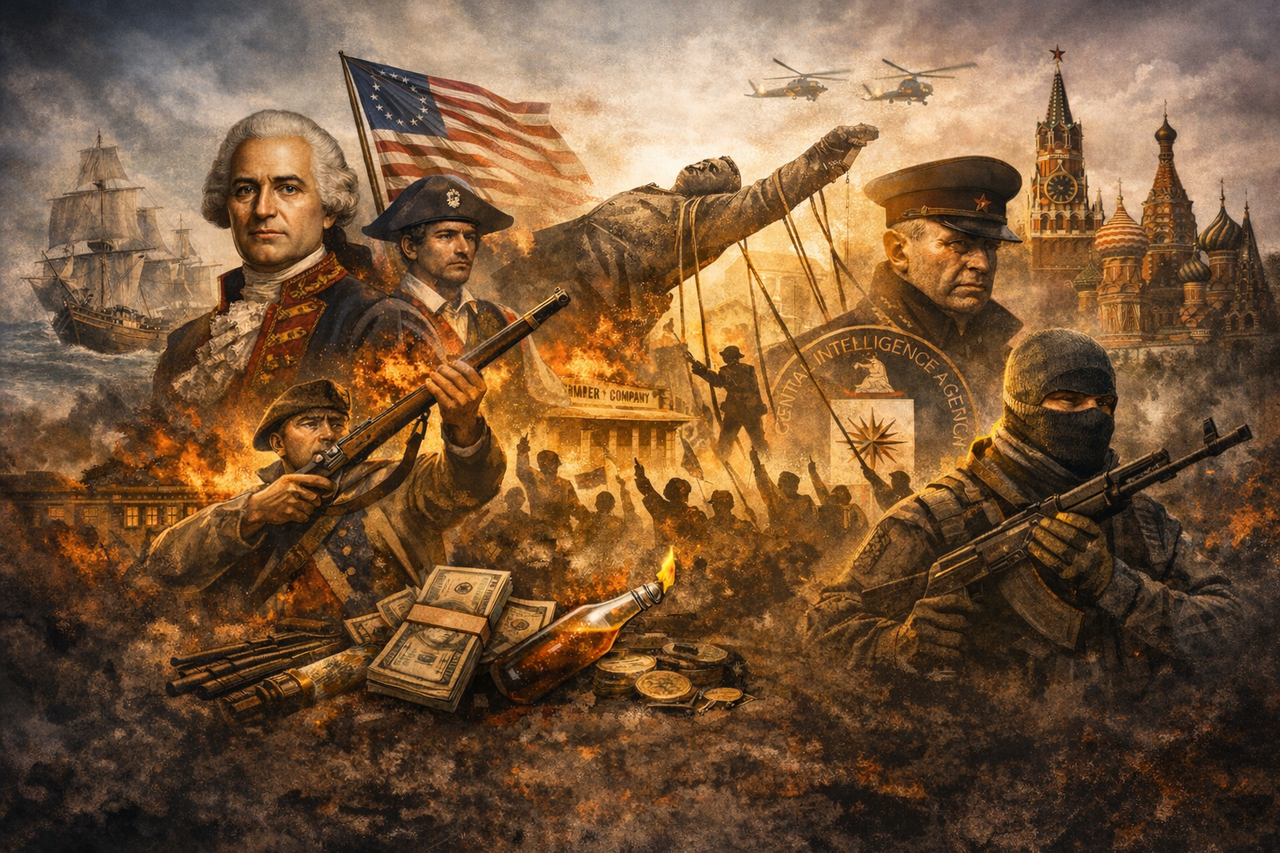
WHAT'S REALLY GOING ON?
Revolution in the popular imagination is a force of nature. Popular rage, streets in smoke, a tyrant's statue falling from its pedestal.
But let's be honest.
Behind that theater there's almost always a much colder logic:
— Who benefits?
— Why right now?
Interference in another country's affairs through support of revolutionary movements is one of the oldest tools in geopolitics.
It lets you weaken a rival without direct armed conflict. Install a loyal regime without formal occupation. And all of this — at relatively low cost.
That's why it never went out of fashion.
HOW IT WORKS
The mechanics are simple. First, an external actor finds an internal "leverage point" — a discontented group, an opposition movement, a regional elite.
Then it supplies that group with resources: money, weapons, propaganda. Even just a word of support. And then it builds a narrative that looks beautiful:
"fight for freedom"
"protection of minorities"
"overthrow of tyranny"
"fight for peace"
But here's the catch. The external player doesn't need to win the revolution.
It's enough to make the target country weak, distracted, internally fractured. Chaos in itself — is already the goal.
Concrete examples.
FRANCE AND THE AMERICAN REVOLUTION
Louis XVI funded the American rebels not because he believed in human rights.
He saw an opportunity to finish off Britain after the Seven Years' War. Weapons, money, diplomatic cover — all through a front company before officially entering the war.
"England is our enemy, and her humiliation is the only way to ensure France's security" — Count de Vergennes, French Minister of Foreign Affairs
The result? The US got independence. And France got state bankruptcy and its own revolution in 1789.
The fire came back to the one who lit it.
THE US IN LATIN AMERICA
1954, Guatemala. The CIA organized the overthrow of elected President Árbenz — because he had carried out a land reform that hit the interests of the American United Fruit Company.
The official narrative? "Communist threat."
And the outcome for Guatemala:
— reforms reversed
— decades of authoritarianism
— civil war all the way to 1996
And examples like this — Nicaragua, Iran, Chile — could go on for a long time.
THE USSR AND "REVOLUTIONARY EXPORT"
The Soviet Union turned support for "fraternal revolutionary movements" into state doctrine.
Cuba, Angola, Afghanistan — the same algorithm every time:
find local allies,
give them resources,
frame their struggle in a beautiful ideological narrative.
But when the ideology lost its appeal — the entire network began to fall apart.
RUSSIA AND HYBRID DESTABILIZATION
Modern Russia perfected the model. Now it's called "hybrid warfare":
— disinformation campaigns
— funding of far-left and far-right parties simultaneously
— financing of "civil society"
The goal is unchanged — not necessarily to bring your own candidate to power. It's enough to maximally polarize the society of the target country.
In Ukraine's case this played out especially vividly. And when destabilization didn't deliver the desired effect — direct military aggression followed.
WHAT'S THE BOTTOM LINE?
The bottom line, I believe, is this:
Be more careful with your allies.