Six Legendary South African Military Aircraft (1960–2000)
South Africa’s military aviation between 1960 and 2000 reflects a unique blend of foreign acquisition, local innovation, and adaptation under international sanctions. The South African Air Force (SAAF), working closely with local industry, operated and modified a range of aircraft suited for long distances, harsh environments, and counter-insurgency warfare.
Here’s a structured look at six legendary aircraft used by South Africa during this period.
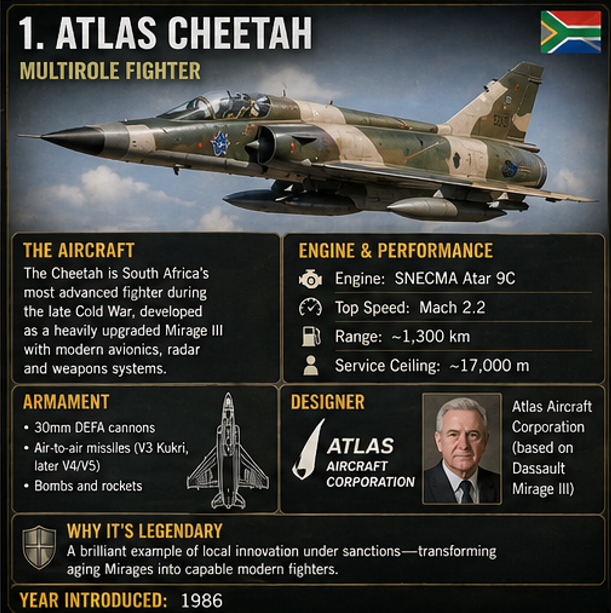
1. Atlas Cheetah
Designer: Atlas Aircraft Corporation (based on Dassault Mirage III)
Year Introduced: 1986
Role: Multi-role Fighter
THE AIRCRAFT
The Cheetah was South Africa’s most advanced fighter during the late Cold War, developed as a heavily upgraded Mirage III. It featured modern avionics, radar, and air-to-air capabilities.
ENGINE & PERFORMANCE
Engine: SNECMA Atar 9C
Top Speed: Mach 2.2
Range: ~1,300 km (combat radius)
Service Ceiling: ~17,000 m
ARMAMENT
30mm DEFA cannons
Air-to-air missiles (V3 Kukri, later V4/V5)
Bombs and rockets
WHY IT’S LEGENDARY
A brilliant example of local innovation under sanctions, transforming aging Mirages into capable modern fighters.
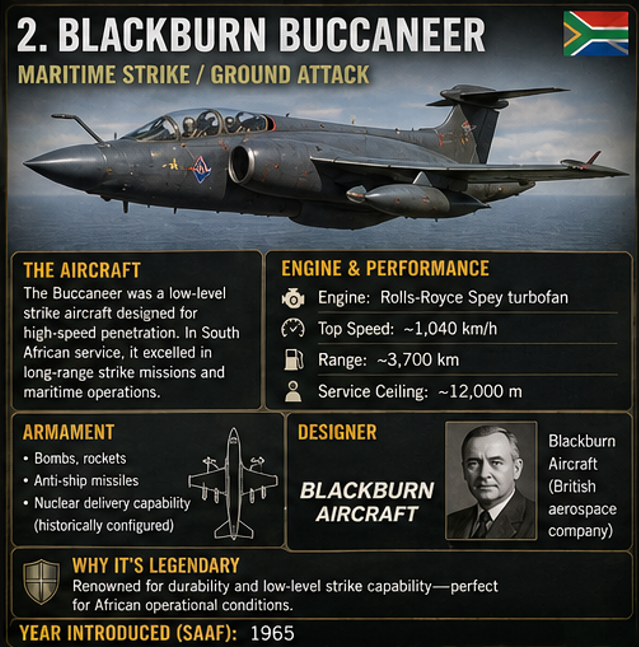
2. Blackburn Buccaneer (SAAF Service)
Designer: Blackburn Aircraft
Year Introduced (SAAF): 1965
Role: Maritime Strike / Ground Attack
THE AIRCRAFT
The Buccaneer was a low-level strike aircraft designed for high-speed penetration. In South African service, it excelled in long-range strike missions and maritime operations.
ENGINE & PERFORMANCE
Engine: Rolls-Royce Spey turbofan
Top Speed: ~1,040 km/h
Range: ~3,700 km
Service Ceiling: ~12,000 m
ARMAMENT
Bombs, rockets, anti-ship missiles
Nuclear delivery capability (historically configured)
WHY IT’S LEGENDARY
Renowned for durability and low-level strike capability, perfect for African operational conditions.
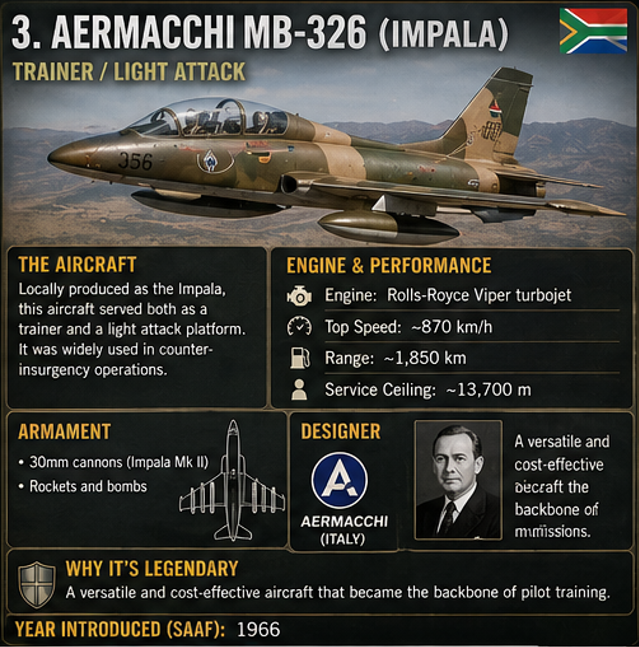
3. Aermacchi MB-326 (Impala)
Designer: Aermacchi
Year Introduced (SAAF): 1966
Role: Trainer / Light Attack
THE AIRCRAFT
Locally produced as the Impala, this aircraft served both as a trainer and a light attack platform. It was widely used in counter-insurgency operations.
ENGINE & PERFORMANCE
Engine: Rolls-Royce Viper turbojet
Top Speed: ~870 km/h
Range: ~1,850 km
Service Ceiling: ~13,700 m
ARMAMENT
30mm cannons (Impala Mk II)
Rockets and bombs
WHY IT’S LEGENDARY
A versatile and cost-effective aircraft that became the backbone of pilot training and light strike missions.
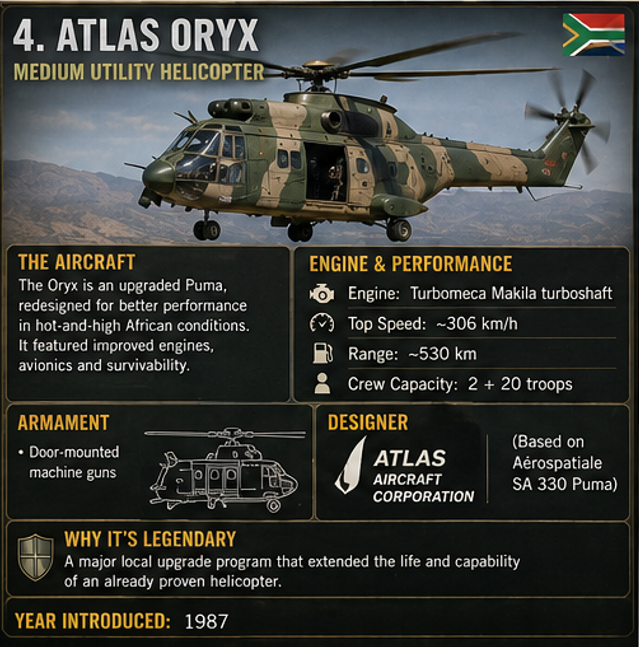
4. Atlas Oryx
Designer: Atlas Aircraft Corporation (based on Aérospatiale SA 330 Puma)
Year Introduced: 1987
Role: Medium Utility Helicopter
THE AIRCRAFT
The Oryx is an upgraded Puma, redesigned for better performance in hot-and-high African conditions. It featured improved engines, avionics, and survivability.
ENGINE & PERFORMANCE
Engine: Turbomeca Makila turboshaft
Top Speed: ~306 km/h
Range: ~530 km
Crew Capacity: 2 + 20 troops
ARMAMENT
Door-mounted machine guns
WHY IT’S LEGENDARY
A major local upgrade program that extended the life and capability of an already proven helicopter.
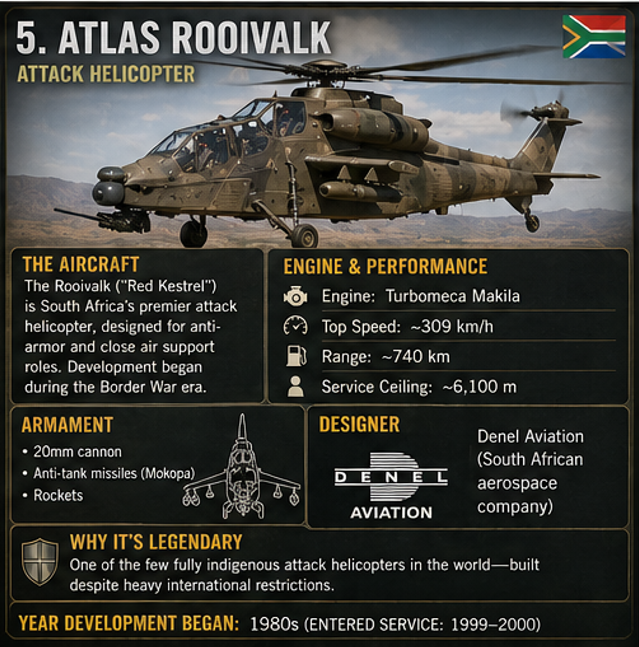
5. Atlas Rooivalk
Designer: Denel Aviation
Year Development Began: 1980s (entered service later, 1999–2000 era)
Role: Attack Helicopter
THE AIRCRAFT
The Rooivalk (“Red Kestrel”) is South Africa’s premier attack helicopter, designed for anti-armor and close air support roles. Development began during the Border War era.
ENGINE & PERFORMANCE
Engine: Turbomeca Makila
Top Speed: ~309 km/h
Range: ~740 km
Service Ceiling: ~6,100 m
ARMAMENT
20mm cannon
Anti-tank missiles (Mokopa)
Rockets
WHY IT’S LEGENDARY
One of the few fully indigenous attack helicopters in the world, built despite heavy international restrictions.
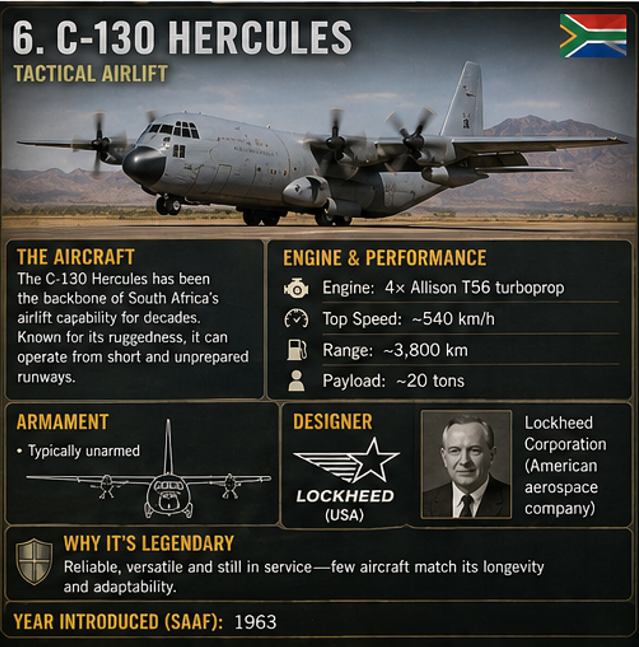
6. C-130 Hercules (SAAF Service)
Designer: Lockheed
Year Introduced (SAAF): 1963
Role: Tactical Airlift
THE AIRCRAFT
Known to most as a "Flossie", the C-130 Hercules has been the backbone of South Africa’s airlift capability for decades. Known for its ruggedness, it can operate from short and unprepared runways.
ENGINE & PERFORMANCE
Engine: 4× Allison T56 turboprop
Top Speed: ~540 km/h
Range: ~3,800 km
Payload: ~20 tons
ARMAMENT
Typically unarmed
WHY IT’S LEGENDARY
Reliable, versatile, and still in service, few aircraft match its longevity and adaptability.
Conclusion
Between 1960 and 2000, South Africa’s air power evolved from reliance on imported aircraft to highly sophisticated local upgrades and indigenous designs. Aircraft like the Cheetah and Oryx demonstrate engineering ingenuity under sanctions, while platforms like the Buccaneer and Hercules provided unmatched operational reliability.
Together, these aircraft tell the story of a nation that adapted, innovated, and built a formidable air capability against the odds.