Legends of War — Series N°2 - Scipio Africanus
Legends of War — Series N°2
Scipio Africanus
Publius Cornelius Scipio Africanus · The man who defeated the undefeatable
The Commander Who Saved Rome and Defeated Hannibal · Architect of the Victory at Zama · First Great Strategist of the Ancient World.
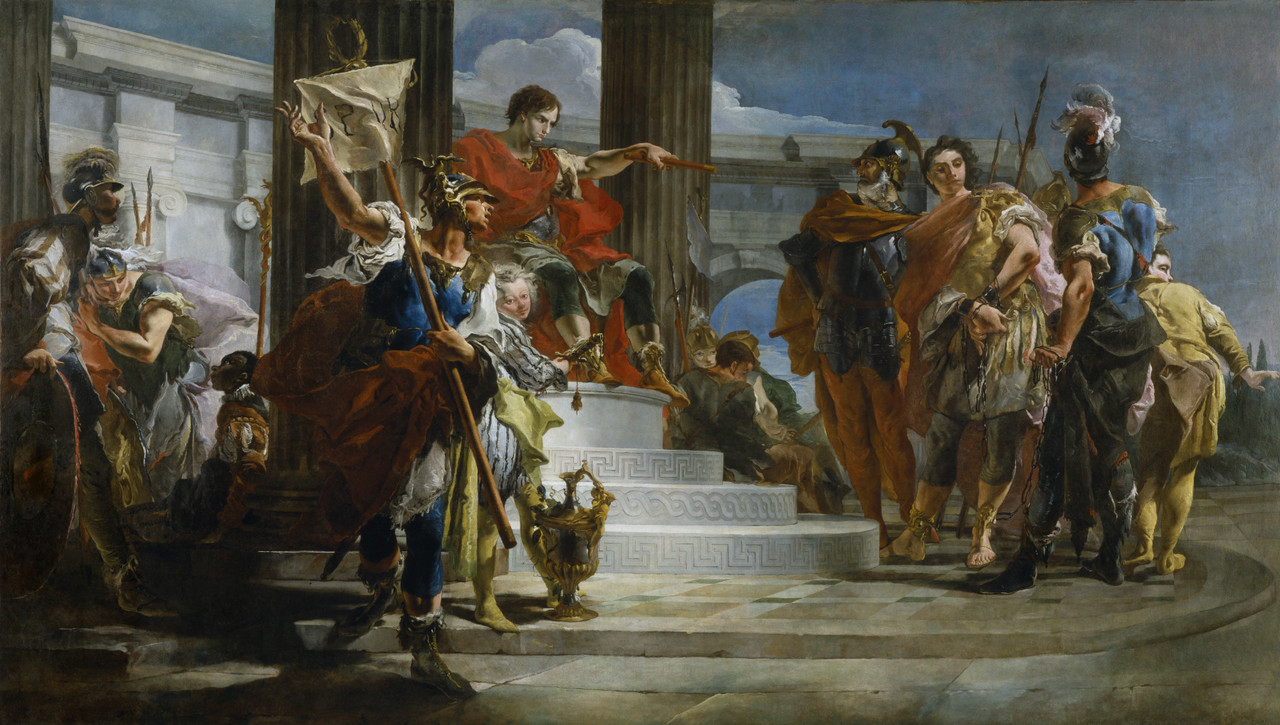
The Legends of War series continues. After exploring the lucid madness of Oda Nobunaga, the Demon King of Japan, I travel back eighteen centuries to the very cradle of our military civilization. Publius Cornelius Scipio — surnamed Africanus for doing what no one believed possible: defeating Hannibal Barca in open battle. A man who was not merely a general, but a force of history itself — clear-eyed, audacious, generous with his enemies, merciless toward mediocrity, and betrayed in the end by the one thing he could never conquer: the ingratitude of his own homeland.
I. Son of Disaster
The year is 218 BC. The Ticino — a cold river in northern Italy. The consul Publius Cornelius Scipio, the Africanus's father, has just been surrounded by Hannibal's Numidian cavalry and is about to die on the field. He is seventeen, the boy who spurs his horse alone into the melee, cuts a path through the enemy and drags his father to safety. Livy tells us the consul wished to award him the corona civica — Rome's highest military honour for saving a fellow citizen's life. The son refused. He said doing it was enough.
That was the first gesture of an extraordinary character. Three years later, at Cannae, he witnesses the most catastrophic defeat in Roman history: seventy thousand legionaries slaughtered in a single day. Most survivors want to flee — abandon everything, seek refuge outside Italy. Scipio, a military tribune at twenty, gathers them at sword-point and forces an oath: no one would betray Rome. He then leads them safely to Canosa, four miles from Hannibal's camp.
In two episodes, the portrait is already complete: physical courage without display, moral leadership without rhetoric, ice-cold composure where others see only the end. And there is something more: Cannae did not break him. It built him. He studied that battle the way a student studies a theorem, until he understood every angle of it. Years later, on the field of Zama, he would use the same encircling tactics Hannibal had used to destroy him — and improve them.
Cognomen ex virtute
Africanus - The African
An honorary title earned in battle, bestowed after the victory at Zama (202 BC). Not an inherited name — a won one. First Roman to receive a surname derived from a conquered people.
Full designation
Africanus Maior - The Elder Africanus
Called "the Elder" to distinguish him from his adoptive grandson Scipio Aemilianus — the Younger Africanus — who would later destroy Carthage in the Third Punic War.
Political standing
Princeps Senatus - First of the Senate
The supreme moral and political rank of the Roman Republic: the senator of greatest authority and prestige, whose name was called first at every vote.
In the memory of ages
Saviour of Rome - Servator Patriae
The title by which posterity remembers him: the man who, when everything seemed lost after Cannae and the Ticino, never yielded — and turned defeat into the laboratory of ultimate victory.
II. Spain — A Masterpiece at Twenty-Four
In 211 BC, Scipio's father and uncle are killed in Spain, overwhelmed by the Carthaginian army. Rome is left without a commander in the Iberian Peninsula — the strategic heart of Hannibal's supply lines. The Senate asks who is willing to take command. Silence. Then a young man of twenty-four steps forward — a private citizen, not yet old enough to be consul under Roman law.
The people vote for him by acclamation. It is the first time in Roman history that imperium proconsulare is granted to someone who has not yet held the praetorship. A revolutionary exception. Scipio honours it with a feat that left his contemporaries speechless.
Capture of Carthago Nova · 209 BC
The Carthaginian capital of Spain — modern Cartagena — was considered impregnable. Scipio attacks with a combined assault: by day he draws the defenders toward the landward walls, while on the northern lagoon side — at low tide, as local fishermen had told him — he sends his legionaries wading up to the nearly unguarded walls. The city falls in a single day. Inside: the Carthaginian war treasury, supply depots, shipyards. Six thousand prisoners — all released. Scipio already understands that loyalty is built through generosity, not terror.
Battle of Ilipa · 206 BC
Against Hasdrubal Gisco, with 45,000 men facing his 48,000. Scipio overturns every conventional tactical principle: he places his best troops on the wings rather than the centre, advances the flanks and keeps the centre deliberately slow — the exact opposite of standard Roman formation. The Carthaginian wings are destroyed before the centres engage. It is Hannibal's own Cannae tactic, replicated with surgical precision by his unwitting student. The Carthaginians are expelled from Spain for good.
III. The Meeting with Hannibal — Two Geniuses Face to Face
Before the Battle of Zama in 202 BC, something unique in ancient military history took place: the two greatest generals of their age met face to face, unarmed, to talk. Hannibal was fifty, carrying the weight of sixteen years of war. Scipio was thirty-three, burning with the certainty that the moment of reckoning had arrived.
Hannibal proposed peace: Carthage would surrender everything it had already lost — Spain, the islands, maritime supremacy. Scipio replied that those were terms already accepted and then violated. That he had not come all this way to be offered what Rome had already won. The negotiations failed. Both men returned to their camps. The next day, they met on the battlefield.
«Malle se unum civem servare quam mille hostes occidere.»
"I would rather save the life of one citizen than kill a thousand enemies."
— Saying attributed to Scipio, recorded in the Historia Augusta (4th century AD) — the motto that best encapsulates his ethical code of command
It was not rhetoric. He proved it repeatedly in action: at Carthago Nova he freed the Spanish prisoners rather than selling them as slaves; after Zama he imposed moderate peace terms on Carthage rather than demanding its annihilation; in Spain he returned a captured Iberian noblewoman to her betrothed without ransom, securing the loyalty of her entire clan for the duration of the campaign. He grasped, centuries before Clausewitz, that war is politics by other means — and that a well-made peace is worth more than a hundred battlefield victories.
IV. Zama — The Day Rome Became Rome
It was the 19th of October, 202 BC. Near present-day Tunisia, two armies faced each other in what would become the most consequential battle in the history of the ancient Mediterranean. On one side: Hannibal Barca — the man who had crossed the Alps with elephants, who had destroyed three Roman armies in three years, who for sixteen years had held Italy hostage by his mere presence. On the other: Publius Cornelius Scipio — the young man who had studied his battles like a sacred text and was now ready to reverse every lesson they contained.
Battle of Zama · 202 BC
Hannibal deployed eighty war elephants in the front line — his most powerful psychological weapon, capable of breaking any formation. Scipio had anticipated everything: his Roman maniples were arranged in columns with empty corridors between each unit. When the elephants charged, the legionaries opened those gaps and let them pass through — then hurled javelins at their flanks and redirected them into Carthaginian ranks. Then, when Masinissa's Numidian cavalry — Scipio's ally — returned from pursuit and struck the Carthaginian rear, Hannibal found himself encircled. Exactly as he had encircled the Romans at Cannae. Twenty thousand Carthaginians dead. Hannibal fled. The Second Punic War was over.
«If you examine the annals of history, you will not find another battle in which two great military commanders were consistently at the top of their game.»
— Basil Henry Liddell Hart's verdict on Zama — the most influential military theorist of the 20th century, in his analysis of the great battles of history
— Liddell Hart, cited in classical sources on the Battle of Zama
After the victory, Scipio did not march on Carthage. He did not sack it. He did not burn it to the ground. He imposed moderate peace terms: return of the fleet, an end to war elephants, a war indemnity, a prohibition on waging war without Rome's permission. Carthage survived as a city, as a civilization, as a people. It would be Cato the Censor, fifty years later, who would obsess over Carthago delenda est — and Scipio Aemilianus, the adoptive grandson, who would raze the city in 146 BC. The Africanus was not built for destruction as an end in itself. He was built for victory.
V. The Psychology of a Victor
Scipio was not an easy figure for the Romans of his time to understand — accustomed as they were to the model of the austere, inward-looking general, devoted to ritual and tradition. He was something different: open to Greek culture — a philhellene, they called him, with a mixture of admiration and unease — patron of the poet Ennius, capable of writing letters in Greek to foreign kings. He had charisma and knew how to deploy it: when Iberian tribes acclaimed him "king" after the conquest of Spain, he refused the title with a speech that Polybius recorded in full — explaining that what he sought was not the power of a king, but kingly greatness of soul: a superiority determined not by rank, but by excellence of character and mind.
The gift of strategic generosity
He understood before anyone else that treating a defeated enemy well transforms him into an ally. Masinissa, king of the Numidians, became his decisive trump card at Zama precisely because Scipio had honoured him years earlier in Spain.
The courage to break the rules
He commands in Spain at 24, when the law would not allow it. He carries the war to Africa when the Senate opposes it. He invents new tactics when tradition says otherwise. He does not disobey — he anticipates.
Contempt for mediocrity
When the Senate puts him on trial for embezzlement — a ludicrous charge against Rome's most glorious man — he tears up the indictment documents in public and invites everyone present to follow him to the Capitol to thank the gods for Zama. Then he walks out. Half the Senate follows him.
Greatness in final defeat
He does not fight the trial, does not plead, does not bargain. He chooses exile as an act of moral superiority. Seneca would later write: "Either Rome had to lose Scipio, or Scipio had to lose his freedom." They could not coexist.
«Multitudo omnis sicut natura maris per se immobilis est, ventis et aurae cient.»
"The whole multitude, like the nature of the sea, is still of itself — it is the winds and the currents that set it in motion."
— Cited in Livy, XXVIII, 27 — Scipio's address to his army in Spain following a mutiny among the troops
VI. The Trial and the Exile — Greatness Betrayed
It was 187 BC. Scipio was fifty years old. He was the greatest general Rome had ever produced, the saviour of the Republic, the conqueror of Hannibal. And the Senate was putting him on trial.
The charge: embezzlement. He and his brother Lucius were accused of pocketing part of the fifteen thousand talents that the Seleucid king Antiochus III owed Rome as war reparations after the Battle of Magnesia. Cato the Censor — his lifelong enemy, the guardian of the most rigid and petty strain of Roman tradition — was the engine of the prosecution. It did not matter that the accusations were slander. It did not matter that thirty years of service to the Republic counted for nothing. It did not matter that there had been a Zama.
Scipio was summoned to the Senate to answer the charges. He took the documents of the indictment. He looked at them. He tore them up in front of everyone. Then he turned to the senators and said one thing only: today is the anniversary of the Battle of Zama. Follow me to the Capitol to give thanks to the gods. And he walked out. A large part of the Senate followed him.
But the accusations returned. The trials returned. Scipio grew weary. And he left — for Liternum, a colony of veterans on the Campanian coast. Not a forced exile: a choice. The declaration of superiority of a man who deemed it beneath him to fight those who were not his equal.
«Ingrata patria, ne ossa quidem mea habes.»
"Thankless homeland, you shall not even have my bones."
The epitaph Scipio dictated for his own tomb at Liternum — recorded by Valerius Maximus, Factorum et dictorum memorabilium, V, III, 2b — refusing to be buried in Rome after his political condemnation
He died at Liternum in 183 BC, at fifty-two, from the illness that had plagued him for years. Tradition holds that his tomb bore only those words. Not his name, not his victories, not his battles. Only that sentence of condemnation addressed to an ungrateful homeland. And perhaps in its fierce simplicity, that epitaph speaks more than any triumphal column ever could.
In that same year of 183 BC, in Bithynia, Hannibal Barca also died — surrounded by Roman soldiers sent to arrest him, he drank poison rather than be taken captive. The two greatest generals of their age left the world in the same year, both betrayed — one by Carthage, the other by Rome.
VII. The Legacy of the Africanus
Scipio Africanus did not build an empire, did not proclaim himself king, did not found a dynasty. He left something more subtle and more lasting: a method. His way of waging war — tactical flexibility, the use of surprise, psychological warfare, generosity toward the defeated — became the template that every great Roman general after him sought to imitate. Caesar studied him. Napoleon admired him. Liddell Hart analysed him in the twentieth century as the father of the strategy of indirect approach.
But there is something more personal in his legacy. Scipio was the first Roman who managed to think bigger than his own city. While the Senate squabbled over careers and honours, he looked at the Mediterranean as a whole. While Cato built walls, he built alliances. While Rome thought about the next battle, he thought about the peace that would come after.
They called him Africanus for a battle won. They could have called him the Founder — for the world he made possible.
Legends of War · Series N°2 · Publius Cornelius Scipio Africanus Maior · 235–183 BC