Limestone and Concrete: Stagnation, Market Manipulation, and Financial Opportunities
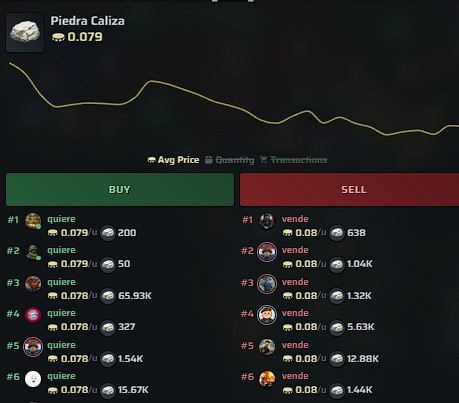
Limestone is trapped in a heavy, stagnant, prolonged bear trend at 0.08 for sell and 0.078 for buy. Although several "whales" are pulling their offers from the market to simulate scarcity and artificially inflate the price, I estimate there are at least 600,000 to 900,000 (and I might be underestimating) hidden rocks sitting in inventories, waiting for the right moment.
Current Order Book Status
The quick-sell price has hit a clustered wall at 0.08 coins, with very heavy visible lots (ranging from 1.44K to 12.88K units). On the buy side, although most strong demand is waiting lower at 0.078 coins (with a massive 65.93K order), small competitive orders have appeared, timidly climbing to 0.079 coins. The whales are watching how the market unfolds so they can either move their massive offers or leave them waiting.
Whale Behavior
Players like Minecraft (one of the richest players in the game) have been seen placing offers of up to 300,000 and then withdrawing them as prices dropped due to oversupply. This is likely a tactic to artificially inflate prices.
Today, demand is weak compared to supply — and that's despite the massive quantities sitting in certain players' inventories. As soon as another one of these players needs gold, the price will finally break down even further...
So What Should We, the Producers, Do?
Convert to Concrete
Manufacturing 1 concrete block costs us 10 rocks + 10 production points (the equivalent effort of 20 rocks total).
Considering the current maximum production bonuses for both cases:
Limestone (56.25%): each work cycle breaks the 1:1 parity, returning 1.56 rocks per base work unit
Concrete (51%): 10 production points yield half the energy of an average competitor
Under the equivalence rule (10 Rocks + 10 Production Points = 20 total Rocks per block), we evaluate the two economic scenarios using real current market prices:
With Raw Limestone
If you sell those 20 raw rocks at the market's quick-buy price (0.079), you get 1.58 coins.
With Concrete
If you process the resource and position yourself at the fastest, most competitive sell order to ensure instant exit, you get:
1.638 coins
Conclusion
It remains far more profitable and efficient to transform limestone into concrete before selling. It gives us an extra margin of nearly +0.058 coins per block instead of giving away raw material in a flooded market. Additionally, you'll sell it faster.
There is no solid floor supporting real long-term stability. Massive accumulation combined with weak organic demand is the perfect recipe for a crash. Limestone market fluctuations might give producers some breathing room, but the trend will continue downward due to oversupply.
Therefore, the strategy of not accumulating raw limestone and converting everything immediately into concrete becomes even more crucial.
Additional Strategic Note
Additionally, you can choose not to convert everything into concrete and leave a portion aside. That way, you don't depend on a single market. Limestone is structurally oversupplied, but conversion to concrete is only superior as long as the price differential holds. The optimal strategy is not "always convert everything", but rather to monitor in real time the entry of hidden inventories and real demand.