Market Matrix GTB#3

Guide to Beginners #3
Market Matrix


This is part of the Guide to Beginners (GTB) series. If you haven’t read the previous guides already, here are the links:
GTB #1: https://app.warera.io/article/693f08a40a15a32ccc480bbc
GTB #2: https://app.warera.io/article/694431bb43f4fb12c8aad174
GTB #3: https://app.warera.io/article/69524d06948fa152a95b7ccd
Introduction
The market throughout human civilisation has been a place of action. In the mediaeval era, markets were the basis of many communities, common grounds for different cultures to blend in. Later on in human history, markets were the places to go if there was any problem or a doubt.
In the modern era, however, there is a different kind of market that has emerged which depends more on supply and demand. This is referred to as the stock market and more recently, the crypto market. It is still bustling and happening, but has an intrinsic difference from the markets of the past.
The market in War Era closely resembles the modern stock market. It is mostly purely based on supply and demand of different items at different times.
Some supply demand terms
Equilibrium: Prices settle where supply equals demand.
Elasticity: Some goods react strongly to price changes, others barely move.
Surplus & Shortage: Too much supply → prices drop. Too much demand → prices spike.
Some quick math! (LOL)
Quick Equilibrium
Look at the market in War Era, all items gave almost similar profit production point (with wheat as a major outlier).
Elasticity in Action
Price rises 20% and demand falls 20%:
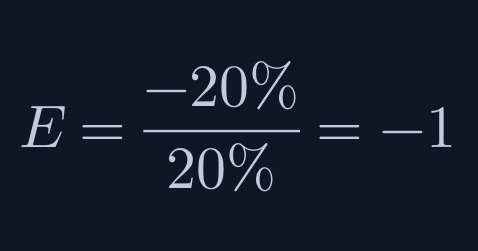
Elasticity is basically consumer psychology in math form.
How to profit?
In the initial stages, it is not feasible to hold a ton of supplies and hence selling items is recommended. But if you are a little experienced player in the game and can afford to hold some supplies or if the clouds of war are nearing, try to hold your supplies as during war, prices of most items will go up and so will your profit.
Efficiency in Holding Supplies vs. Investing Funds
The Core Dilemma
Players often face two choices:
Hold supplies → stockpile resources for future campaigns or emergencies.
Sell supplies → convert them into funds, then reinvest in companies for growth.
The efficiency question is: Which option yields greater long-term advantage?
Key Factors to Consider
Market Prices: Selling is more attractive when demand is high and prices peak.
Investment Returns: Reinvesting funds into companies can generate compounding growth.
Strategic Timing: Holding supplies can be useful before wars, events, or shortages.
Mathematical Analysis
When we assume ROI from hoarding supplies to be 7% and ROI from investment in companies to be 5%

When we assume ROI from hoarding supplies to be 7% and ROI from investment in companies to be 5%
But there is a catch here
Key asymmetry: Costs grow exponentially; automation benefit (production-time reduction or output-rate increase) grows linearly per upgrade. This means early upgrades tend to have better ROI than late ones.
Break-Even Analysis
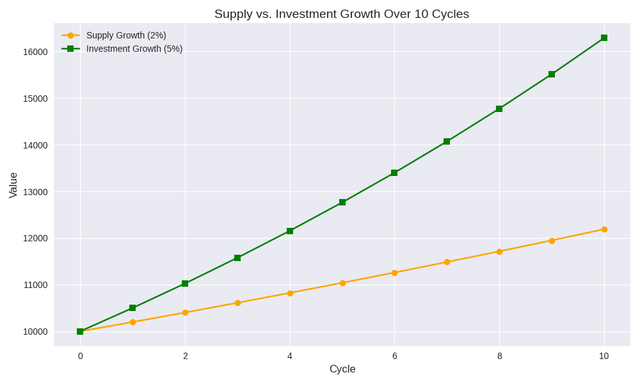
Here we assume that supply prices rise 2% per cycle, while company investments grow 5% per cycle.
Holding supplies: 10,000 × (1.02)^5 = 11,041
Investing funds: 10,000 × (1.05)^5 = 12,763
Investing beats holding unless supply prices spike above 5% growth.
Risk Factor
If market volatility is high, holding supplies can hedge against sudden shortages.
If company growth is stable, reinvestment is mathematically superior.
Practical Game Strategy
Short-term wars/events: Hold supplies for immediate leverage.
Long-term growth: Sell and reinvest for compounding returns.
Hybrid approach: Keep a reserve (e.g., 20–30%) while reinvesting.
Investing in the Market
This is a part most people don’t pay heed to but for you all, it will not be just another extempore.
There are three rules of thumb:
Build a pure inventory daily – small purchases daily will lead to amazing results in the long term.
Diversify – just like stock market portfolios, diversify, don’t bet on just one resource.
Don’t hamper your growth economically – do not pour in excessively in the market. Rely on the above information for reasonable investment, otherwise, you might miss achieving factory upgrades.
Conclusion
Efficiency depends on comparing expected supply price growth vs. company investment returns.
If supply growth < investment growth → sell and reinvest.
If supply growth > investment growth → hold supplies.
If uncertain → split strategy to balance risk and reward.
YOUR SUPPORT MATTERS TO US❤️
Sooo.....
What r u waiting for?
LIKE, Subscribe AND KEEP ON YAPPIN'!!!