Official Statement of the President of the Italian Republic
To the international community,
In light of the recent events, I believe it is my duty to explain the position of the Italian Republic and the reasons that have led us to this difficult moment.
The collapse of negotiations with the Vatican was not the result of a single meeting. It was the culmination of weeks of increasingly difficult discussions, marked by profound disagreements over the future of our nations, as they did with previous enemy as Portugal, Cyprus and other Cristian Nation.
The final round of negotiations failed because the demands presented to Italy went far beyond what I could responsibly accept as President. Every Head of State has one sacred duty above all others: to protect the interests, dignity, and future of their own nation. I could not sacrifice Italy's welfare for terms that my government and my people considered unacceptable.
This was not the first time pressure had been applied against us.
Under the previous Pope, Italy was repeatedly warned that military action would follow should we refuse certain demands. Those threats deeply troubled us, not only politically but morally, as they stood in stark contrast to the values of dialogue, compassion, and peace that Christianity teaches.
When the Vatican requested a two-day ceasefire to allow for the election of a new Pope, Italy accepted immediately.
We did so out of respect—not merely for the Vatican, but for God, for our Christian principles, and for the hope that a new pontificate might open a new chapter of peace.
Unfortunately, those hopes were not fulfilled.
Since taking office, I have conducted a complete review of Italy's international relations.
What I discovered surprised me.
Several nations long described as "friends" appeared interested only in advancing their own agendas through Italy. At the same time, I found that some countries officially considered our enemies were, in reality, far more willing to engage in honest diplomatic dialogue.
As President, it is my responsibility to explore every possible path toward peace.
That is why, during a private conversation with the Pope, I asked for his thoughts on the possibility of opening diplomatic channels with Beer. My intention was simple: to end a war that has brought suffering to all sides. I sought advice, not conspiracy.
The trust placed in that private conversation was, in my view, later broken when elements of it became the subject of political accusations.
Diplomacy cannot survive where private dialogue becomes a weapon.
Let me also make one thing absolutely clear.
Italy has never hidden the fact that it maintains respectful communication with countries whose governments currently stand on opposite sides of the conflict.
That is not weakness.
That is diplomacy.
In the coming days I will participate in a public AMA with members of the Serbian community. I do so openly because I believe dialogue should never be feared. Speaking with those who disagree with us is not betrayal; it is the very foundation of lasting peace.
This has always been Italy's approach.
Whether in Europe or during our efforts to mediate conflicts in Western Africa, we have consistently sought stability over chaos. Although those mediation efforts ultimately failed due to irreconcilable differences between the parties, our commitment to peace has never wavered.
Recent accusations describing Italy as an authoritarian state deserve a direct response.
Ironically, only yesterday the Pope repeatedly mocked me by claiming that I am merely a puppet of my Congress.
Nothing could be further from the truth.
I am not a puppet.
I am the democratic expression of it.
Every major decision I take is discussed with my Congress. I actively listen to my ministers, my representatives, and my citizens. I spend countless hours explaining our international situation, our military choices, and our national strategy directly to the Italian people through public voice discussions.
Any Italian citizen can testify that my government does not rule above its people—it governs with them.
Regarding the recent tensions with Malta, I personally entered into dialogue with the Maltese people and their leadership.
Those discussions resulted in an agreement that, I believe, will finally put an end to unnecessary disputes by fully recognizing Malta's independence and reinforcing the friendship between our nations.
If any member of my government has acted outside democratic principles, including those accusations recently directed at our former Vice President and current Minister of Defence, those matters will be examined through the appropriate parliamentary institutions.
No individual stands above the Republic.
That is what democracy means.
Italy does not fear scrutiny.
We embrace it.
It is precisely this democratic spirit that, in my opinion, has often been misunderstood—and at times openly ridiculed—by those who now accuse us of authoritarianism.
Finally, I cannot ignore another contradiction.
In private conversations, the current Pope himself spoke of abandoning his previous alliances in pursuit of a mercenary path. Yet today, after those ambitions failed to materialize, every remaining diplomatic bridge with Italy appears to have been deliberately burned, accompanied by threats against our capital and our people.
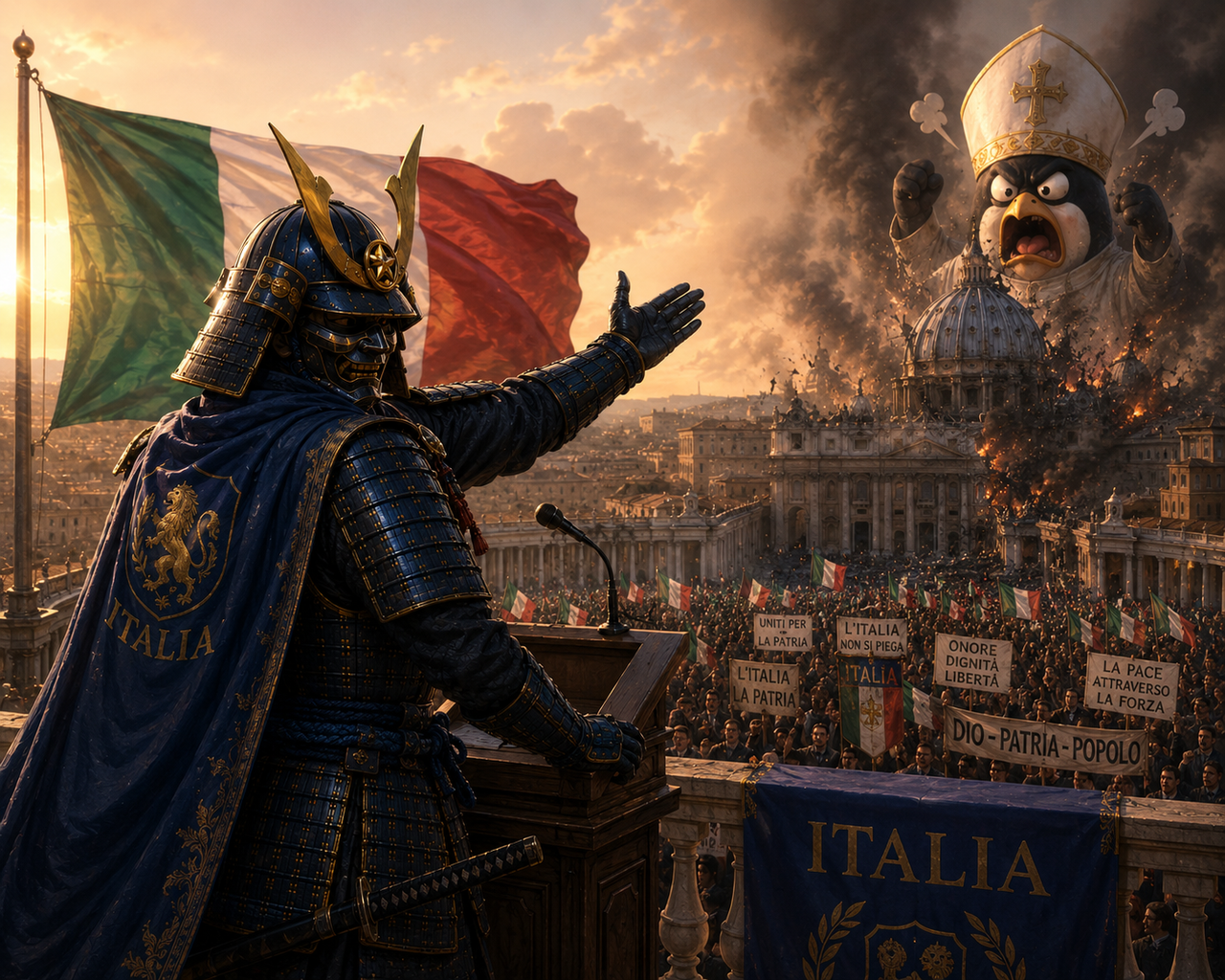
History will judge these choices.
Italy will remain faithful to its own principles.
We do not seek conquest.
We do not seek revenge.
We seek peace.
But peace cannot exist without dignity.
And if history demands that we fight in order to secure a just and lasting peace for our people, then we shall fight—not out of hatred, but out
of duty.
Long live the Italian Republic.
Long live peace.
May God protect our people.