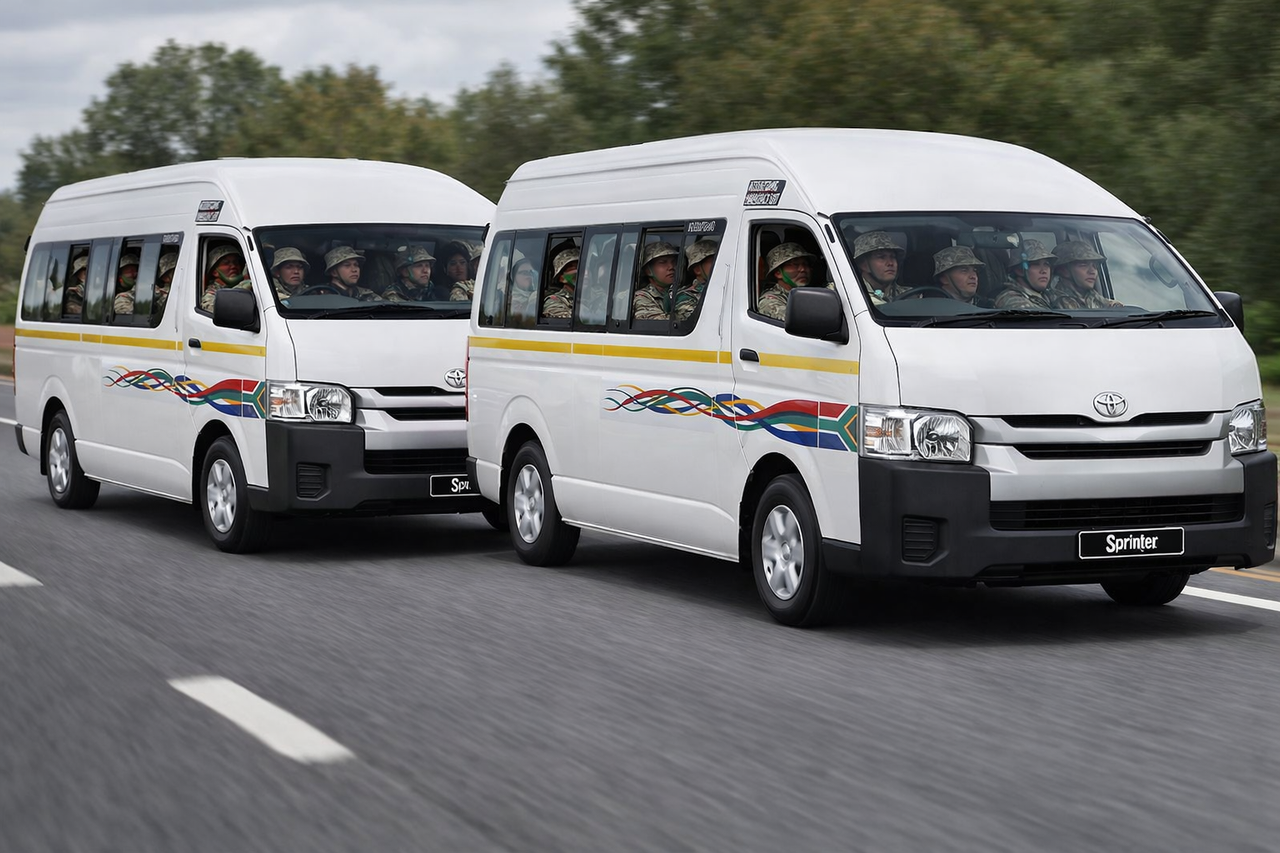
Operation Rank & File
Operation Rank & File: How the SANDF Went to War in Minibus Taxis
When the call to arms echoed through SANDF headquarters, the quartermasters reached instinctively for the usual options. Armoured personnel carriers. Logistics trucks. Airlift schedules. Then someone, probably a corporal who’d spent years commuting, cleared his throat and said the unthinkable.
“Why not taxis?”
Thus began Operation Rank & File, the first modern military campaign in which South Africa’s most battle-hardened transport system was formally inducted into national defence doctrine.
A Proven Platform
The South African minibus taxi is not merely a vehicle. It is a rolling philosophy. Built to survive potholes, peak-hour traffic, and passengers who want to be dropped “just here by the robot,” it arrives pre-tested for hostile environments.
Where conventional military transports require training, the taxi requires only a destination shouted vaguely in its direction. Its suspension laughs at terrain. Its doors are optional. Its speed is aspirational rather than regulated.
SANDF analysts quickly realised they were not adopting civilian transport. They were conscripting a veteran.
Advanced Driving Tactics
Traditional armies rely on manoeuvre warfare. The SANDF, enlightened by taxi logic, upgraded to something far more unpredictable.
Lane Multiplication Doctrine
Taxi drivers do not see lanes as fixed entities. They see potential. Three lanes become five. One lane becomes two if you believe hard enough. This fluid interpretation of road space allows rapid advances through choke points previously considered impassable by NATO standards.
Aggressive Right-of-Way Acquisition
Where other forces wait for clearance, the taxi simply takes it. Intersections are treated as negotiations rather than rules. Eye contact is avoided. Indicators are theoretical. The result is uninterrupted momentum and complete psychological dominance of enemy traffic.
Urban Ambush and Extraction
Taxis can stop anywhere, anytime, without warning. Troops deploy mid-traffic, behind enemy lines, or directly in front of confused motorists who are too stunned to react. Exfiltration follows the same principle, often before the enemy realises a battle has occurred.
Force Projection Through Vibes
Enemy intelligence struggled to track SANDF movements. Convoys of armoured vehicles show up on satellites. A swarm of white minibuses with peeling decals and gospel music does not.
Blending perfectly into civilian flow, taxi-based units move invisibly through cities and towns. Soldiers arrive relaxed, slightly annoyed, and already mentally prepared for chaos. Morale improves. Fear transfers entirely to the opposition.
Psychological warfare units report that hearing a hooter followed by shouted instructions in three languages has caused multiple enemy platoons to retreat pre-emptively.
Logistics, Simplified
Supply lines traditionally strain under pressure. Taxi logistics thrive on it.
Ammo crates share space with cooler boxes. Troop rations coexist with a suspiciously good kota. Fuel management is intuitive: when the gauge is low, you simply keep driving until a garage appears.
Most critically, every taxi comes with an operator who knows every shortcut, alley, and “secret road” not marked on any map. GPS is unnecessary. Asking for directions is replaced with absolute certainty, even when wrong.
Conclusion
In embracing the minibus taxi, the SANDF has not lowered itself to improvisation. It has elevated warfare to a uniquely South African art form.
This is not war by the book. This is war by experience. By instinct. By hooter.
And when history asks how the SANDF moved so fast, struck so unexpectedly, and arrived everywhere at once, the answer will be simple.
They caught a taxi.