Solo on a Broken Clarinet: The Story of Pavlo Tychyna
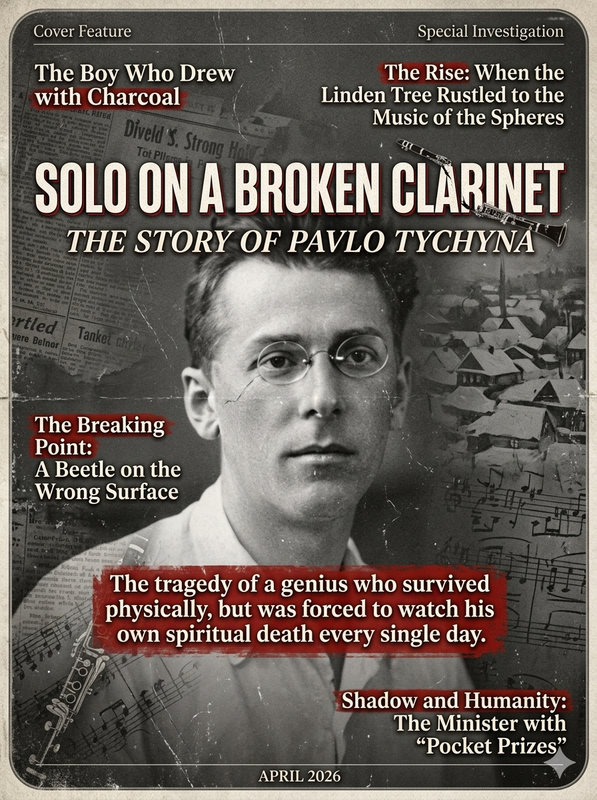
How could a man with perfect pitch — one who could hear the rhythm of the cosmos — become a megaphone for a totalitarian system? How could someone who knew forty languages and played six instruments suddenly begin playing out of tune in the horrifying choir of "builders of communism"?
The story of Pavlo Tychyna is neither a biography of success nor of betrayal. It is the tragedy of a genius who survived physically, but was forced to watch his own spiritual death every single day.
The Boy Who Drew with Charcoal
Picture a snow-covered village of Pisky in Chernihiv region at the end of the 19th century. In the poor family of a village church cantor, thirteen children are growing up. The seventh among them is Pavlo. The boy had such a pure descant voice and refined ear that his first teacher, Serafyma Morachevska, practically begged his father to send the boy to the bishop's choir in Chernihiv — it was the only chance for a poor child to receive a free education.
He was no star student at the bursa. The future academician earned top marks only in singing, drawing, and literature. From childhood, he was surrounded by the smell of incense and the grandeur of church chanting, but at home he drew with charcoal on the whitewashed walls.
His first "artistic masterpiece" ended with a scolding from his father, but a local priest, noticing the spark, gave the child colored pencils. That same boy would later teach his friend Hryhoriy Veryovka to read music, and grow into a virtuoso for whom clarinet, oboe, bandura, flute, sopilka, and piano became extensions of his own hands.
The Rise: When the Linden Tree Rustled to the Music of the Spheres
Young Tychyna entered Ukrainian literature not as a poet, but as a force of nature. His Soniachni Klarnety ("Clarinets of the Sun", 1918) was a landmark event that all of Europe discussed. He created his own style — klarnetyzm — in which a word not only carried meaning, but color, sound, and vibration.
His spiritual father was Mykhailo Kotsiubynsky, who read young Pavlo's poems aloud at his famous "literary Saturdays," marveling at how the young man felt nature. Tychyna corresponded with the world-renowned Norwegian Knut Hamsun and drew inspiration from the Indian sage Rabindranath Tagore.
In his verses "old groves sleep" and the music of the sun becomes the source of life. It seemed then that only light lay ahead. Even his poem "The Golden Resonance," which almost literally described the proclamation of Ukrainian autonomy, slipped through the censors' net — the officials simply lacked the intelligence to decode a genius's complex metaphors.
The Breaking Point: A Beetle on the Wrong Surface
The terrible year of 1933 cut the poet's life in two. While Ukraine was dying of the Holodomor, a correspondent from the newspaper Pravda came to the Kharkiv building "Slovo," where Tychyna lived. The system demanded an ode. Tychyna, who always let his work "age" before sending it to print, refused to write on demand. But under pressure, he recited what he himself called "a little ditty for Pioneer kids." The editor Bohovyi, hearing the lines of "The Party Leads," exclaimed with delight: "The title alone is worth everything!"
So a children's verse became an ideological manifesto, and Tychyna became the regime's "official bard." Vasyl Stus would later write that Tychyna was as much a victim of Stalinization as the executed Zerov or Kurbas — with one difference: their death was physical, while Tychyna was forced to live as a "spiritual corpse." In his diary, surrounded by glory and official titles, the poet compared himself to a beetle that had been moved against its will to a foreign surface.
He lived in constant fear of the black vans. They say he could sit in silence for hours, listening for footsteps outside his door, and the slightest rustle in his apartment would make him tremble. His brother Yevhen was arrested, and the poet who had become an academician and minister was powerless before this machine of terror.
Shadow and Humanity: The Minister with "Pocket Prizes"
Yet even in this grotesque role of "Soviet dignitary," Tychyna remained human. As Minister of Education, he personally secured the opening of a Taras Shevchenko Museum in the former Tereshchenko estate. His "fanatical love for all things Ukrainian" often bordered on risk — he championed the Ukrainian language in schools and ultimately resigned as Chairman of the Verkhovna Rada of the Ukrainian SSR rather than sign a decree allowing parents to opt out of teaching their children their native language.
A special atmosphere reigned in his apartment on Tereshchenkivska Street. His wife Lidiia Paparuk — his manager and guardian angel for 44 years — quietly slipped money into the coat pockets of poor students who came to visit. Tychyna himself called it "a prize from the minister." In reality, he was giving away his own royalties.
His refuge was his library — 21,000 books. He read up to seven at a time, making notes with his famous red-and-blue pencil. He could translate Wagner or Rimsky-Korsakov with the nuance of a native speaker. He could stand in for the night watchman at the ministry while she ran to get food for her children, bewildering officials with his complete lack of pretension.
The End: A Calvary of Fame
Pavlo Tychyna died on September 16, 1967, from complications of diabetes, which he ironically attributed to chronic stress: "If you keep a cat in a cage with a vicious dog nearby, the cat will get diabetes too." He was buried at Baikove Cemetery, accompanied by official speeches that he, in all likelihood, despised.
How should we understand Tychyna today? We should not judge him for "The Party Leads" without having lived a single day under total surveillance and execution lists.
Tychyna was a man who diluted "the dewdrop of his talent with a bucket of water" in order to preserve the very possibility of Ukrainian culture's survival.
His true legacy is not his ideological verses, but that same Golden Resonance and Clarinets of the Sun — works that contemporary musicians are rediscovering today, returning to the poet his real, untainted voice. Physical death only brought him closer to true life, where he finally ceased to be an "official poet" and became once again what he always was: a brilliant clarinettist of the Universe.