Strategic Resources, Production Bonuses, and Military Performance in War Era.
786
Rabi Al-thani 29, 1448
Introduction:
As the quest to explore the hidden value of strategic resources (SRs) progresses, it remains a mystery which SRs possess specific powers and influence particular game mechanics. Although it has been observed that Gold and Diamond play substantial roles in wealth accumulation and spending, the potential value and functions of other SRs remain to be explored. (1,2) Thus, considering military performance; which represents an interaction between economic capacity, production systems, and population; may be a reasonable next target. These differences may translate into variations in national combat output, particularly Weekly Damage. Furthermore, Damage by Citizens provides an additional measure of the contribution of citizens to overall military performance.
It is hypothesized that the role of SRs in shaping military outcomes may be substantial; however, their influence may vary according to population size and production capacity. In particular, nations with a 5% production bonus may differ from those without a production bonus, while Fanatic Agrarian nations represent a distinct 0% production profile despite possessing strategic resources. This study therefore compares Weekly Damage and Damage by Citizens across three groups: 0% production nations without SRs, Fanatic Agrarian nations with SRs, and 5% production nations with SRs. An exploratory assessment of individual strategic resources is then performed to further examine their potential association with military performance.
For material and methods (1)Conclusion:
Results:
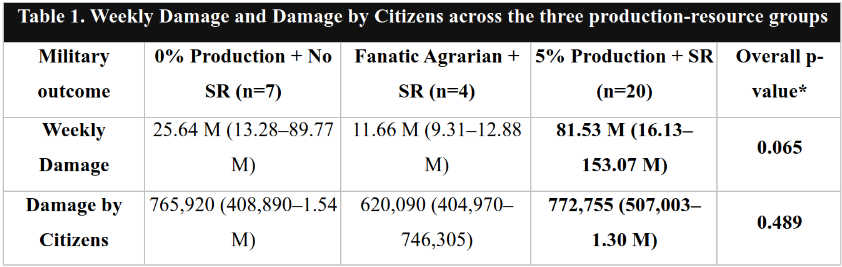
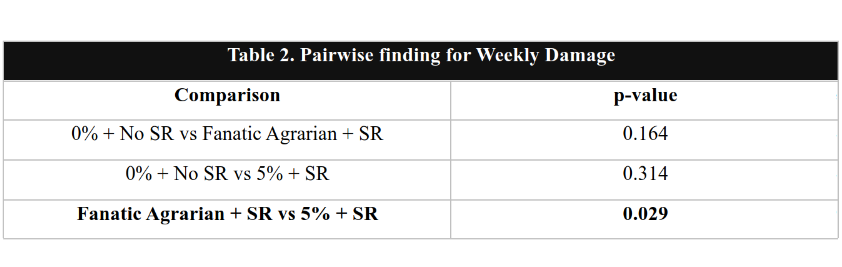
Among the three groups, the 5% production + SR nations demonstrated the highest median Weekly Damage at 81.53 million (IQR: 16.13–153.07 million), followed by the 0% production + no-SR group at 25.64 million (IQR: 13.28–89.77 million), while Fanatic Agrarian + SR nations had the lowest median at 11.66 million (IQR: 9.31–12.88 million). The overall difference in Weekly Damage approached statistical significance but did not reach the conventional threshold (Kruskal–Wallis p=0.065). (Table 1) Pairwise analysis demonstrated a significant difference between Fanatic Agrarian + SR and 5% production + SR nations (p=0.029). (Table 2) In contrast, Damage by Citizens was relatively similar across groups, with no statistically significant overall difference (p=0.489)
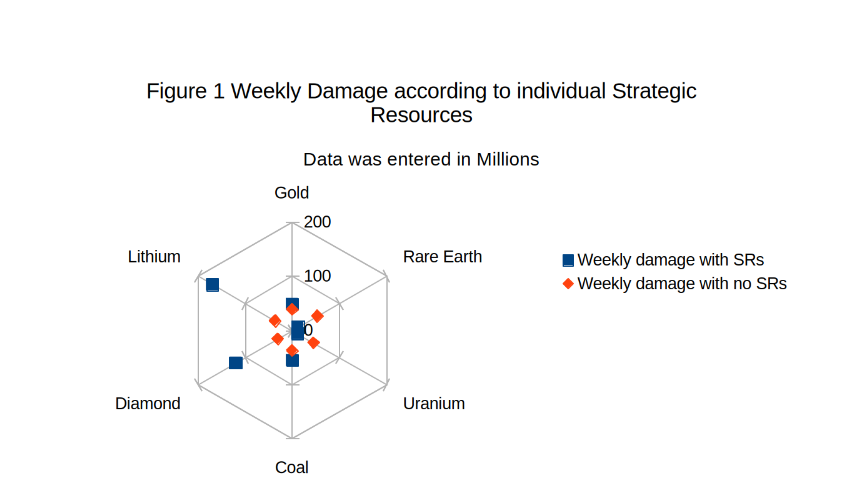
The most striking descriptive finding is Lithium. Nations possessing Lithium had a median Weekly Damage of 169.78 million (n=6) compared with 36.51 million (n=25) among nations without Lithium. However, this difference did not reach statistical significance (p=0.190). Diamond also showed a higher median Weekly Damage among nations possessing the resource (119.56 million vs. 31.08 million), but again the difference was not significant (p=0.285). (figure 1) Interestingly, Uranium showed the opposite pattern: nations with Uranium had a lower median Weekly Damage than those without it (11.32 vs. 45.13 million; p=0.635). For Damage by Citizens, none of the six strategic resources demonstrated a statistically significant association (all p > 0.05).
Discussion:
Nations possessing strategic resources generally showed higher Weekly Damage, although this pattern varied by resource. Lithium had the highest median Weekly Damage, but the association was not statistically significant. Its apparent military advantage may reflect greater conflict activity or resource-related production benefits, although players’ use of higher-production factory locations may reduce the practical influence of such resource-specific laws.
Diamond showed the second-highest Weekly Damage, potentially reflecting its economic advantages and greater military spending. (1,2) In contrast, Uranium and Rare Earth showed lower median Weekly Damage than their respective non-resource groups, suggesting that SR possession does not necessarily translate into greater military activity and that these resources may serve different economic, technological, or strategic functions.
Total Damage was excluded to avoid potential circularity, making Weekly Damage a more appropriate measure of current military activity. Population may also independently influence military output; therefore, SR–damage associations should not be interpreted as causal. These findings are exploratory, with Lithium and Diamond showing higher military activity, while Uranium and Rare Earth may have different roles requiring further study.
Conclusion:
Strategic resources may influence military performance, but their effects appear heterogeneous and dependent on production capacity and population. Lithium and Diamond showed higher median Weekly Damage, although no individual SR association was statistically significant. Future studies should examine population-adjusted military performance and the combined effects of SRs, production, and economic strength.Conclusion:
References:
Cadet602, Strategic Resources or Agrarian Flexibility? A Comparative Economic Analysis of War Era Nations Dated: Rabi al-Th, 28 1448 https://app.warera.io/article/6ac7e31b539027037c01ec17
Cadet602, Critical Review; Beyond the Production Bonus: Reconsidering the Economic Mechanics of War Era Dated: Rabi al-Th 28, 1448 https://app.warera.io/article/6ac813b413d6372b78646ee1