SUSTAINABLE WAR MODE - How do you stay in War Mode without taking a loss?
War Mode is when you reset your skills to prioritize combat skills over economic skills.
That boosts your damage in battle, but slows down your economic growth.
The idea of this guide is to show how to enter Sustainable War Mode without becoming a hostage to losses.
Basic concept: spend less than you earn
To be sustainable, the foundation is simple: spend less money than you make.
That may sound obvious, but if you do not follow this rule, sooner or later you will end up having to go back to an economic build.
It is always good to have an emergency reserve in case your expenses exceed your income for a while, but if you want to avoid nasty surprises, the ideal is to keep your income positive.
Sources of income in War Mode
1 — Economic skills
Work, entrepreneurship, and workers
Nothing fancy here. Unlike in economic mode, these income sources are going to be much lower. Work and entrepreneurship will generate at most around 10 BTC per day each. Workers depend a lot on salary, tax, and the product being made, but they are still a challenge to profit from.
Missions
Every week, through missions, you receive 100 BTC and 10 boxes.
If you sell the boxes, you can get around 130 to 135 BTC per week in total.
Companies
The number of companies you have will probably be one of your biggest income sources. Passively, they produce resources that can be sold on the market or even used by you.
A basic rule is to expect a gain of 3 BTC per day per company level.
So a level 5 company will generate around 15 BTC per day.
That is why it is very important to build a solid base of well-developed companies before venturing into Sustainable War Mode.
How many companies should you have?
There is no single answer here. But after testing the simulator quite a lot (more on that later), in the current state of the game, the ideal number to maximize damage in Sustainable War Mode is somewhere between 6 and 8 companies.
This varies because equipment costs on the market fluctuate. The more companies you have, the more points in economic skills will be needed to keep them active, and the fewer skill points will remain for combat skills.
Note: there are players who can sustain themselves without having that many active companies. They cover their military expenses with other sources of income. We will talk more about that later.
What level of automatic engine should you leave the companies at?
The higher, the better (you know the rest).
After testing level 5, level 6, and level 7 companies, the increase in damage is around 8 to 10% with each extra company level. Even though the higher levels are expensive, in the long run, upgrading the engine is worth it.
Boxes
As you attack — and you will attack a lot — eventually you will get some boxes.
For a more consistent gain, selling the boxes is safer. But if you want a bit of excitement, opening them can give you a bigger payout.
Note that there is a combat skill associated with this source of income. At high levels, this skill becomes very useful for a Sustainable War build.
Scrap
As your equipment and weapons are destroyed, you receive scrap.
The value of the scrap received is around 20% to 25% of the value of the equipment used. So an item you paid 50 BTC for will generate roughly 12 BTC worth of scrap.
Just like with boxes, selling is a way to get a more guaranteed value. But you can also craft equipment to use or sell.
It is not the purpose of this guide to decide what is best to do with your scrap, but I believe that depends on the value of scrap, steel, and equipment on the market.
Rewards
As battles happen, countries place bounties to encourage players to fight on their side.
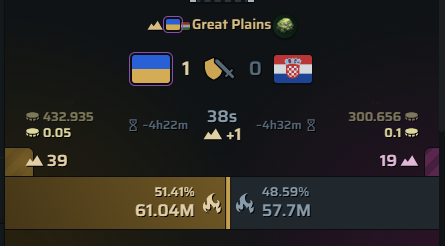
The top number next to the coin shows the amount of money the country has put into the reserve.
The bottom number shows how much the player who deals 1k damage will receive.
So the stronger your attacks, the more money you will receive as a reward. Note that each side of the battle can set a different value for each 1k damage.
These rewards allow players to use more expensive builds without taking a loss.

Lamine’s tip: be careful, because there is a cooldown right after the country puts money into that reserve. If you want the reward, wait for the cooldown to pass.
War spoils
While the battle is happening, rewards are distributed to the players who deal the most damage.
In each combat round, for every 200k damage caused by both sides, an elite box is opened and its item is added to the war spoils.
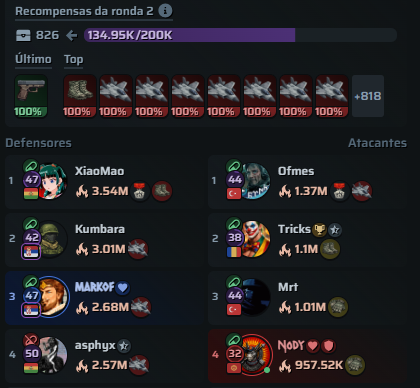
An icon next to the damage dealt by the player shows what your reward is. The more damage you deal, the more valuable the item you receive will be (at least that is how it should work, because I have seen some weird stuff).
Besides the round rewards, there are also rewards for the battle as a whole. The difference is that the ranking takes total combat damage into account, and a box is opened every 500k total damage.
At higher levels, these rewards are really worth it. In the example, notice the items that the players with the highest damage will receive.
Lamine’s tip: high-damage battles distribute good rewards without requiring a huge amount of damage. Even if you are in eco, it is possible to grab something nice to sell or use.
Mercenary contracts

When entering a battle, right at the top, you can notice the mercenary contracts (that paper icon with a little pen). Click to see the available contracts (highlighted in red).
In this arrangement, on one side we have the country demanding a certain amount of damage, and on the other, the Military Unit receiving more money for the damage dealt by fulfilling that contract.
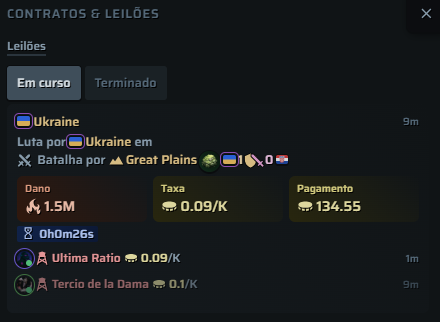
In the example, we have:
The damage expected by this contract is 1.5M.
Each 1k damage will receive 0.09 BTC.
And the total payment is 134.55 BTC.
The timer is the auction competition time for any Military Unit to apply to fulfill this contract.
Notice that, in this example, the Military Unit “Ultima Ratio” will get the contract, because it offered to deal 1.5M damage for 0.09/K, while “Tercio de la Dama” lost the auction because it asked for more money for the same amount of damage.
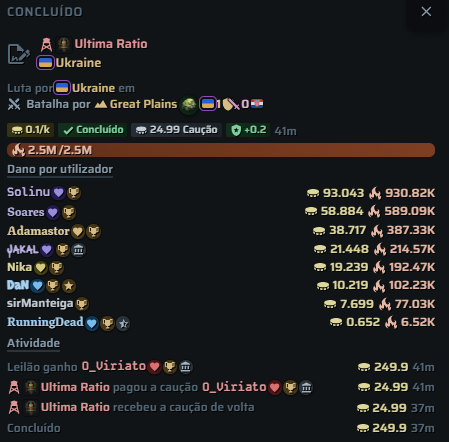
In this other example, we can see that after the contract is completed, the money is distributed according to the damage dealt by the players. The deposit amount is the guarantee that the Military Unit will fulfill the contract. If the MU fails, the deposit stays with the country that made the contract. If the MU completes it, the deposit is returned to the MU’s treasury.
Your best friend: the simulator
On the website https://intel.warera.wiki/builder it is possible to test builds and find the ideal build so you do not take a loss.
How do you use the simulator?
The simplest way to use it is to select your character using the button in the top-right corner, “IMPORT PLAYER.” That way, your parameters will be selected automatically.
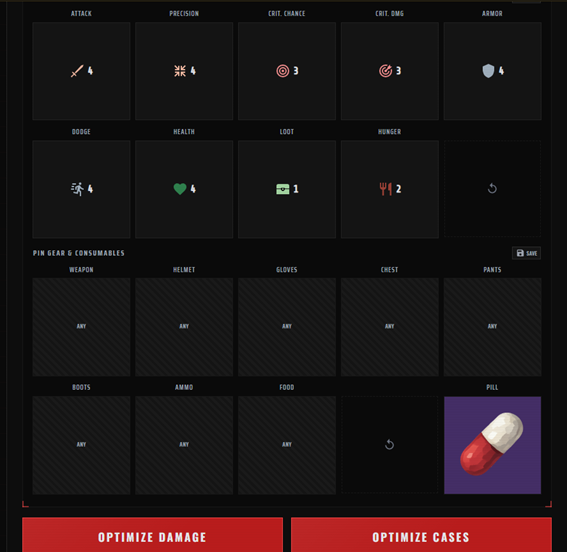
Once selected, you can reset your combat skills so the simulator tests the best combination for you. Just click the icon with the semicircle and arrow.
You can also choose whether or not to use a specific weapon or piece of equipment. Since it is a simulator, you can mess around and test all kinds of combinations (I bet you have already wondered how much damage you would do if you were using a jet). Otherwise, you can leave all options marked as “ANY” and the simulator will test several combinations for you.
Click the “OPTIMIZE DAMAGE” button and let the simulator do its magic.
After loading, it will show several item options and the estimated daily damage. Let us look at a few examples just to understand it better.
First example
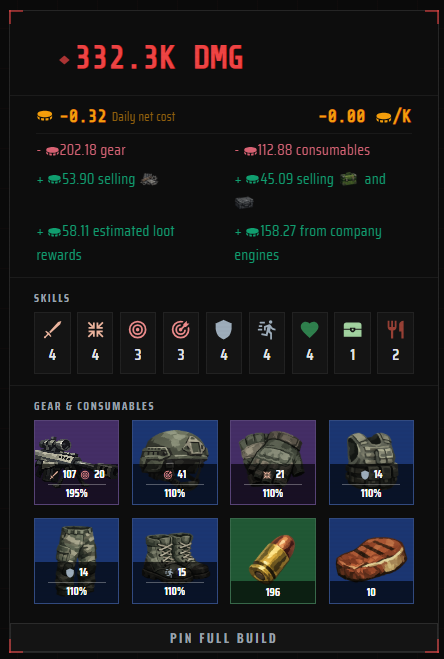
In this first case, this build is sustainable. Notice that, in yellow, the daily cost is negative, meaning you will spend less than you earn.
In red, it shows how much you will approximately spend on equipment and consumables, and in green, your sources of income. For each item, besides the tier, the simulator chooses a stat value for each piece.
The consumables show the amount of each item that will be used throughout the day. And the items show the expected wear percentage over the course of battles. If the value is above 100%, it means more than one item will be consumed during the day.
Why does the weapon consume more than the other equipment? Every time you attack, the weapon loses 1% durability. Equipment does not lose durability if you dodge in combat.
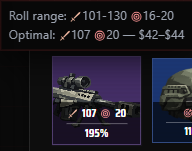
Lamine’s tip: you can also see the cost the simulator used to buy that item. Sometimes it is possible to find good market opportunities and buy better items with the same budget.
Second example
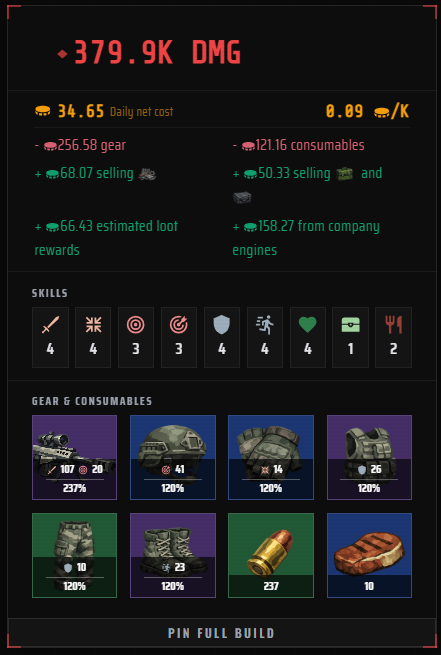
Unlike the first build, here the damage increased, but so did the cost.
In this case, there is a daily cost of approximately 34 BTC and a cost of 0.09 BTC/K.
This second value is very important, because if you can get a combat reward or mercenary contract that pays that amount, this build is also sustainable.
In other words, it is possible to use better equipment, deal more damage, and still not take a loss.
Third example
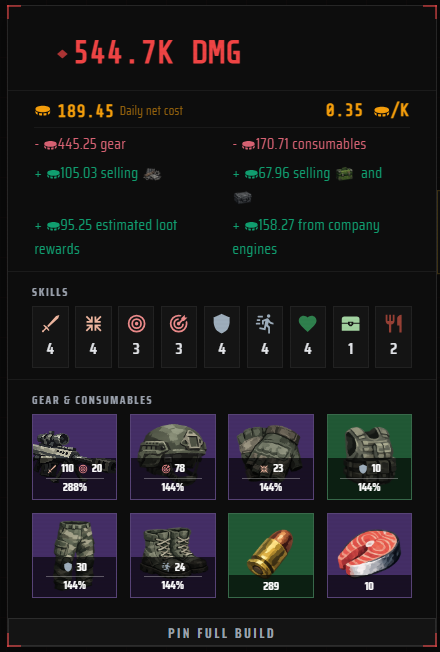
Here it becomes harder to be sustainable, because it requires a reward of 0.35 BTC/K to stay afloat.
It is not impossible, but it is much harder to get. For Sustainable War Mode, this kind of build is not recommended.
An important factor to keep in mind
With more skill points and a higher rank, your damage will naturally be higher.
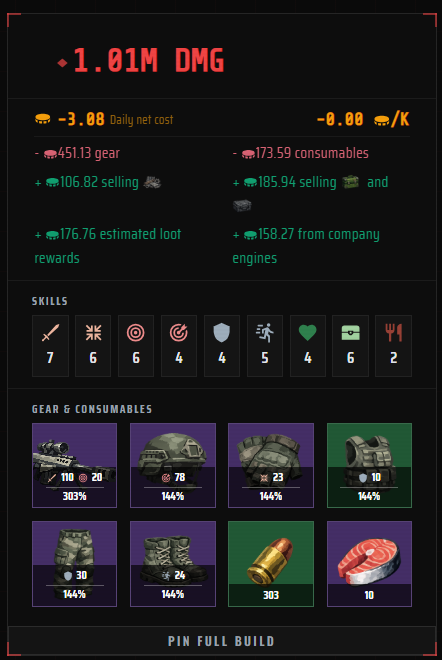
For comparison, a level 40 character, with a 25% rank bonus, can, using the same equipment as in the third example, deal much more damage and still remain sustainable.
Notice that loot chance and combat rewards are what keep this build afloat. Higher-level characters can even give up factories and stay in Sustainable War Mode with just that. It is a bit riskier, but still a very viable strategy. Since I do not have much experience being high level, I will leave that for an advanced guide.
Conclusion
Be patient and strengthen your economy in the beginning.
Over time, you will increase your rank, level up, and deal more damage. Then you will be able to get better combat rewards and become more relevant to your country and your allies.
Sustainable War Mode is not about charging headfirst into everything. It is about hitting hard, spending smart, and staying financially alive after the war.