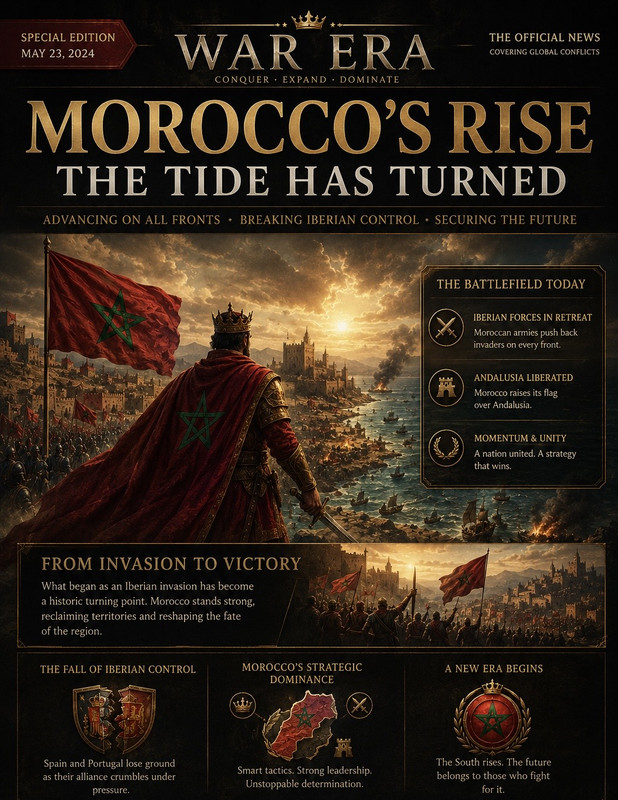
The Collapse of Iberian Hegemony
From the occupation of Morocco and Africa to the unraveling of Andalusia under the Moroccan offensive
In the first weeks following the outbreak of the conflict, the picture seemed unmistakably clear: a solid Iberian alliance striking forcefully southward, extending its reach across the strait deep into Morocco while expanding its control over vast areas of the African continent. But war, as history has always taught us, is never decided by early advances alone.
Spanish and Portuguese players entered the conflict with remarkable military momentum, taking advantage of their international alliances and logistical networks to impose a tightly controlled battlefield reality over the occupied Moroccan territories. At that stage, the balance of control on the map appeared decisively tilted in favor of the Iberian bloc — and observers believed victory was merely a matter of time.
Yet this rapid expansion carried within it the seeds of its own crisis. The deeper the Iberian forces advanced, the more stretched their supply lines became and the more their resources were drained, while rear fronts quietly took shape, waiting for the right moment to alter the rules of engagement.
Phase Two — The Moroccan Reversal
The Moroccan response came with an entirely different strategy. It was neither impulsive nor reactionary — rather, it was the result of a systematic rebuilding of positioning and offensive capability. The liberation of occupied territories unfolded in stages, each casting heavy shadows over Iberian morale and shaking the confidence of their allies in the alliance’s ability to endure.
What began as limited tactical strikes gradually evolved into a full-scale counteroffensive, reclaiming one region after another through a disciplined rhythm that combined battlefield pressure with psychological exhaustion before breaking the enemy militarily.
Andalusia Under the Crescent
“What is built through rapid military expansion remains fragile when nations choose resistance.”
Today, the battlefield situation has been completely reversed. Andalusia — long considered a strategic Spanish stronghold — now lies under Moroccan control in one of the most dramatic turning points since the conflict began. Moroccan advances have not stopped there, as pressure continues toward Portuguese territory, opening internal fronts Portugal had not faced since the beginning of the war.
Defeat Despite Allies
What makes this Iberian setback particularly extraordinary is that it occurred despite the external support Spain and Portugal received from their allies. That support, which was expected to tip the balance of the conflict, failed to provide the intended protection. A powerful ally may amplify your strength — but it cannot repair flaws in your strategy of war.
Analysts see in this pattern something resembling a recurring law throughout the history of conflicts: any power that expands too rapidly without securing what lies behind it inevitably creates vulnerabilities that its enemy can transform into opportunities. This is precisely what the Moroccan side exploited with remarkable tactical skill, turning every previous Iberian expansion into a weakness rather than a strength.
What Awaits the Frontline?
Spain and Portugal now find themselves facing difficult choices: retreat and reorganize at the cost of devastating morale, or continue fighting under mounting pressure that tests the endurance of the Iberian alliance in its most difficult moment yet.
What once appeared to be a desperate defensive struggle has now transformed into a project of regional dominance whose outlines are becoming increasingly visible across the battlefield map. And as Iberian flags retreat from one front after another, one decisive question remains suspended in the air:
Can the Iberian alliance still reverse the balance once again? Or has the era of supremacy shifted to the other side of the strait?
The war is not over — but the wind is now blowing from the south. 🇲🇦