The dutch that the nordics love
On May 3rd, 2026, the Dutch occupation of Sweden and Norway carried on under a sky that couldn’t quite decide if it wanted to rain or just sulk. Low clouds hung heavy, the air damp and cold, with a persistent drizzle that blurred sightlines and patience alike. Equipment faltered, radios crackled, and clarity was in short supply.
https://app.warera.io/user/69553bdbbead69ddcf1381cd, already soaked and running on instinct more than certainty, caught fragments of a warning through the static—something about an enemy convoy disguised as friendly units. The message dissolved before it became useful.
Then shapes appeared in the mist. Headlights. Engines. Movement.
He made the call.
“Fire.”
It was quick, decisive—and catastrophically wrong.
The convoy was Dutch. Supplies, vehicles, and a large number of soldiers were destroyed before anyone could correct the mistake. For a brief moment, the drizzle and silence settled together, as if the landscape itself was unsure how to react.
Then the consequences arrived all at once.
Without those supplies, Dutch forces across Sweden and Norway began to falter almost immediately. Units stalled, coordination broke down, and resistance groups—long waiting for a fracture—moved with precision. Within days, the occupation began to collapse. Within weeks, it was over.
https://app.warera.io/user/69553bdbbead69ddcf1381cd was detained, expecting a harsh and very final judgment. Instead, as the strategic reality set in, his actions became something far more complicated than a simple error. They were studied, discussed, and—quietly—reframed.
Months later, in Stockholm, a joint Swedish-Norwegian ceremony was arranged. It was not celebratory. There were no crowds, no music—just officials, observers, and a carefully chosen set of words.
The formal appraisal was delivered with deliberate precision.
A Swedish representative described the incident as “a singular disruption of operational continuity,” noting that while resistance efforts had long aimed to weaken the occupation, they had lacked the means to induce systemic collapse. https://app.warera.io/user/69553bdbbead69ddcf1381cd’s actions, though unintended, had “accelerated structural failure beyond any projected scenario.”
A Norwegian official followed, less technical but no less measured. He acknowledged “the paradox of consequence without intent,” emphasizing that the outcome—restoration of sovereignty—could not be separated from the scale of the act that enabled it. “History,” he noted, “does not always distinguish between the deliberate and the decisive.”
There was, notably, no attempt to call it heroism.
Instead, the joint statement framed https://app.warera.io/user/69553bdbbead69ddcf1381cd as a “catalyst”—an uncomfortable but undeniable force that shifted the balance irreversibly. The language avoided praise, but it also avoided condemnation. It sat carefully in between, where nuance lives and certainty doesn’t.
When the medal was presented, it came with a final line:
“For actions that, regardless of origin, contributed materially to the reestablishment of national autonomy.”
https://app.warera.io/user/69553bdbbead69ddcf1381cd accepted it without ceremony. No speech, no visible reaction—just a nod, as if acknowledging something that didn’t quite belong to him.
In the end, the appraisal didn’t try to resolve the contradiction. It preserved it.
Because everyone present understood the same thing:
sometimes history moves forward not through brilliance or intention—
but through one very confident mistake, made in very bad weather.
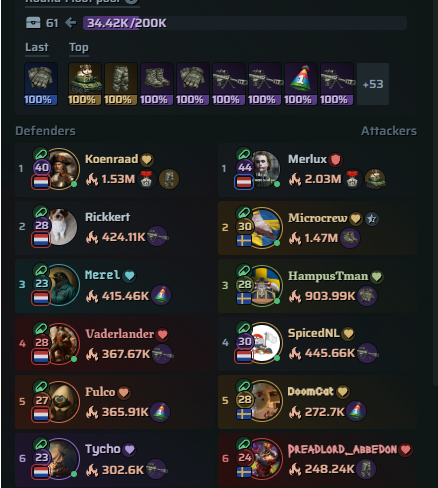
We thank you for your service https://app.warera.io/user/69553bdbbead69ddcf1381cd.