The Elusive Johnny Sins Part II — Gold Destroys Regions. Data Destroys Narratives.
This one should have stopped at the mercenary questions.
We had discussed Only Mercs.
Contracts. Gold. Friendship.
The increasingly difficult life of the neutral mercenary.
This was enough for one interview.
Then this one made the mistake of asking Johnny Sins why he spends so much time analysing WarEra.
Johnny smiled. A spreadsheet appeared.
Then another. Graphs followed. API data.
Entire countries. This one looked toward the door.
Too late.
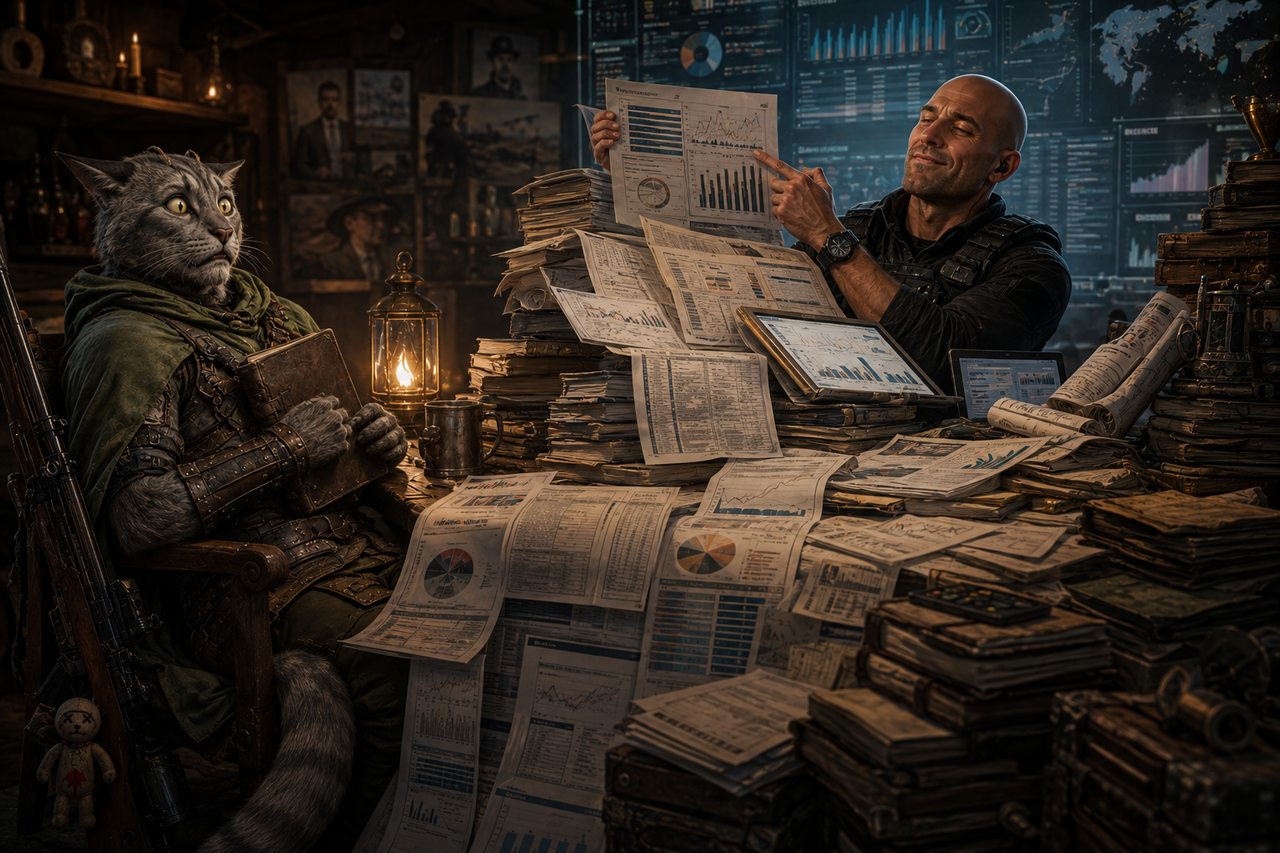
“The API Can Embarrass Him, Me, or Preferably Both of Us”
Binya: This one has noticed a pattern, Johnny. Whenever someone makes a confident claim about WarEra, you seem to disappear for several hours and return carrying numbers. Where did this obsession begin?
Johnny's explanation was considerably simpler than expected.
Johnny: “I work as a data engineer in real life, so when somebody makes a very confident political claim, my first instinct is to check whether the API can embarrass him, me or preferably both of us.”
“WarEra has plenty of opinions and very few denominators. The articles began because I wanted arguments that could be audited instead of screenshots that could be cropped.”
This one considered this. There are certainly plenty of screenshots in WarEra.
Somehow they always seem to contain precisely the portion of reality required by whoever posted them.
Johnny preferred something other people could check. Which raised another question.
What happens when they check... and Johnny is wrong?
Johnny Goes Looking for the Villain
Binya: Have you ever begun one of these investigations already believing you knew what the numbers would show?
Yes. And this one suspects Johnny regretted continuing to collect data.
Johnny: “I believed that only one side relied heavily on multis, boosted accounts and huge donations to state treasuries.”
“Once I looked beyond my own political bubble, the same patterns appeared almost everywhere.”
“I went looking for the villain and discovered an industry standard.”
This one laughed. Johnny was not finished.
“Apparently only evil can defeat evil, because nobody seems willing to uninstall it.”
That answer perhaps tells us more about Johnny's articles than any graph could.
It is easy to investigate your enemies. It is considerably less comfortable when the same methodology starts producing inconvenient answers about everyone else.
So this one asked him directly.
“I Hesitate About the Mathematics”
Binya: Some of your articles deal with subjects that people become rather... enthusiastic about. Do you ever hesitate before pressing publish because you know the result is going to upset someone?
Johnny: “I hesitate about the mathematics, not about whether somebody will be upset.”
That sounded suspiciously confident. Then Johnny immediately gave an example of getting the mathematics wrong.
“The prestige article was audited by the comment section almost immediately. They found mistakes, I reran everything and published the corrections.”
“Being corrected publicly is cheaper than protecting a wrong conclusion forever.”
This one rather likes this philosophy.
WarEra has an extraordinary ability to transform:
"I was wrong."
into:
"You have misunderstood the complicated strategic brilliance of what I originally meant."
Johnny's solution is considerably less exciting.
Rerun it. Fix it.
Publish the correction. Move on.
But there was another question this one wanted to ask.
After analysing so many different WarEra statistics...
Which number does Johnny trust the least?
His answer caused this one immediate personal distress.
“One Billion Damage Can Mean You Saved the Battle...”
Binya: What is the most dangerous WarEra statistic to look at without context?
Johnny: “Raw damage.”
“One billion damage can mean you saved the battle, farmed a dead round or set fire to a treasury with excellent graphics.”
This one slowly lowered the journal.
There may currently be a Warrior Binya article containing several excellent graphics about 13,030,016 damage.
Johnny continued, completely unaware that he was attacking this one's newest literary project.
“Without cost, bonuses, timing and battle importance, damage measures how much was fired, not how much value was created.”
This one stared at the page.
Thirteen million still sounds impressive, yes?
Fortunately, this one's journal records where the bullets went.
Mostly.
There are still several hundred points of damage we would rather not discuss.
Johnny believes cost per damage may become one of his next investigations.
This one wishes the treasurers of WarEra good luck.
Then Johnny Followed the Money
Raw damage was only one rabbit hole.
Eventually Johnny began following gold.
Treasury movements. Bounties. Mercenary payments.
Who funded whom. How much they paid.
And whether the public story surrounding a war matched what could actually be reconstructed from the transactions.
This seemed like an excellent way to make friends.
Johnny's previous work on the economics of war even placed his own Only Mercs under examination rather than conveniently excluding his own organisation from the data.
But another investigation raised a much more difficult question.
What happens to gold donated by players who are later banned?
Johnny reconstructed banned-player donations and searched the public records for administrator reversals.
Sometimes he found them. Sometimes he did not.
His analysis identified 338,600 gold from banned donors spread across 282 vaults where he could not identify a corresponding administrator debit in the available records.
The important part, however, was what Johnny didn't claim.
The data could not prove that every recipient knowingly kept illegitimate funds.
It could not reveal administrative actions that never appeared in the records he could access.
It could show only what was publicly visible.
So this one asked him what he believed the real problem was.
“An Unwritten Rule Becomes Whatever the Last Administrator Said”
Binya: Is transparency one of WarEra's biggest problems?
Johnny: “Yes. The treasury clawbacks were a good example.”
“In some cases we could identify a corresponding debit after a banned player's donation; in many others we could not identify one or a consistent written rule explaining what should happen.”
And then came the important part:
“A bad written rule can at least be challenged.”
“An unwritten rule becomes whatever the last administrator said in a private message.”
This one stopped writing for a moment.
That applies to considerably more than treasury gold.
If a rule is visible, players can dislike it.
They can argue about it.
They can ask for it to be changed.
They can compare two decisions against the same rule.
But when nobody knows exactly what the rule is...
Every decision becomes another argument about what someone was privately told.
For Johnny, transparency is therefore not simply about whether the administrators made the correct decision.
It is whether everyone can determine what the correct decision was supposed to be.
Johnny Discovers a Strange Way to Get Rich in a War Game
Eventually this one returned to fighting.
After all, Johnny owns a mercenary Military Unit.
Surely if anyone knows whether WarEra rewards warfare properly...
It should be the man sending invoices for it.
Binya: Does WarEra actually reward fighting properly?
Johnny: “Not really.”
Straight to the point.
“In the medal cohort I analysed, labor badges paid 389,314 medal gold while war badges paid 139,258.”
“Factories paid almost three times as much as combat badges in a game largely marketed around war.”
The underlying investigation itself was careful about the conclusion: a reward system can be working exactly according to its intended design while still producing incentives worth questioning.
But Johnny believes the July changes added another layer.
“The July patch made the message worse: the game rewards fighting for the correct political structure more than fighting well.”
“It rewards obedience better than mercenary skill.”
This one could see why that bothers him. Johnny's preferred role exists specifically between the large political structures.
Only Mercs wants to decide where it fights. Who it helps. Which contracts it accepts.
Which friendships are worth more than the gold offered to break them.
Yet Johnny believes the mechanics increasingly reward fighters for choosing a political home and remaining inside it.
And that brought this one back to something Johnny had said during Part I.
The July patch was the result that surprised him most.
“I Did Not Expect the Game to Balance an Entire Playstyle Out of Existence”
Binya: Of everything you have investigated, what result genuinely surprised you?
Not the strange treasury transactions.
Not moderation.
Not the article economy.
Not even some wonderfully questionable spending decision hidden in the depths of WarEra.
Johnny: “The effect of the July patch on mercenaries.”
“Our practical fighting reach fell from around 120 percent bonus to barely 60 percent unless we behave like permanent soldiers of one bloc.”
“I expected balancing.”
“I did not expect the game to balance an entire playstyle out of existence.”
That is a much stronger criticism than merely saying Only Mercs does less damage now.
Johnny believes a way of playing WarEra is disappearing.
Neutral fighters.
Independent mercenary organisations.
Groups occupying the space between the blocs rather than permanently belonging to one.
And this one began to realise why Johnny keeps producing these articles.
He is not simply interested in which number is biggest.
He wants to know what behaviour the numbers encourage.
The Man Who Analyses His Own Invoice
This one looked again at the mercenary sitting opposite.
The two versions of Johnny suddenly seemed considerably less separate.
The mercenary says:
We promise only damage we can deliver.
The analyst says:
Make claims someone else can audit.
The mercenary calculates equipment before quoting the job.
The analyst wants damage measured alongside cost, bonuses, timing and importance.
The mercenary values his word.
The analyst publishes corrections when his numbers fail.
Perhaps Johnny had already explained himself perfectly at the beginning.
“I fight, sell the damage, analyse the invoice and then write an article explaining why everyone understood the numbers incorrectly.”
This one had originally thought he was joking.
Khajiit was beginning to suspect this was simply Johnny's workflow.
Which Is More Dangerous?
At this point this one decided the interview had become far too serious.
So Khajiit asked a sensible question.
Binya: Which is more dangerous: an enemy with unlimited gold, or Johnny with unrestricted API access?
Johnny: “Johnny with unrestricted API access.”
Naturally.
“Unlimited gold can win a battle.”
“The API can reveal who paid for it, how badly they overpaid, who benefited and why the official victory article needs a correction.”
Then Johnny smiled.
“Gold destroys regions.”
“Data destroys narratives.”
This one looked toward the door again.
Perhaps it was time to leave before Johnny decided to investigate South Africa.
Or this one. Especially this one.
Then This One Saw a Different Graph
But among Johnny's articles was one investigation this one could not simply laugh away.
This time he had not followed bullets.
Or gold. Or politicians.
He followed the players.
Johnny had heard the same complaint everyone in WarEra has heard:
There are no new players. Our country is getting old.
When the veterans leave, everything dies.
So Johnny decided to count them.
All of them.
His population investigation walked the citizen lists across 180 countries and produced 18,323 living, non-banned players in the snapshot he analysed.
And then he discovered something strange.
WarEra actually receives enormous numbers of newcomers.
His measurable 27–31 July cohorts contained 10,790 new accounts.
The problem was not that people weren't arriving.
The problem was that only 1,084 of those accounts were still playing when Johnny measured them.
Roughly 10 percent.
Even more concerning, the survival rate wasn't clearly declining between his nine-day-old and thirteen-day-old cohorts.
Johnny concluded that much of the bleeding had already happened before day nine.
This one looked at Johnny.
No jokes this time.
Binya: Why?
And Johnny had an answer.
Not something the dataset itself could prove.
But something he believed the numbers, combined with his experience of WarEra, were pointing toward.
Johnny: “Because they have no meaningful role.”
“The players who remain usually have at least one of two things. They have a strong national attachment and want to prove something for their country, even when it hurts their account.”
“Or they are high-level veterans, the ‘ancients,’ who hold political power or regularly appear among the top damage dealers.”
And the newcomers?
“New players have neither status nor influence.”
Then Johnny said something that changed the tone of the entire conversation.
“They do not leave because they cannot find the Work button.”
“They leave because the world barely notices whether they pressed it.”
This one stopped writing.
Because suddenly...
The next article was obvious.
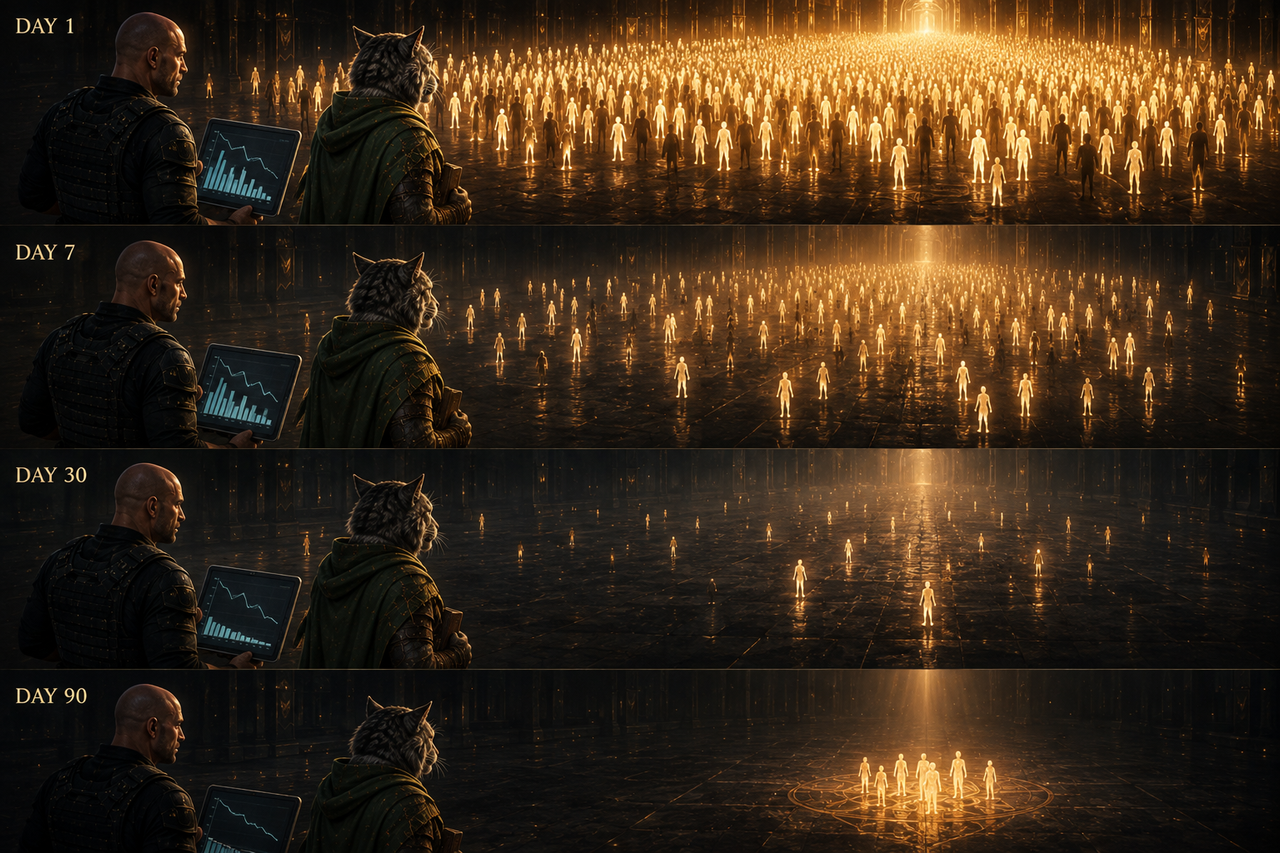
Next: Part III — If Nobody Knows Your Name by Day Nine
Johnny's data shows the disappearance.
But why are they leaving?
Can governments and Military Units solve it?
Or is Johnny right that communities are being asked to repair something only the developers can truly fix?
What would he change about the first nine days?
What are the three problems he most wants WarEra's developers to confront?
And after counting the players, following the gold and watching an entire playstyle squeezed between the blocs...
Does Johnny Sins still believe in WarEra's future?
This one promises Part III will eventually become less depressing.
There is still the matter of paying Only Mercs in moon sugar.
Johnny will calculate precisely how much damage this one must deal before everyone forgets about 528 points of friendly fire.
Someone will become a veterinarian.
And this one will discover what happens when Johnny Sins receives 10,000 gold and absolutely no instructions.
But first...
We should probably talk about those missing players.
May your roads lead to warm sands. 🐾