The Fisherman
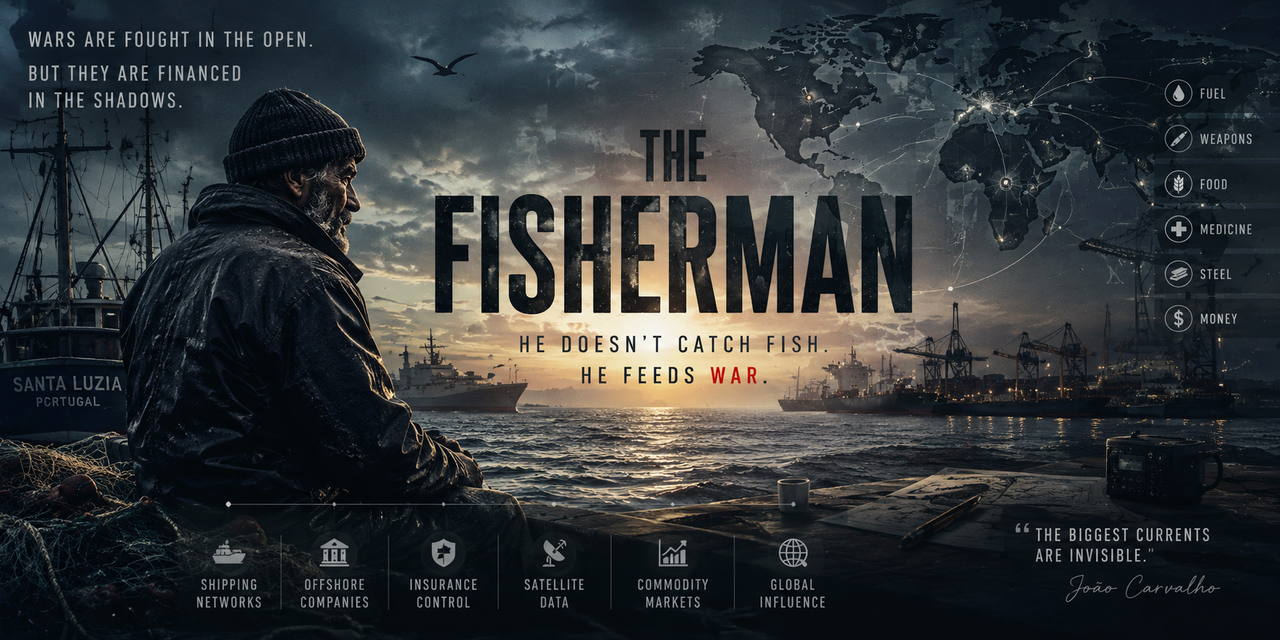
The Fisherman
At dawn, João Carvalho looked exactly like every other fisherman in the tiny Atlantic village.
He wore weathered boots.
His hands were scarred by rope burns.
His boat, Santa Luzia, was older than he was.
Every morning at five, he sailed into the gray sea with a thermos of coffee and a radio that barely worked.
Everyone believed he sold tuna.
Everyone was wrong.
João's true catch was information.
For forty years he had built an invisible empire—not with weapons, but with cargo contracts, insurance firms, satellite communications, shipping companies, and commodity investments.
He understood something generals rarely did.
Wars were fought by soldiers.
But they survived on fuel, food, steel, medicine, spare parts, and money.
While governments argued in public, anonymous corporations quietly bought ports, warehouses, and shipping fleets around the globe.
Many of those corporations ultimately answered to a single office hidden beneath an abandoned fish cannery overlooking the ocean.
That office belonged to João.
No politician had ever met him.
No intelligence agency had his photograph.
Tax records described him as an aging fisherman whose annual income barely covered his diesel.
The illusion was perfect.
Every profitable company was owned by another company.
Every shareholder represented another trust.
Every trust led to another country.
At the center sat João, repairing fishing nets between phone calls.
When conflicts erupted in distant lands, markets reacted immediately.
Fuel prices jumped.
Insurance premiums surged.
Shipping routes shifted.
Most investors panicked.
João had predicted it years earlier.
His companies earned fortunes by adapting faster than everyone else.
The profits disappeared into an intricate web of foundations and investment funds that quietly acquired more businesses.
The cycle continued.
The fisherman never needed to fire a shot.
He merely understood how the tides of economics followed the tides of conflict.
One evening, a young journalist arrived at the harbor chasing a rumor.
She expected a criminal mastermind.
Instead, she found an old man mending nets beside a faded blue boat.
"People say someone controls half the shipping routes in this region," she said.
João smiled without looking up.
"People tell strange stories when they're afraid."
She laughed.
"So it's just a myth?"
He tied another knot.
"The sea teaches one lesson."
"What lesson?"
"The biggest currents are invisible."
Years later, after João's death, investigators finally unraveled a fraction of his business empire.
It stretched across continents.
Its records filled entire warehouses.
Yet every document pointed to legal businesses and ordinary commercial decisions.
There was no dramatic throne room.
No hidden vault of gold.
Only decades of patient planning by a man who had understood that history was often shaped not by those who stood in the spotlight, but by those who quietly watched the horizon from a small fishing boat.
Long after his passing, villagers still remembered João as the quiet fisherman who always returned before sunset.
No one could say how much of the legend was true.
But whenever ships crossed the Atlantic in uncertain times, sailors still repeated an old saying:
"Never underestimate the man who knows the sea better than the storm."