The Illusion of Borders in WarEra: A Critical Analysis on the Absence of a Real Logistics System
Introduction: The Map Without Geography
In the theory of geopolitical and military simulators, space is not merely an aesthetic canvas; it is the fundamental variable that determines the viability of strategy. Distance, historically, acts as a natural regulator of power: it imposes transportation costs, limits force projection, and protects local economies through inherent geographic barriers.
However, the current architectural framework of WarEra suffers from a systemic contradiction: it possesses a detailed map of national divisions, yet completely lacks the physics of space. By removing logistical friction, the simulator reduces geopolitics to an abstract board of pure numerical aggregation, where territory loses its strategic meaning and borders become mere purely visual cosmetics.
1. The Deterritorialization of Labor and the Disintegration of the Regional Economy
The first pillar affected by this absence of friction is the productive apparatus. In a healthy macroeconomic model, labor is subject to geographic mobility; workers consume and produce within their immediate environment, allowing the development of internal fiscal policies and protected regional markets.
In WarEra's design, the labor market operates under absolute and globalized liquidity. A citizen located in Venezuelan territory can sell their daily energy quota to an industrial infrastructure in Poland or Latvia instantaneously, interacting exclusively through a menu interface without requiring physical displacement or tariff penalties.
This hyper-globalization generates a profound distortion due to the mechanics of production bonuses. These incentives —random by territory and temporary in nature (except for the country's fixed specialization)— are the engine of business profitability. Here lies the great advantage of the powers: countries with larger territorial extension have a mathematically superior probability of hosting these bonuses within their borders.
Possessing a high bonus gives the governments of these megacoalitions the economic backing to impose high tax rates in key sectors. Local employers in such powers can absorb the cost of inflating gross wages to guarantee the Universal Net Floor because the efficiency of their production compensates for the tax burden.
The true problem is suffered by small or peripheral nations. Lacking large land extensions, they are marginalized from the lottery of temporary bonuses. Without that productive advantage, they become incapable of competing in the globalized labor market: if they raise taxes to finance the State, their businesses go bankrupt; if they lower them, their workforce simply "digitally emigrates with a click" towards the bonus-backed factories of the powers.
Added to this geographic asymmetry is a structural flaw in the simulator's fiscal design: the non-existence of a corporate income tax. The system does not tax the net profits of corporations, but only the wages of human employees. This allows the server's economic elite to use automation as an absolute tax haven. The richest players, by equipping their industries with high-level engines, completely eliminate the need to hire human labor. By having no employees on payroll, their companies operate with a real tax rate of 0%, accumulating clean, tariff-free margins.
A paradigmatic example of this dynamic is found in the profile of Minecraft, currently positioned as the Top 6 global wealth in WarEra:
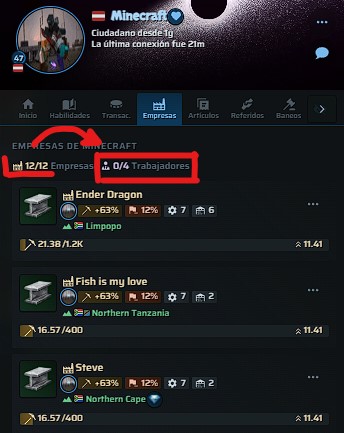
Industrial Concentration: Twelve active companies under a single patrimony exploiting massive +63% production bonuses, taking advantage of the territorial advantage of the regions where the branches are located.
Automation and Unemployment: Zero workers on payroll thanks to infrastructure maximized to the limit with engines at their top level (Level 7).
Mechanical Tax Evasion: An effective tax rate of 0% on its real productive capacity, completely evading the nominal 12% tax burden shown by the interface.
The result is an unsustainable gap: while the technological elite operates free of tariffs, the medium industries and independent workers who still depend on human labor bear the entire financial weight of the State. And this is not an isolated case; the vast majority of the Top 100 wealth operates under the exact same model, consolidating a cycle where territorial and technological centralization dictates who survives.
2. Superficial Citizenship as a Mechanism of Fiscal Arbitrage
Naturalization and national identity should constitute high strategic impact decisions within the simulation. However, the political migration process in the current environment lacks structural gravity. Changing nationality has been degraded to a low-cost transaction.
The system entrusts migration control exclusively to the discretionary approval of the receiving government. If the applicant manages to evade the elementary suspicions of espionage or if the current administration simply needs to increase its demographic indicators, the request is approved. The player receives a new flag next to their name without facing real migration costs, waiting periods, or loss of roots.
By stripping citizenship of severe entry barriers, the game incentivizes regulatory opportunism. Nationality ceases to be a political or territorial security commitment to become a transient cosmetic used to optimize temporary production bonuses or evade the fiscal asphyxiation of the region of origin.
3. Military Teleportation and the Destruction of Asymmetric Warfare
The most severe impact of this space-time compression occurs in the military operations theater. Historically, force projection is limited by the supply chain and logistical lines. A power cannot intervene militarily on the other side of the planet without a massive macroeconomic cost and prolonged deployment time.
In the current conflict architecture, military logistics have been replaced by a mechanism of mass damage teleportation. The same combatant can start the day participating on a front in Russia, contribute damage in a battle in Spain, and close their activity in Germany without experiencing distance penalties, relocation costs, or degradation of combat effectiveness.
An empirical breakdown of this logistical anomaly is observed by integrally analyzing the anatomy of an active war front on the server:
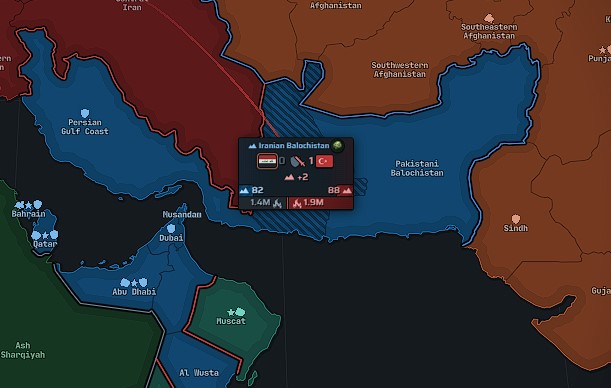
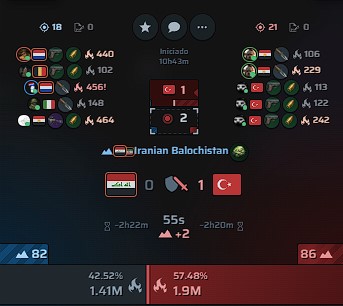
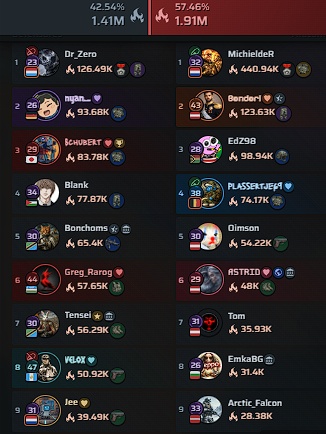
While the cartographic map places the armed conflict strictly in the Iranian Balochistan region, the real activity record of the interface and the accumulated damage matrix reveal that the destiny of local sovereignty is not decided by neighboring armies. The maximum damage catalysts on the front are users with operational bases in Luxembourg, Germany, Japan, Austria, and the Netherlands, who project their military power instantaneously thousands of kilometers away without dragging supply lines.
This mechanic profoundly alters the balance of asymmetric conflicts, directly affecting local resistance and rebellion movements:
Neutralization of territorial strategy: No matter how meticulous the planning of a local insurgency to liberate its occupied territory; the design allows the occupying power to annul geography.
The Discord factor: To quell a rebellion, the occupier does not need to move armies across the map; they only need to issue a notification in an international communication channel to coordinate the damage of global allies instantaneously.
War, therefore, ceases to reward intelligent occupation and control of supply lines, and instead exclusively benefits megacoalitions capable of concentrating the largest number of simultaneous clicks in a time window, regardless of which hemisphere their members are standing in.
4. Proposals for a Systems Re-engineering
For the simulator to regain its depth and return value to geopolitics, it is imperative to reintroduce friction into the game's code through four structural reforms:
1. Comprehensive Fiscal Reform and Labor Mobility Tariffs
The current design taxes only wages, granting an unjustified tax haven to mass automation, while encouraging the flight of labor towards jurisdictions with temporary bonuses. To correct this double imbalance, a hybrid collection model is proposed:
Implement fixed rates per level of automated engine or installed capacity, equally affecting companies with human personnel and those completely automated. This approach avoids the costly calculation of net profits and directly taxes the installed productive capacity.
Introduce specific tariff levies on the hiring of foreign energy, shielding the internal labor market of each nation and forcing industries to prioritize the development of their own citizens.
In this way, the tax burden is distributed equitably according to the real economic capacity of each corporation, the legal vacuum of automation as a tax refuge is closed, and the strategic value of labor borders is restored.
2. Physical Costs of Political-Economic Migration
Establish that applying for a new citizenship requires the payment of a significant tariff fee in local currency and a cool-down period where the player loses access to certain state benefits during their transition period.
3. Introduction of Supply Lines and Military Logistics
Implement a deployment cost system where participating in battles outside native borders or neighboring allied territories requires the consumption of transportation resources (fuel, logistics) proportional to the physical distance of the conflict. Those who cannot pay for deployment cannot teleport their damage. This mechanic cuts the "Discord Factor" at the root.
4. Geographic Specialization and Decentralization of Resources
Restrict the production of certain advanced raw materials to specific geographic regions in a fixed manner, reducing dependence on random territorial bonuses and forcing the creation of real commercial routes that must be militarily defended.
Conclusion: The Strategic Value of Friction
Distance is not a design error to be eliminated to streamline the user experience; in political simulation, distance is the very substance of strategy. An environment where space is irrelevant is an environment where flags lose their meaning.
If WarEra aspires to be a true nation simulator and not a mere globalized click counter, it must restore the map's ability to impose limits. True strategy does not consist of eliminating obstacles, but of governing through them.
June 2, 2026