The Ratel IFV – South Africa’s Legendary “Honey Badger” of the Bush War
The Ratel IFV is widely regarded as one of the most iconic armoured fighting vehicles ever produced in Africa. Tough, fast, rugged, and uniquely suited to African warfare, the Ratel became the backbone of South Africa’s mechanised infantry forces during the Cold War and the long South African Border War.
More than just an armoured troop carrier, the Ratel changed how mobile warfare was fought in Southern Africa. It was the world’s first operational wheeled infantry fighting vehicle (IFV), a revolutionary concept at the time.
Origins – Why the Ratel Was Created
During the 1960s and early 1970s, South Africa faced growing military pressure along its borders, particularly in what was then South West Africa (modern Namibia) and Angola. At the same time, international arms embargoes made importing modern armoured vehicles increasingly difficult.
The South African Army needed a new vehicle that could:
Carry infantry safely across huge distances
Fight alongside armoured units
Operate independently in harsh African terrain
Be easy to maintain far from supply bases
Survive mines and rough bush warfare
Travel long distances without heavy logistical support
Unlike European armies preparing for massive tank battles in Europe, South African forces needed something different. Southern Africa’s battlefield was vast, dry, dusty, and often lacked roads or infrastructure. Traditional tracked IFVs consumed enormous fuel, required constant maintenance, and wore down quickly in abrasive sand and rock.
South African planners therefore chose a wheeled design instead of tracks, something considered unconventional at the time.
The vehicle was designed by Springfield-Büssing and later produced by Sandock Austral. Development began around 1968–1972, with prototypes appearing in the mid-1970s. Production officially started in 1976.
The name “Ratel” comes from the Afrikaans word for the honey badger, a small but famously fearless African animal known for attacking creatures much larger than itself. The name proved extremely fitting.
A Revolutionary Vehicle
At the time of its introduction, the Ratel was groundbreaking.
It became:
The first wheeled infantry fighting vehicle in operational military service
One of the first IFVs specifically designed for long-range mobile warfare
One of the first African-designed combat vehicles to achieve international recognition
The Ratel combined troop transport, heavy firepower, and battlefield mobility into one platform. Most armoured personnel carriers (APCs) of the era were little more than “battle taxis” that delivered soldiers to the battlefield and then withdrew.
The Ratel, however, was designed to fight with the infantry onboard.
Design and Layout
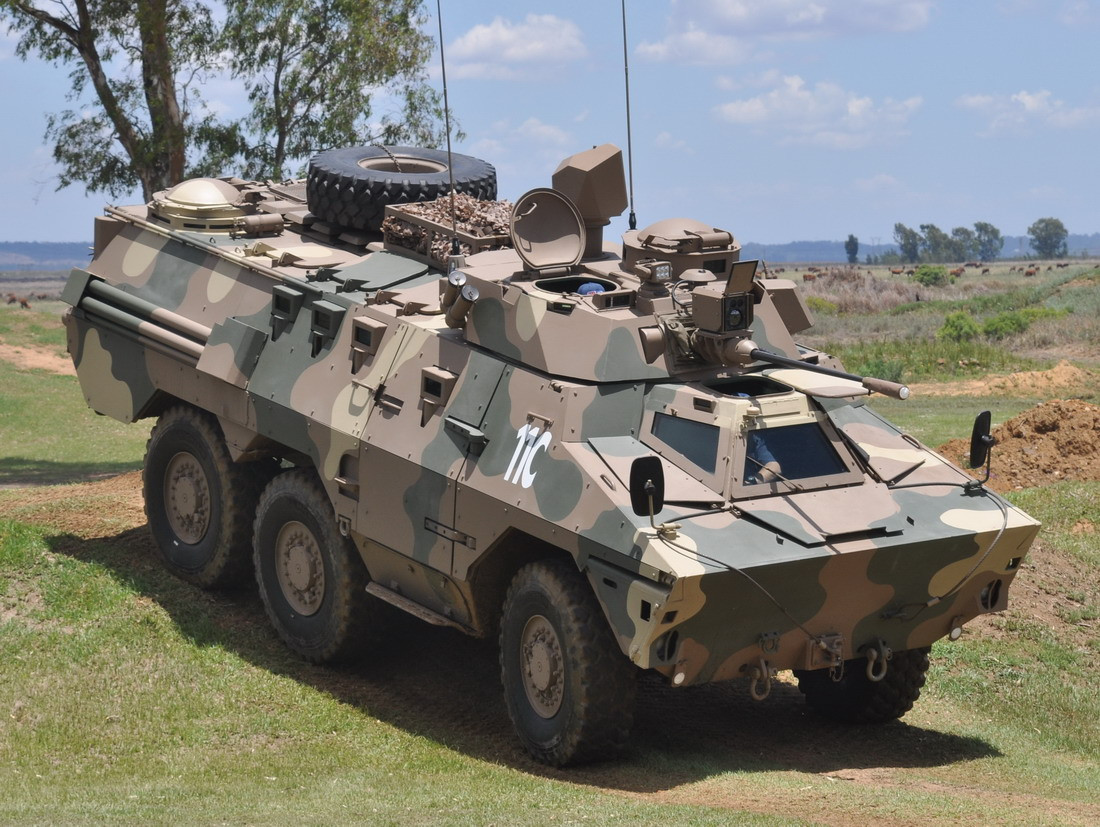
The Ratel used a 6×6 wheeled configuration with excellent cross-country mobility.
Crew and Troops
Typical crew:
Driver
Commander
Gunner
Plus:
Up to 9 infantry soldiers
The driver sat in the front of the hull, while the turret was positioned centrally. Infantry troops rode in the rear compartment with firing ports and vision blocks allowing them to fight from inside the vehicle.
Armour and Protection
The Ratel was not heavily armoured like a tank, but it was designed intelligently for its environment.
Protection included:
Resistance against small-arms fire
Protection against shell splinters
Basic mine resistance
Sloped armour for better survivability
The hull shape helped deflect blast energy from mines, a crucial feature in African bush warfare where landmines were a constant threat.
The Ratel also used run-flat tyres, allowing it to continue moving even after tyre damage.
Engine and Mobility
The Ratel was powered by a Büssing six-cylinder turbocharged diesel engine producing around 275 horsepower.
Performance figures included:
Top speed~105 km/h
Operational range~1,000 km
Drive 6×6
Weight 18–19 tons
Its long operational range became legendary. Ratels could conduct deep penetration operations over enormous distances with comparatively little logistical support.
This was one of the reasons the vehicle became so successful during operations in Angola.
Main Variants and Weapons
One of the Ratel’s greatest strengths was its versatility. The chassis became an entire family of combat vehicles.
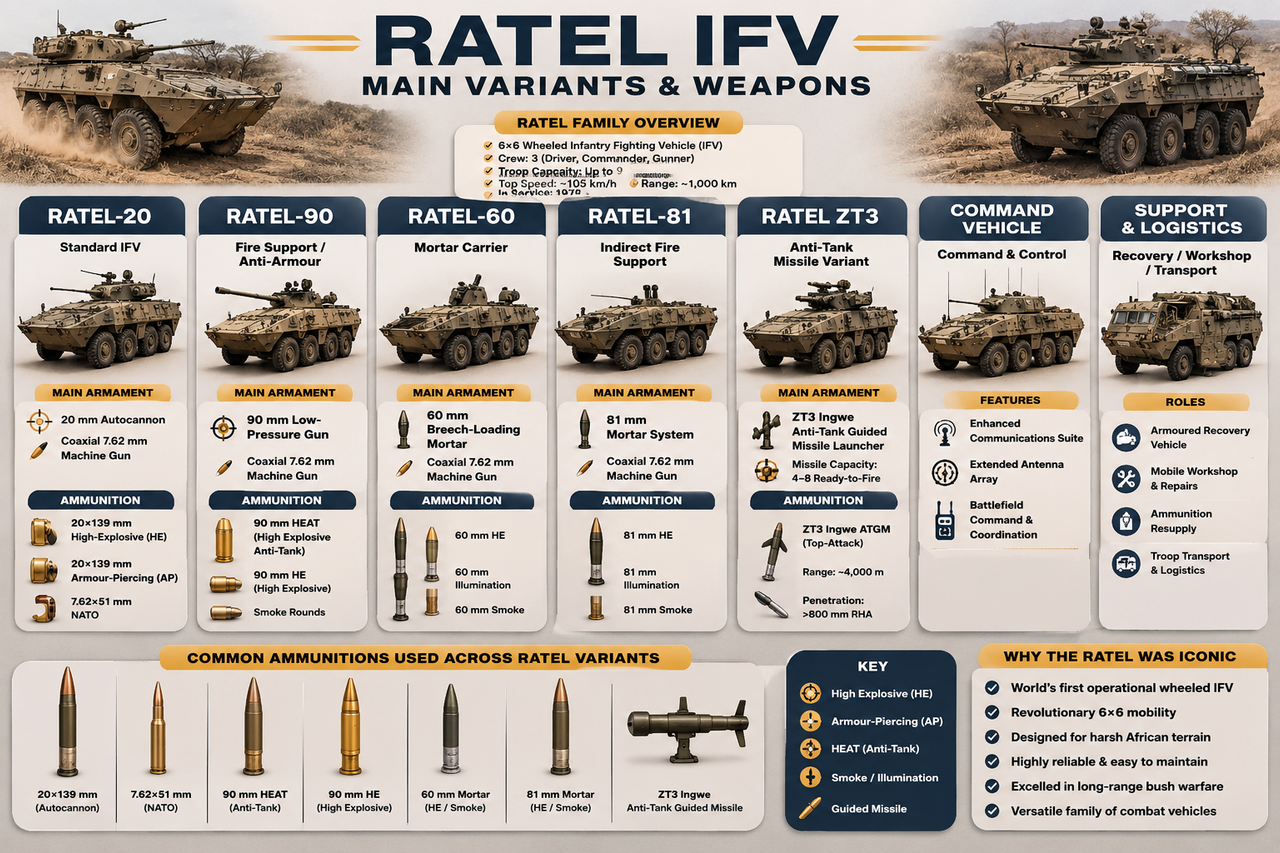
Ratel-20
The standard infantry fighting version.
Armed with:
20 mm autocannon
Coaxial 7.62 mm machine gun
This was the primary mechanised infantry variant. The 20 mm cannon had a dual-feed ammunition system allowing rapid switching between:
High explosive rounds
Armour-piercing rounds
This gave the crew flexibility against infantry, bunkers, light armour, and soft-skinned vehicles.
Ratel-90
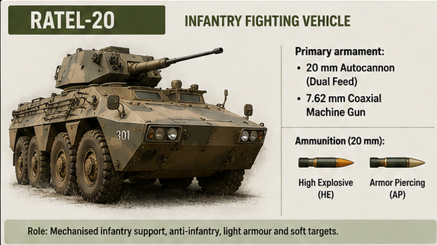
Probably the most famous variant.
Armed with:
90 mm low-pressure gun
The turret was derived from the Eland 90 armoured car.
Although not originally intended as a tank destroyer, the Ratel-90 became highly effective against Angolan and Cuban armour during the Border War.
The 90 mm gun could fire:
HEAT (High Explosive Anti-Tank)
High explosive shells
Smoke rounds
In combat, South African crews often used speed, surprise, and aggressive manoeuvring to engage Soviet-made T-54 and T-55 tanks at close range.
Ratel-60
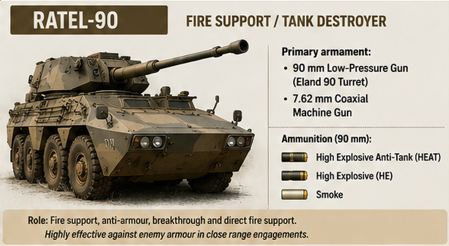
Armed with:
60 mm breech-loading mortar
This variant combined mortar support with direct-fire capability.
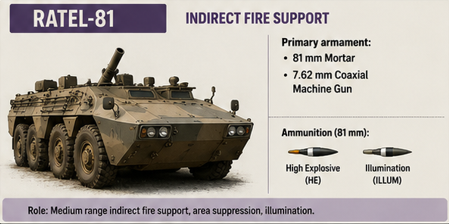
Ratel-81
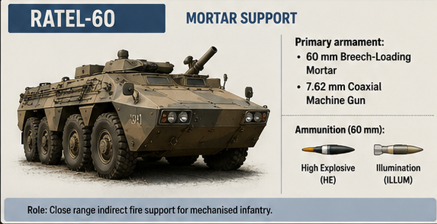
Equipped with:
81 mm mortar system
Used as indirect fire support.
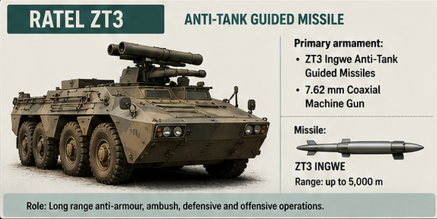
Ratel ZT3
A later anti-tank variant armed with:
ZT3 Ingwe anti-tank guided missiles
Designed to destroy enemy armour at long range.
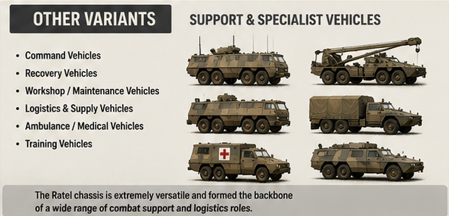
Other Variants
The Ratel family also included:
Command vehicles
Recovery vehicles
Workshop vehicles
Logistics versions
Missile carriers
Combat in the South African Border War
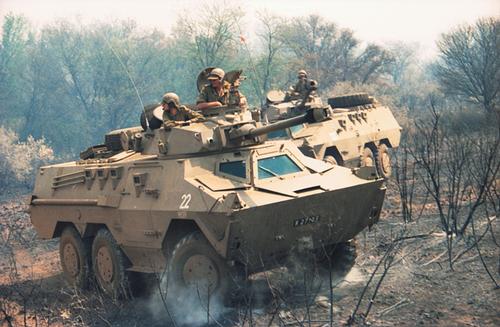
The Ratel became synonymous with the South African Border War (1966–1989).
It was heavily used in:
Angola
Namibia/South West Africa
Cross-border operations against SWAPO
Battles against Angolan FAPLA forces and Cuban troops
The vehicle excelled in:
Long-range raids
Mechanised manoeuvre warfare
Rapid flanking attacks
Hit-and-run engagements
Deep bush operations
The Ratel’s mobility allowed South African mechanised forces to move rapidly across terrain that many tracked vehicles struggled to traverse efficiently.
Military historian Roland de Vries noted that the Ratel heavily influenced the development of uniquely South African mobile warfare doctrine during the Border War.
Why the Ratel Became Legendary
The Ratel earned an almost mythical reputation among South African soldiers.
1. Incredible Reliability
The vehicle was famously rugged and dependable in brutal conditions:
Dust
Heat
Mud
Long-distance operations
Many crews trusted the Ratel completely in harsh bush warfare.
2. Speed and Mobility
The Ratel could move rapidly over huge distances without transporters or rail networks.
This gave South African forces operational flexibility that many opponents lacked.
3. Psychological Impact
The sight and sound of approaching Ratels became feared during the Border War.
The 20 mm cannon and 90 mm gun variants delivered devastating firepower against infantry and light armour.
4. Perfect for African Warfare
The Ratel was designed specifically for Southern African conditions rather than European battlefields.
That specialised focus made it exceptionally effective in its intended environment.
Interesting Facts About the Ratel
It Was the World’s First Operational Wheeled IFV
This was a major military innovation. Today, many modern armies use wheeled IFVs, but the Ratel pioneered the concept.
It Could Travel Vast Distances
A range of roughly 1,000 km meant Ratels could conduct extremely deep operations without refuelling.
Some Ratels Fought Tanks Successfully
Although not designed primarily as tank killers, Ratel-90 crews managed to destroy Soviet-made tanks during clashes in Angola through aggressive tactics and close-range engagements.
It Influenced Future Vehicles
The Ratel’s concepts helped inspire later wheeled combat vehicles around the world.
South Africa eventually developed successors such as the Badger IFV.
The Vehicle Remained in Service for Decades
Despite entering service in the 1970s, Ratels continued serving into the 21st century due to their durability and effectiveness.
Legacy
The Ratel IFV remains one of the most respected armoured vehicles ever produced in the Southern Hemisphere.
It symbolised:
South African military innovation
Adaptation under sanctions
Mechanised bush warfare
Mobility over brute force
Few military vehicles are so closely associated with a specific environment and style of warfare. The Ratel was not merely an armoured vehicle, it became the defining symbol of South African mechanised infantry during the Cold War era.
Even today, veterans and military historians often regard it as one of the finest wheeled combat vehicles ever built for African warfare