The Silver Falcons (Die Silwer Valke) – South Africa’s Pride in the Sky
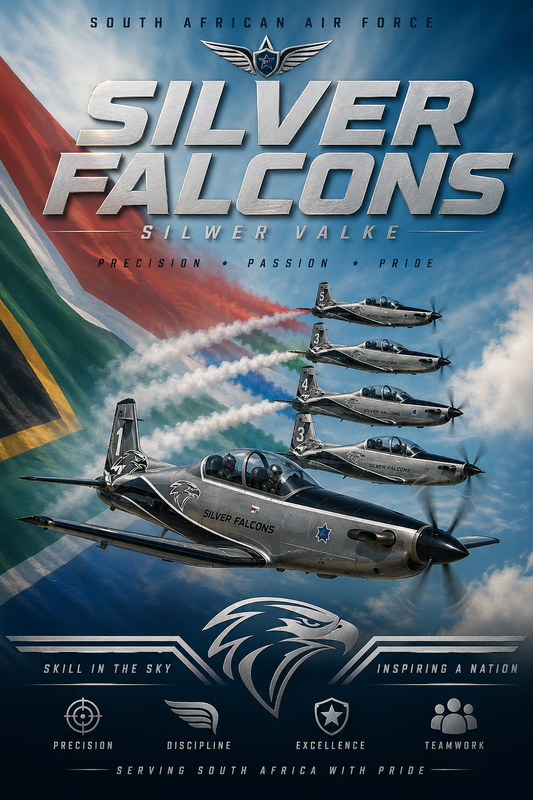
Few aviation teams capture national pride quite like the Silver Falcons (or as they are known in Afrikaans, Die Silwer Valke). As the official aerobatic display team of the South African Air Force (SAAF), they have become a symbol of precision flying, discipline, and national identity.
Origins and History
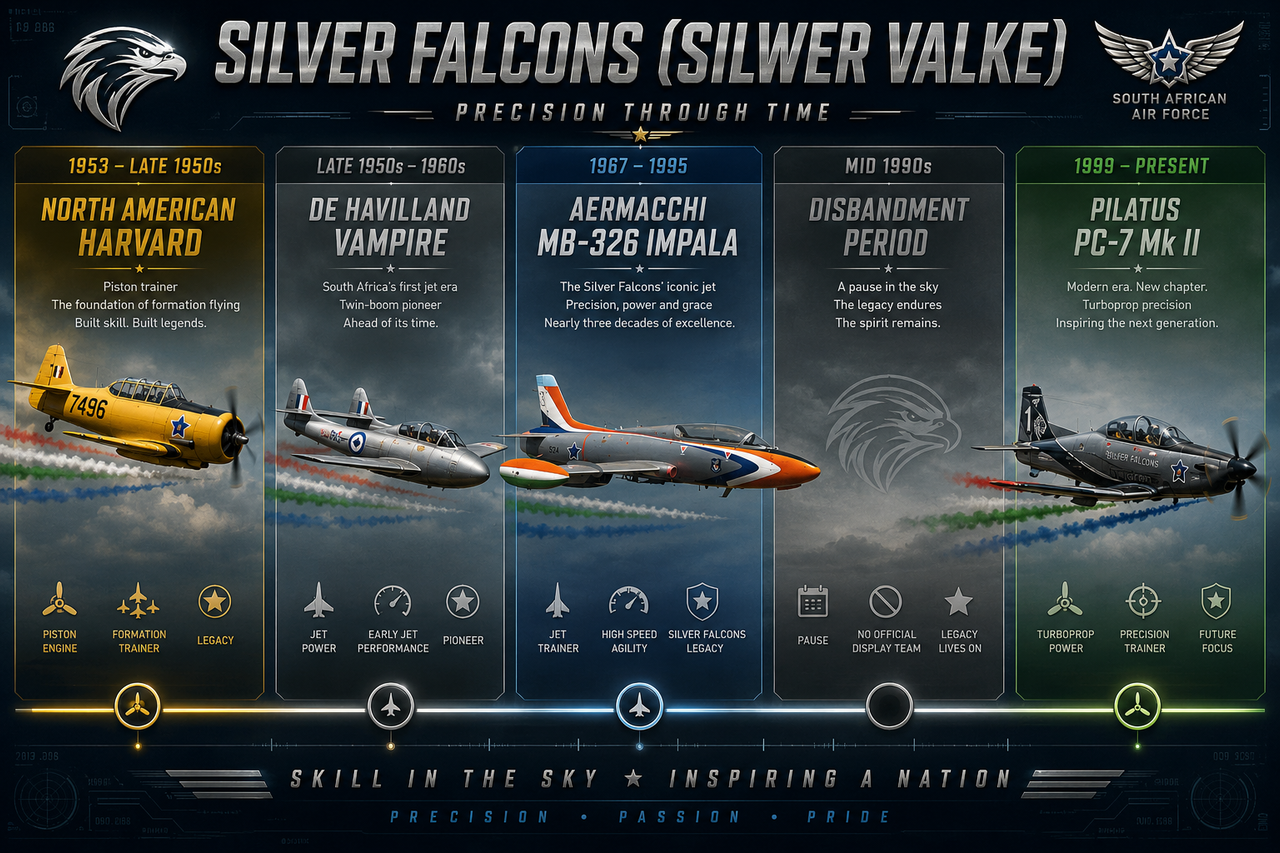
The roots of the Silver Falcons date back to 1953, when an earlier team called the Bumbling Bees began performing aerobatic displays using aircraft like the Harvard and Vampire.
After a brief disbandment in the late 1950s, the concept was revived in the mid-1960s when South Africa introduced the locally built Aermacchi MB-326 Impala jet trainer. In 1967, the team was officially rebranded as the Silver Falcons (Silwer Valke), a name chosen to work equally well in English and Afrikaans and to reflect strength and elegance.
Their first official display under the new name took place in November 1967, marking the beginning of what would become one of the world’s longest-running aerobatic teams.
Over the decades, the team evolved:
Expanded from a 4-aircraft formation to a 5-ship display in the 1980s
Temporarily disbanded in the mid-1990s
Revived in 1999 with modern aircraft and a renewed national role
The Aircraft of the Silver Falcons
Today, the Silver Falcons fly the Pilatus PC-7 Mk II, a high-performance turboprop trainer used by the SAAF.
Key Features of the PC-7 Mk II
Single-engine turboprop with excellent manoeuvrability
Capable of handling high G-forces (+7 to −3.5 G)
Tandem seating (pilot and instructor)
Maximum speed around 300 knots (≈555 km/h)
Service ceiling of about 25,000 feet
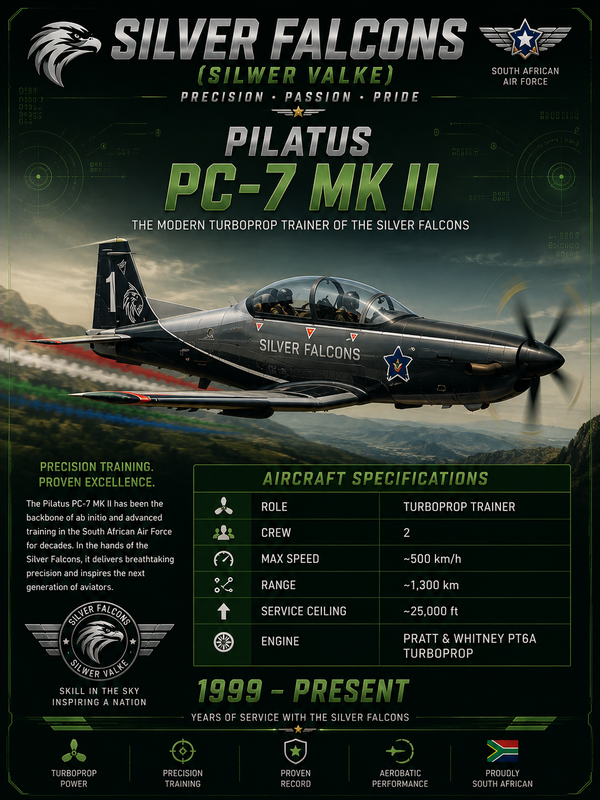
Although not a jet, the PC-7 Mk II is ideal for aerobatics due to its agility, reliability, and lower operating cost. Its use also reflects the team’s strong link to pilot training, as it is the same aircraft used to train new SAAF pilots.
Historically, the team has flown several aircraft types:
North American Harvard (early years)
de Havilland Vampire (early jet era)
Aermacchi Impala (1966–1990s)
Pilatus PC-7 Mk II (1999–present)
Purpose of the Silver Falcons
The Silver Falcons are not just about airshows—they serve several key strategic roles:
1. Promoting the Air Force
Their primary mission is to enhance the public image of the SAAF. Through precision displays, they showcase professionalism, skill, and technological capability.
2. Recruitment Tool
Airshows inspire young South Africans to consider careers in aviation and the military. Watching the Falcons often sparks the first interest in flying.
3. National Pride
The team performs at major national events and international airshows, reinforcing unity and pride. Their displays—often trailing smoke in national colours—have become iconic symbols of South Africa.
4. Pilot Excellence
Being selected for the Silver Falcons is a mark of elite flying skill. Pilots are typically experienced instructors, meaning the team also represents the highest standard of SAAF training.
Significance in South Africa
The Silver Falcons hold a unique place in South African history and culture:
A symbol of continuity: They have existed through apartheid, democratic transition, and modern South Africa, adapting their identity along the way.
A reflection of national change: Aircraft colours and displays have evolved to reflect South Africa’s changing flags and identity, especially post-1994.
Global representation: They have performed at international events, showcasing South African aviation on the world stage.
One of the oldest aerobatic teams: With origins in the 1950s, they are among the longest-running teams globally.
Conclusion
Die Silwer Valke are far more than just an aerobatic display team, they are a flying embodiment of South African heritage, resilience, and excellence. From humble beginnings as the Bumbling Bees to a world-class aerobatic unit, the Silver Falcons continue to inspire generations while representing the very best of the South African Air Force.
Their motto could easily be summed up in three words: precision, pride, and passion, written across the African sky.