The War Behind the War - Part IX (Comic & History) [EN/PT]
Comic & History
We’re looking at the comic, followed by the History content
THE WAR BEHIND THE WAR — IX
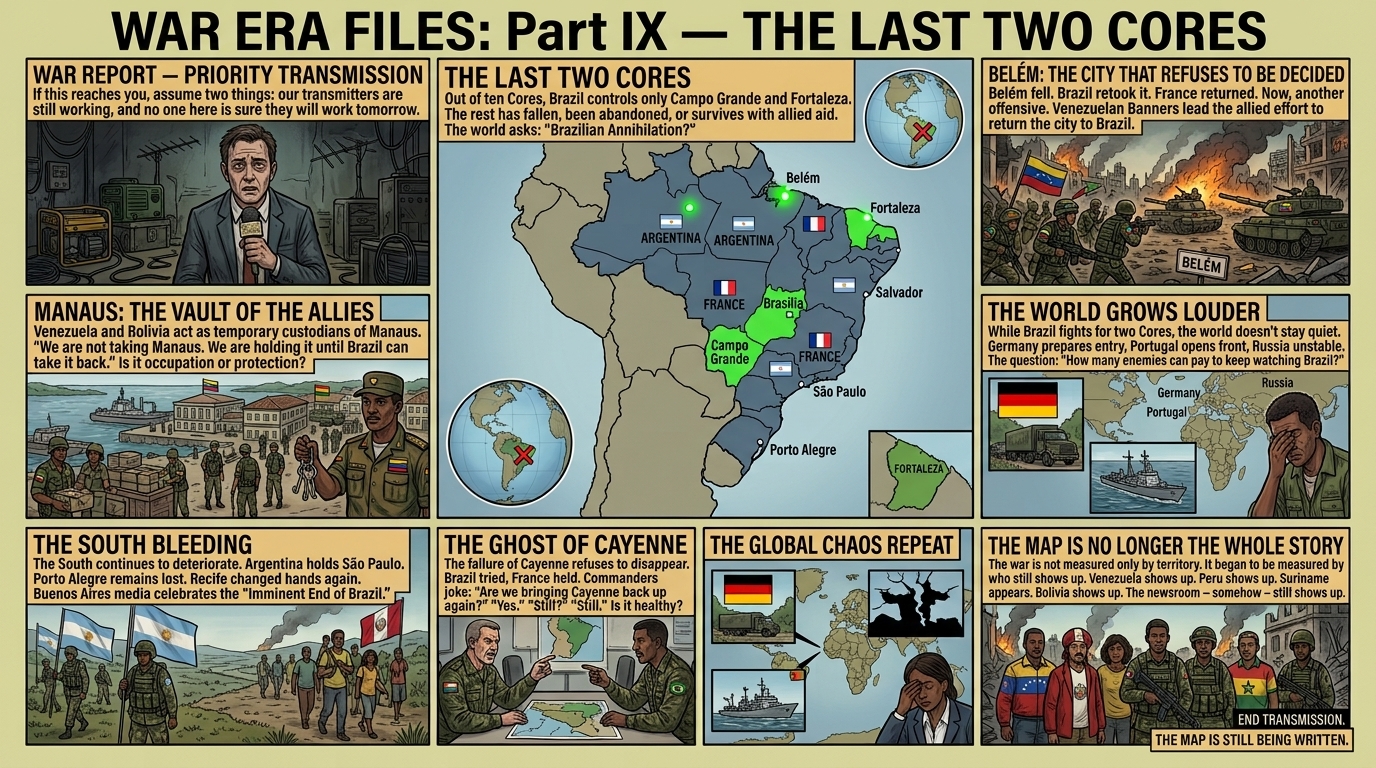
THE LAST TWO CORES
Belém Burns Again, Venezuela Carries the Banner, and Brazil Refuses to Leave the Map
WAR REPORT — PRIORITY TRANSMISSION
If this report reaches you, assume two things.
First:
Our transmitters are somehow still working.
Second:
Nobody here is entirely sure they'll still be working tomorrow.
The newsroom now operates with generators, improvised antennas and equipment salvaged from abandoned stations. Entire neighborhoods that once housed correspondents no longer answer our calls. Some reporters are missing. Others simply stopped transmitting.
The war has become so fast that information often arrives after the battlefield has already changed.
And yet, somehow—
we are still writing.
THE LAST TWO CORES
The number that now haunts every Brazilian strategist is painfully simple.
Two.
Out of ten Core Regions, Brazil controls only Campo Grande and Fortaleza.
Everything else has either fallen, been abandoned, or survives only through allied coordination.
Military analysts have stopped debating whether Brazil is weakened.
They are debating whether Brazil still qualifies as a country that can sustain a long war.
The international media has already chosen its headline.
"Total Brazilian Wipe?"
Inside Brazil, nobody wants to answer it.
BELÉM: THE CITY THAT REFUSES TO STAY DECIDED
There may not be another city that better represents this entire war.
Belém fell.
Brazil retook it.
France returned.
Now, another offensive is underway.
This time, however, the banners advancing toward Belém are not only Brazilian.
Venezuelan forces are leading a coordinated allied effort to help return the city to Brazil.
The operation has become symbolic.
Because Belém is no longer simply territory.
It has become proof that maps can change back.
Some veterans have reportedly begun calling the city:
"The Boomerang Capital."
Nobody is certain whether that's official military terminology.
It almost certainly isn't.
MANAUS: THE ALLIES' VAULT
One of the greatest misconceptions currently circulating abroad concerns Manaus.
Foreign observers describe Venezuelan and Bolivian troops as competing for control.
That interpretation is wrong.
The reality is considerably stranger.
Venezuela and Bolivia are effectively acting as temporary custodians.
As one allied officer reportedly explained:
"We're not taking Manaus. We're holding it until Brazil has enough hands to take it back properly."
Military historians are already debating whether this should count as occupation, protection or the diplomatic equivalent of holding someone's house keys.
No conclusion has been reached.
THE SOUTHERN BLEEDING
The South continues to deteriorate.
Argentina still holds São Paulo.
Porto Alegre remains lost.
Recife has changed hands again.
And despite previous coordinated operations with Peru, the southern theater continues demanding resources Brazil no longer possesses.
Curiously, Argentina has become louder precisely when the battlefield has become more complicated.
The same media that once mocked Brazil's six-front celebration now celebrates every territorial gain as definitive proof that Brazilian collapse is inevitable.
Brazilian circles continue answering with the phrase that has quietly become the unofficial motto of the war:
"We did not celebrate the war. We celebrated proving that a war we thought we could not fight was, in fact, a war we could survive."
The statement has aged surprisingly well.
Mostly because survival remains measurable.
Victory does not.
THE CAYENNE GHOST
The Failure of Cayenne refuses to disappear.
Brazil attempted its offensive.
France held.
Some commanders now joke that Cayenne has become less of a military objective and more of a recurring family argument.
"We're bringing up Cayenne again?"
"Yes."
"Still?"
"Still."
Military morale experts have reportedly classified this exchange as "healthier than expected."
THE FRIENDLY FIRE INCIDENT HAS GOTTEN WORSE
Remember the famous accidental Brazilian volley that somehow hit French and Argentine forces despite being fired in the wrong direction?
It has now become official military folklore.
New recruits are apparently told the story during orientation.
Not as tactical instruction.
As motivation.
One veteran allegedly summarized the lesson:
"If you're going to make a mistake, at least confuse the enemy first."
No military academy has confirmed adding this to its curriculum.
Our legal department insists we clarify that.
We no longer have a legal department.
THE WORLD KEEPS GETTING LOUDER
While Brazil fights for two remaining Core Regions, the world refuses to stay quiet.
Germany prepares its entrance.
Portugal has opened another European front.
Russia continues showing signs of instability.
Every new conflict drains attention from somewhere.
The question Brazilian analysts now ask is no longer:
"Who will help Brazil?"
It is:
"How many enemies can afford to keep looking at Brazil?"
Those are not the same question.
Not anymore.
THE MAP IS NO LONGER THE WHOLE STORY
Something changed after Belém's first reconquest.
Something changed after Suriname's night offensive.
Something changed after Peru refused to abandon Campo Grande.
The war stopped being measured only by territory.
It started being measured by who still shows up.
Venezuela shows up.
Peru shows up.
Suriname shows up.
Bolivia shows up.
The newsroom—
somehow—
still shows up.
THE FINAL QUESTION
Brazil has two Core Regions left.
Its capital has fallen.
Its economy has collapsed.
Its government remains officially silent.
Its allies keep buying it time.
Its enemies keep promising the end.
So perhaps the wrong question has been asked all along.
Not:
"Will Brazil disappear?"
But:
"How many times can a country refuse to disappear before history is forced to rewrite its ending?"
The investigation remains active.
The transmitters remain active.
Belém remains burning.
And somewhere between Venezuela's advance, France's defenses and Brazil's last two Core Regions—
someone is still writing tomorrow's map.
END TRANSMISSION.
(Quadrinhos e História)
Vamos analisar os quadrinhos, seguidos pelo conteúdo de História.
A GUERRA POR TRÁS DA GUERRA — IX
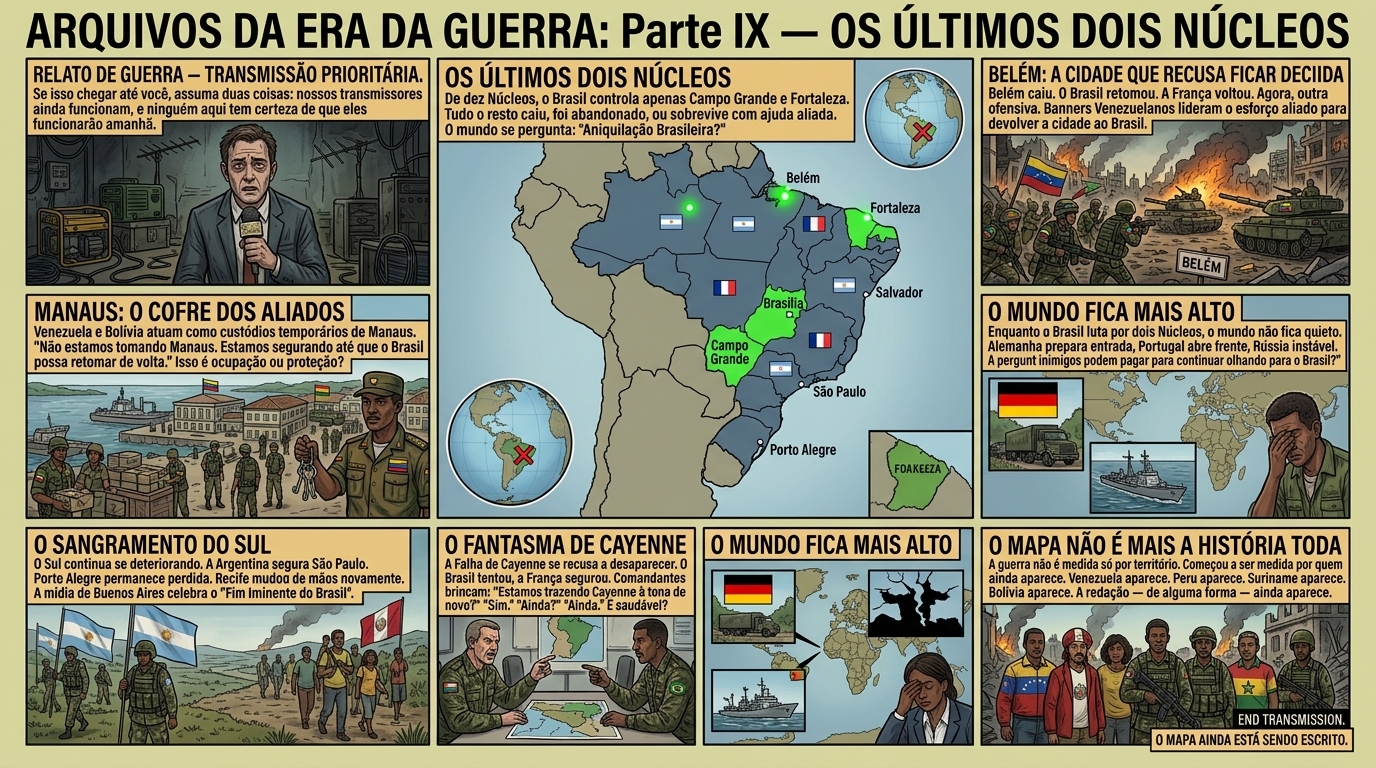
AS DUAS ÚLTIMAS CORES
Belém Arde Novamente, a Venezuela Carrega a Bandeira e o Brasil Se Recusa a Sair do Mapa
RELATÓRIO DE GUERRA — TRANSMISSÃO PRIORITÁRIA
Se esta reportagem chegou até você, assuma duas coisas.
A primeira:
Nossos transmissores ainda funcionam.
A segunda:
Ninguém aqui sabe por quanto tempo continuarão funcionando.
Nossa redação agora opera com geradores improvisados, antenas remendadas e equipamentos retirados de estações abandonadas. Regiões inteiras deixaram de responder. Alguns correspondentes desapareceram. Outros simplesmente pararam de transmitir.
A guerra acelerou tanto que, às vezes, a notícia chega quando o mapa já mudou.
Mesmo assim—
continuamos escrevendo.
AS DUAS ÚLTIMAS CORES
Existe um número que passou a assombrar todos os estrategistas brasileiros.
Dois.
Das dez Core Regions, o Brasil mantém apenas Campo Grande e Fortaleza.
Todo o resto caiu, foi cedido ou sobrevive apenas graças à coordenação dos aliados.
Os analistas já não discutem se o Brasil está enfraquecido.
Discutem se o país ainda possui condições de sustentar uma guerra longa.
A mídia internacional já escolheu sua manchete.
"Total Brazilian Wipe?"
Dentro do Brasil, ninguém parece disposto a respondê-la em voz alta.
BELÉM: A CIDADE QUE SE RECUSA A ESCOLHER UM DONO
Talvez nenhuma cidade represente melhor esta guerra do que Belém.
Ela caiu.
Foi retomada.
Voltou a cair.
E agora volta a ser disputada.
Desta vez, porém, quem avança em direção à cidade não carrega apenas bandeiras brasileiras.
As forças venezuelanas lideram uma operação coordenada para devolver Belém ao Brasil.
A ofensiva tornou-se muito maior do que uma simples batalha territorial.
Belém deixou de ser apenas uma cidade.
Virou uma ideia.
Alguns veteranos já começaram a chamá-la de:
"A Capital Bumerangue."
O Estado-Maior jamais confirmou esse apelido.
Sinceramente?
Nem precisa.
MANAUS: A CIDADE QUE OS ALIADOS GUARDAM
Existe outra confusão circulando pela imprensa internacional.
Alguns veículos afirmam que Venezuela e Bolívia disputam Manaus.
Errado.
A realidade é muito mais curiosa.
Ambos os países atuam em uma estratégia conjunta para segurar Manaus para os brasileiros até que o Brasil tenha condições de reassumir plenamente a frente.
Um oficial aliado resumiu a situação da melhor forma possível:
"A gente não está pegando Manaus. Estamos só segurando a chave da casa."
Juristas internacionais ainda discutem como classificar essa situação.
Nossos repórteres classificaram como:
"Empréstimo patriótico."
O SUL CONTINUA SANGRANDO
Enquanto o Nordeste tenta respirar novamente, o Sul continua pagando a conta.
A Argentina mantém São Paulo.
Porto Alegre permanece ocupada.
Recife voltou a mudar de mãos.
Mesmo após as operações conjuntas com o Peru, o teatro sul continua consumindo recursos que o Brasil simplesmente já não possui.
Curiosamente, quanto mais complexo o campo de batalha fica, mais alto fala a propaganda argentina.
A mesma imprensa que ridicularizou o Brasil por "comemorar uma guerra de seis frentes" continua apresentando cada avanço como prova definitiva do colapso brasileiro.
A resposta brasileira permanece a mesma.
A frase já virou praticamente um lema nacional:
"Não comemoramos a guerra. Comemoramos provar que uma guerra que achávamos não poder travar era, na verdade, uma guerra que podíamos sobreviver."
Curiosamente...
Essa frase envelheceu melhor do que muita previsão internacional.
O FANTASMA DE CAYENNE
A Falha de Cayenne continua perseguindo esta guerra.
O Brasil tentou atacar.
A França segurou.
E Cayenne passou a ocupar um lugar curioso na memória dos soldados.
Já não parece apenas uma cidade.
Parece aquela discussão familiar que nunca termina.
— Vamos falar de Cayenne de novo?
— Vamos.
— Ainda?
— Ainda.
Especialistas em moral militar classificaram a conversa como:
"Estranhamente saudável."
O FOGO AMIGO AGORA VIROU LENDA
Lembra daquela história absurda em que tropas brasileiras, completamente exaustas, atiraram para o lado errado—
—e, por algum milagre estatístico, acertaram franceses e argentinos?
Ela deixou de ser boato.
Virou folclore militar.
Recrutas já escutam essa história durante o treinamento.
Não como lição tática.
Como inspiração.
Um veterano teria resumido tudo em uma única frase:
"Se for errar... erra de um jeito que assuste o inimigo também."
Até o momento, nenhuma academia militar confirmou incluir isso no manual.
Nossa equipe jurídica pediu que esclarecêssemos esse detalhe.
Nós não temos mais equipe jurídica.
ENQUANTO ISSO, O MUNDO CONTINUA PEGANDO FOGO
O Brasil já não luta sozinho no centro das atenções.
A Alemanha prepara sua entrada na guerra.
Portugal abriu uma nova frente contra Marrocos.
A Rússia continua demonstrando sinais de instabilidade.
Cada novo conflito aberto longe da América do Sul significa uma coisa muito específica.
A França talvez precise olhar para outro lugar.
Pela primeira vez desde o início da campanha, os analistas brasileiros deixaram de perguntar:
"Quem vai ajudar o Brasil?"
Agora perguntam:
"Quantos inimigos ainda conseguem manter todos os olhos voltados para o Brasil?"
Parece a mesma pergunta.
Não é.
O PAÍS QUE CONTINUA APARECENDO
Algo mudou desde a primeira retomada de Belém.
Algo mudou desde a Madrugada do Suriname.
Algo mudou quando o Peru se recusou a abandonar Campo Grande.
A guerra deixou de ser medida apenas pelo território.
Passou a ser medida por outra coisa.
Quem continua aparecendo.
A Venezuela aparece.
O Peru aparece.
O Suriname aparece.
A Bolívia aparece.
E nossa redação—
de alguma forma—
também aparece.
A PERGUNTA FINAL
Semanas atrás, o mundo perguntava:
"Total Brazilian Wipe?"
Hoje essa pergunta ficou mais difícil.
O Brasil perdeu Brasília.
Perdeu quase todas as suas Core Regions.
Mas recuperou cidades.
Recuperou aliados.
Recuperou iniciativa.
E, principalmente—
recuperou a capacidade de obrigar o mapa a mudar novamente.
Talvez a maior surpresa desta guerra já não seja que o Brasil sobreviveu.
Talvez seja outra.
Quantas vezes um país consegue se recusar a desaparecer antes que a História seja obrigada a reescrever seu próprio final?
A investigação continua ativa.
Os transmissores continuam ligados.
Belém continua queimando.
E, entre o avanço venezuelano, a resistência francesa e as duas últimas Core Regions brasileiras—
alguém ainda está desenhando o mapa de amanhã.
FIM DA TRANSMISSÃO.