The War Behind the War - Part VI (Comic & History) [EN/PT]
Comic & History
We’re looking at the comic, followed by the History content
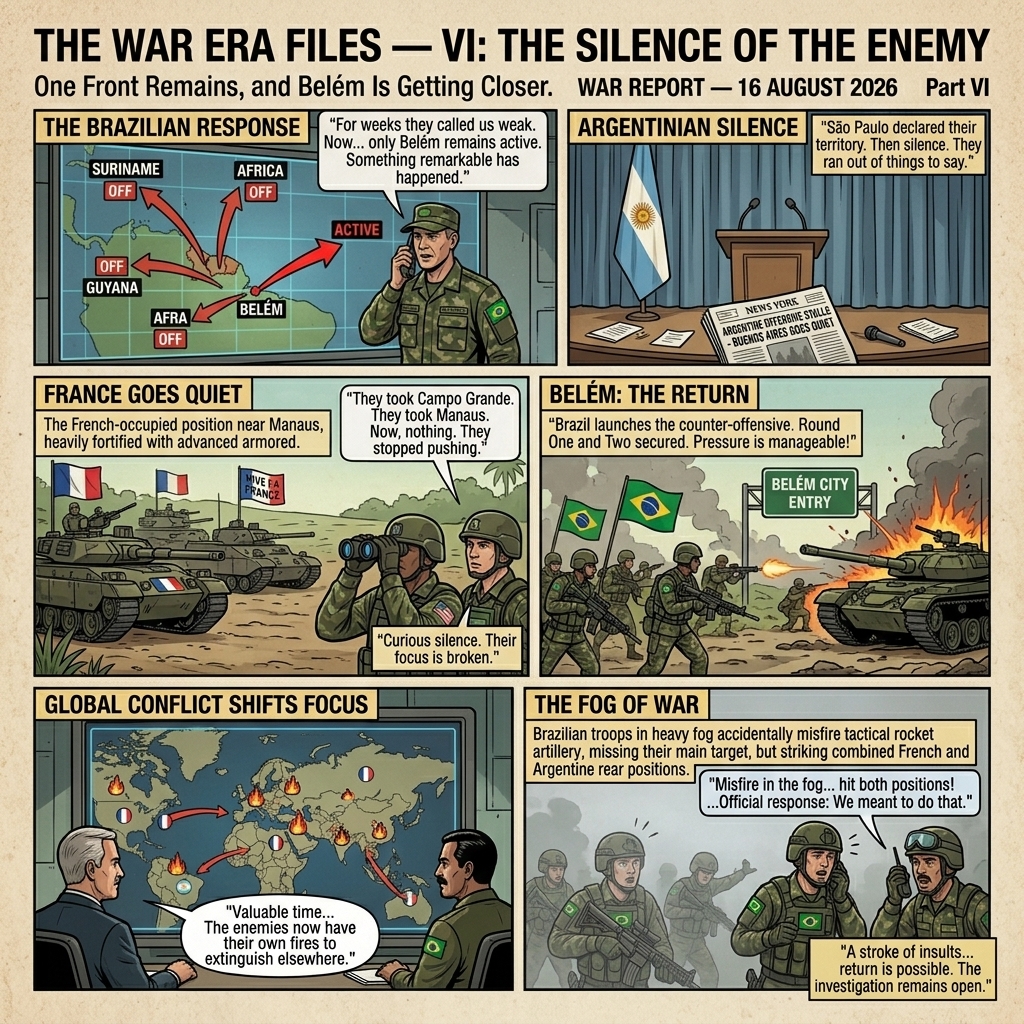
THE WAR BEHIND THE WAR — VI
THE SILENCE OF THE ENEMY
One Front Remains, and Belém Is Getting Closer
WAR REPORT — 16 AUGUST 2026
The previous report, “The Silence of Brazil,” described a country exhausted by war, battered by bombardment and increasingly isolated by international opinion.
Since then, something remarkable has happened.
For the first time in what feels like an eternity—
Brazil has only one active front.
Belém.
And, strangely enough, the loudest enemies have gone quiet.
THE ARGENTINIAN SILENCE
For weeks, Argentine voices dominated the international narrative.
Brazil was called weak.
Brazil was called cowardly.
São Paulo was declared Argentine territory.
The Brazilian silence became a recurring joke.
Then the battlefield changed.
Argentina stopped talking.
There are no new declarations of victory.
No triumphant speeches.
No fresh culinary diplomacy.
Just silence.
Brazilian intelligence has no confirmed explanation.
One theory suggests exhaustion.
Another suggests Argentina has simply discovered that talking is considerably easier when the map is moving in your favor.
A third theory remains classified.
It is reportedly titled:
“Maybe They Finally Ran Out of Things to Say.”
FRANCE GOES QUIET
The French silence is even more curious.
France conquered Belém.
France conquered Fortaleza.
France defeated Peruvian forces and took Campo Grande.
France defeated Ecuador and took Manaus.
For a time, French forces appeared capable of pushing Brazil deeper into its own territory.
But now?
Nothing.
The French front has effectively become the only battlefield Brazil is actively fighting.
And Brazil is not retreating.
It is attacking.
BELÉM: THE RETURN
The Brazilian army launched the operation to retake Belém.
The first Round went to Brazil.
Then came Round Two.
Brazil maintained its position with surprisingly little difficulty.
For an army that had spent days fighting France, Argentina, Liberia, Guinea, Ivory Coast, Senegal and others, the change is almost surreal.
The front is quiet.
The pressure is manageable.
And the conclusion increasingly appears obvious:
Brazil may be taking Belém back.
The city that became the symbol of Brazilian vulnerability may soon become the symbol of its recovery.
THE WAR THAT CHANGED EVERYTHING
Meanwhile, the world itself has entered a much larger conflict.
A war on a global scale has erupted, forcing nations and armies to reconsider their priorities.
Whether this benefits Brazil remains uncertain.
But one consequence is already visible:
attention is no longer concentrated entirely on Brazil.
The enemies that once had the luxury of focusing on Brazilian territory now have other fires to extinguish.
And suddenly, Brazil has something it desperately needed:
time.
THE FOG OF WAR
There is another problem.
The bombardments have damaged infrastructure.
Reporters have disappeared.
Some have reportedly been killed.
Communications are unreliable.
Information arrives incomplete, contradictory and sometimes hours late.
Even our own coverage has become a reconstruction of fragments.
In one particularly absurd incident, exhausted Brazilian troops reportedly opened fire in the wrong direction.
It should have been a disaster.
Instead, by an almost insulting stroke of luck, the shots managed to hit French and Argentine forces.
The official military assessment remains unavailable.
The unofficial assessment was considerably shorter:
“We meant to do that.”
THE BRAZILIAN RECOVERY
Something else has changed.
Brazil's international reputation, once severely damaged, has begun to recover.
The country lost cities.
It lost territory.
It lost battles.
But it also demonstrated something its enemies increasingly struggle to dismiss:
Brazil survived.
It defended multiple fronts simultaneously.
It maintained alliances.
It absorbed enormous losses.
It continued fighting while its reserves collapsed.
And now, after all of that—
Brazil is standing before the gates of Belém.
Again.
THE QUESTION
So why are Argentina and France silent?
Perhaps they are exhausted.
Perhaps they are preparing something.
Perhaps the global war has forced them elsewhere.
Or perhaps they simply understand something that Brazil has only recently discovered:
the war has changed.
Brazil is no longer surrounded by six active fronts.
It is no longer desperately trying to prevent another city from falling.
For the moment, there is only one objective.
Belém.
And the Brazilian army is advancing toward it.
The city that once represented defeat may soon represent something very different.
Return.
The investigation remains open.
The battlefield remains active.
And for the first time in weeks, Brazilian commanders may finally be asking a question they had almost forgotten:
“What do we do after we win?”
THE WAR CONTINUES.
(Quadrinhos e História)
Vamos analisar os quadrinhos, seguidos pelo conteúdo de História.
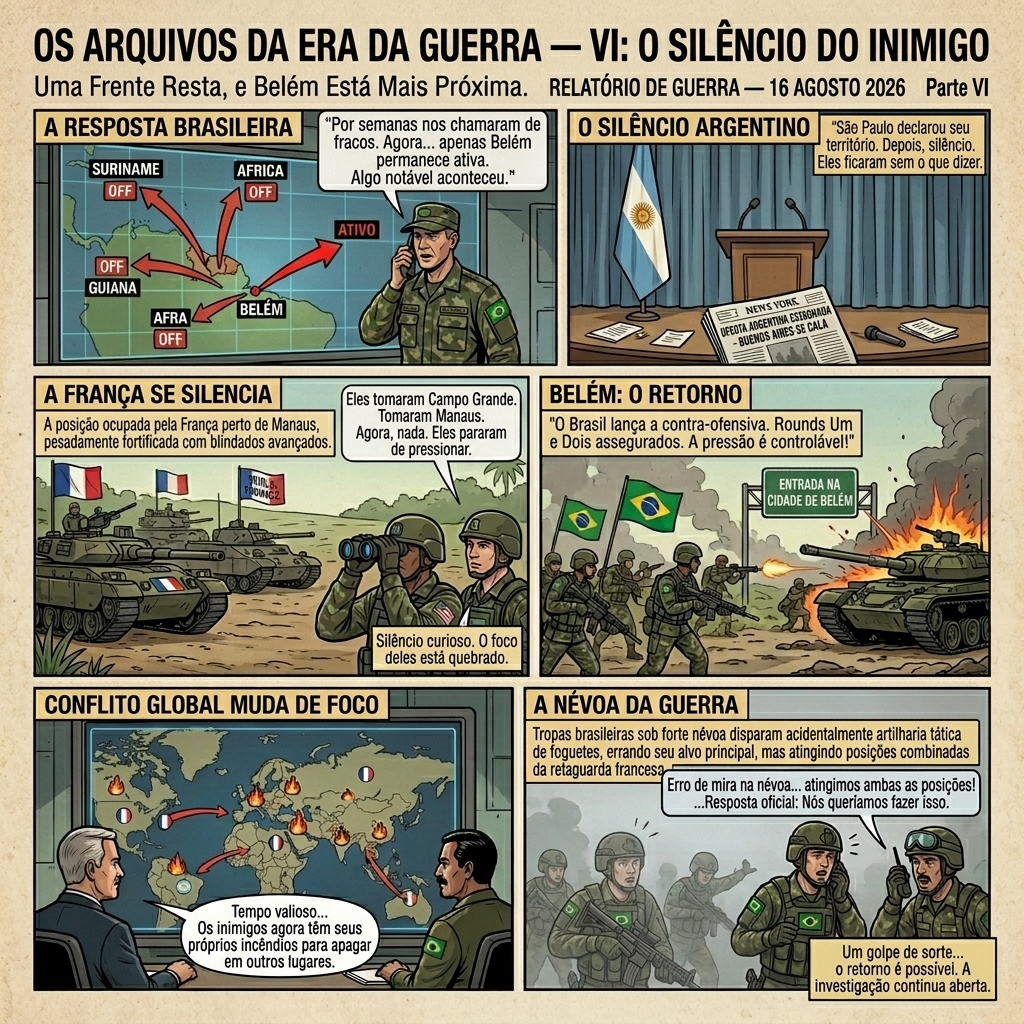
A GUERRA POR TRÁS DA GUERRA — VI
O SILÊNCIO DO INIMIGO
Uma Frente Restante, e Belém Está Cada Vez Mais Próxima
RELATÓRIO DE GUERRA — 16 DE AGOSTO DE 2026
O relatório anterior, “The Silence of Brazil”, descreveu um país exausto pela guerra, castigado pelos bombardeios e cada vez mais isolado pela opinião internacional.
Desde então, algo extraordinário aconteceu.
Pela primeira vez em uma eternidade—
o Brasil possui apenas uma frente ativa.
Belém.
E, estranhamente, os inimigos mais barulhentos ficaram em silêncio.
O SILÊNCIO ARGENTINO
Durante semanas, vozes argentinas dominaram a narrativa internacional.
O Brasil foi chamado de fraco.
O Brasil foi chamado de covarde.
São Paulo foi declarado território argentino.
O silêncio brasileiro virou motivo recorrente de piadas.
Então o campo de batalha mudou.
A Argentina parou de falar.
Não há novas declarações de vitória.
Nenhum discurso triunfal.
Nenhuma nova diplomacia culinária.
Apenas silêncio.
A inteligência brasileira ainda não possui uma explicação confirmada.
Uma teoria sugere esgotamento.
Outra sugere que a Argentina simplesmente descobriu que falar é consideravelmente mais fácil quando o mapa está se movendo a seu favor.
Uma terceira teoria permanece classificada.
Seu título seria:
“Talvez eles finalmente tenham ficado sem coisas para dizer.”
A FRANÇA FICOU EM SILÊNCIO
O silêncio francês é ainda mais curioso.
A França conquistou Belém.
A França conquistou Fortaleza.
A França derrotou as tropas peruanas e tomou Campo Grande.
A França derrotou o Equador e tomou Manaus.
Durante algum tempo, as forças francesas pareciam capazes de empurrar o Brasil cada vez mais para dentro de seu próprio território.
Mas agora?
Nada.
A frente francesa tornou-se, efetivamente, o único campo de batalha que o Brasil está enfrentando ativamente.
E o Brasil não está recuando.
Está atacando.
BELÉM: O RETORNO
O Exército Brasileiro iniciou a operação para recuperar Belém.
O primeiro Round terminou com vitória brasileira.
Então veio o segundo.
O Brasil manteve sua posição com surpreendentemente pouco esforço.
Para um exército que passou dias lutando contra França, Argentina, Libéria, Guiné, Costa do Marfim, Senegal e outros adversários, a mudança chega a ser surreal.
A frente está tranquila.
A pressão é administrável.
E a conclusão começa a parecer cada vez mais evidente:
o Brasil pode estar prestes a recuperar Belém.
A cidade que se tornou símbolo da vulnerabilidade brasileira pode em breve se tornar símbolo de sua recuperação.
A GUERRA QUE MUDOU TUDO
Enquanto isso, o próprio mundo entrou em um conflito muito maior.
Uma guerra em escala global começou, obrigando nações e exércitos a reconsiderarem suas prioridades.
Ainda não se sabe se isso beneficiará o Brasil.
Mas uma consequência já é visível:
a atenção não está mais concentrada exclusivamente no Brasil.
Os inimigos que antes podiam se dedicar quase integralmente ao território brasileiro agora possuem outros incêndios para apagar.
E, de repente, o Brasil conseguiu algo de que precisava desesperadamente:
tempo.
A NÉVOA DA GUERRA
Existe ainda outro problema.
Os bombardeios comprometeram a infraestrutura.
Repórteres desapareceram.
Alguns teriam sido mortos.
As comunicações estão instáveis.
Informações chegam incompletas, contraditórias e, às vezes, horas atrasadas.
Até nossa própria cobertura tornou-se uma reconstrução feita a partir de fragmentos.
Em um incidente particularmente absurdo, tropas brasileiras exaustas teriam aberto fogo na direção errada.
Deveria ter sido um desastre.
Em vez disso, por uma demonstração quase ofensiva de sorte, os disparos acabaram atingindo forças francesas e argentinas.
A avaliação militar oficial continua indisponível.
A avaliação não oficial foi consideravelmente mais curta:
“Era exatamente isso que pretendíamos fazer.”
A RECUPERAÇÃO BRASILEIRA
Outra coisa também mudou.
A reputação internacional do Brasil, antes severamente prejudicada, começou a se recuperar.
O país perdeu cidades.
Perdeu territórios.
Perdeu batalhas.
Mas também demonstrou algo que seus inimigos têm cada vez mais dificuldade de ignorar:
o Brasil sobreviveu.
Defendeu múltiplas frentes simultaneamente.
Manteve suas alianças.
Absorveu perdas enormes.
Continuou lutando enquanto suas reservas desapareciam.
E agora, depois de tudo isso—
O Brasil está novamente diante dos portões de Belém.
A PERGUNTA
Então por que Argentina e França estão em silêncio?
Talvez estejam exaustos.
Talvez estejam preparando alguma coisa.
Talvez a guerra global tenha obrigado ambos a olhar para outros lugares.
Ou talvez simplesmente tenham entendido algo que o Brasil só descobriu recentemente:
a guerra mudou.
O Brasil não está mais cercado por seis frentes ativas.
Não está mais desesperadamente tentando impedir que outra cidade caia.
Por enquanto, existe apenas um objetivo.
Belém.
E o Exército Brasileiro está avançando em sua direção.
A cidade que um dia representou a derrota pode em breve representar algo muito diferente.
O retorno.
A investigação continua aberta.
O campo de batalha permanece ativo.
E, pela primeira vez em semanas, os comandantes brasileiros talvez estejam finalmente fazendo uma pergunta que quase haviam esquecido:
“O que faremos depois de vencer?”
A GUERRA CONTINUA.