The War Behind the War - Part VII (Comic & History) [EN/PT]
Comic & History
We’re looking at the comic, followed by the History content
THE WAR BEHIND THE WAR — VII
THE END OF THE LINE
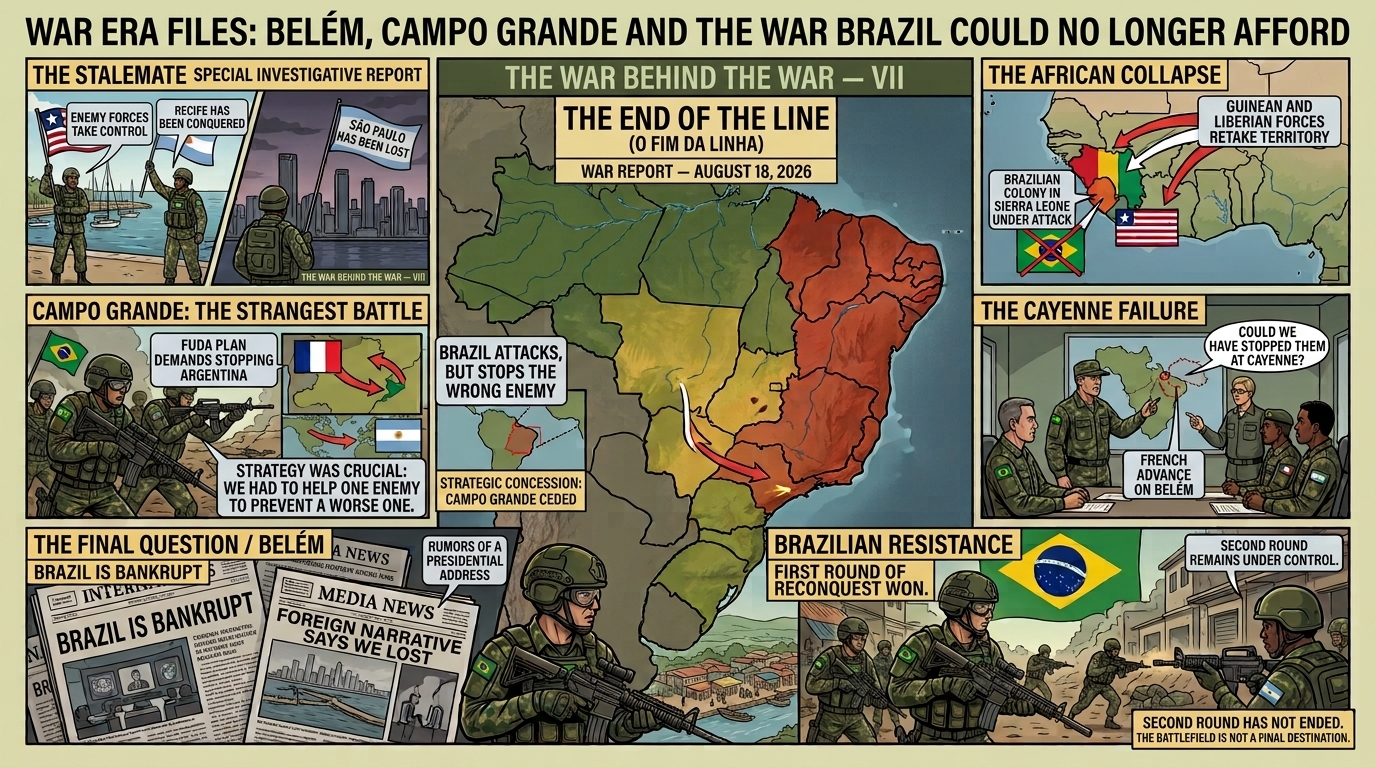
Belém, Campo Grande and the War Brazil Could No Longer Afford
WAR REPORT — 18 AUGUST 2026
The previous report asked why France and Argentina had suddenly gone quiet.
The answer may have been hidden beneath the battlefield itself.
Because while the world watched Brazil defend its last positions, the country was running out of something more valuable than territory:
resources.
Brazil is now effectively broke.
Weeks of war on multiple fronts have consumed its reserves, manpower and financial capacity. The country that once defended six fronts simultaneously is now struggling to sustain even the wars it considers essential.
And yet, somehow, the fighting continues.
RECIFE FALLS. SÃO PAULO FALLS.
The collapse came almost simultaneously.
Liberia conquered Recife.
Argentina conquered São Paulo.
Two cities that had resisted previous assaults were finally lost.
The Argentine victory was immediately celebrated by its media as further evidence of Brazilian weakness.
The Brazilian response, however, was noticeably different.
There was no grand counterclaim.
No declaration of imminent victory.
Just another front disappearing from the map.
And perhaps that was the most revealing response of all.
THE AFRICAN COLLAPSE
The situation in Africa deteriorated just as quickly.
Guinean forces continued attacking Brazilian colonies in Sierra Leone.
Eventually, Brazil lost Sierra Leone.
Liberia was also recovering territory in its former regions, including Northeastern Liberia, which Brazilian command had already classified as a secondary priority.
The African theater, once part of Brazil's expansion, had become a battlefield Brazil could no longer afford to prioritize.
The map was shrinking.
The war bill was not.
CAMPO GRANDE: THE STRANGEST BATTLE OF THE WAR
Then came the most confusing decision of the entire campaign.
Brazil had previously attacked French forces in Campo Grande, attempting to retake territory occupied by France.
But the strategic situation changed.
The FUDA plan required preventing Argentina from gaining control of Campo Grande.
And suddenly, Brazilian forces found themselves involved in a maneuver that could appear completely contradictory to outside observers:
Brazil needed to attack, but also needed to prevent the wrong enemy from winning.
To someone reading the battlefield without the intelligence behind it, the strategy looked absurd.
To those inside the operation, it was reportedly a matter of denying Argentina a strategic position.
Then came the outcome.
Brazil ceded Campo Grande.
The French position remained part of the equation.
Argentina did not receive the prize the FUDA strategy was designed to deny them.
It was not a victory in the conventional sense.
It was something far stranger:
a strategic concession made to prevent a worse outcome.
THE FAILURE OF CAYENNE
And now, old mistakes have returned to the discussion.
Among Brazilian commanders and military analysts, the Failure of Cayenne has become increasingly controversial.
The question is brutally simple:
Could Brazil have prevented the French advance on Belém in the first place?
If the answer is yes, then the fall of Belém was not inevitable.
It was an opportunity lost.
And that makes the current battle for its reconquest even more significant.
Brazil has already defeated France in the first Round of the operation to retake Belém.
The second Round has remained surprisingly manageable.
For a country that has lost Recife, São Paulo, Campo Grande and Sierra Leone, Belém has become more than territory.
It has become a test of whether Brazil can still reverse anything.
THE GREAT IRONY
The international narrative once described Brazil as cowardly.
Then Brazil fought six fronts.
It was called weak.
Then it held them.
It was called finished.
Then it survived.
Its enemies mocked the Brazilian silence.
Then the silence became resistance.
Brazil even managed to recover part of its international reputation simply by demonstrating that it could defend itself against overwhelming pressure.
But there is a cruel irony.
Brazil proved it could survive the war.
It did not prove it could afford the war.
Now the reserves are gone.
The infrastructure is damaged.
The government faces increasing internal criticism.
And rumors continue circulating that the Presidency may eventually address the nation.
There is still no confirmation.
But the rumors persist.
THE PRESIDENTIAL QUESTION
The international media has gone further.
Some reports now claim that President Rafael's government has already internally recognized defeat against French and Argentine forces.
There is no official confirmation.
But the rumor alone has become politically explosive.
Inside Brazil, criticism grows.
Outside Brazil, the narrative has already been written.
According to some foreign media:
Brazil has lost.
According to Brazilian supporters:
Brazil has simply reached the limit of what one country can endure.
And according to the battlefield?
The answer remains unfinished.
THE WAR BEHIND THE WAR
The war began with Liberia.
Then came Argentina.
Then France.
Then six fronts.
Then Belém.
Fortaleza.
Manaus.
Campo Grande.
Recife.
São Paulo.
Africa.
The reserves.
The alliances.
The diplomacy.
The propaganda.
The spies.
The rumors.
And now, perhaps, exhaustion.
Brazil has lost enormous amounts of territory.
But it has also forced its enemies to spend enormous amounts of resources to take it.
The FUDA alliance remains involved.
The global war has changed the strategic environment.
France and Argentina are no longer operating in the same world they were when the invasion began.
And Brazil, despite everything, remains on the battlefield.
THE FINAL QUESTION
The question is no longer whether Brazil can win every front.
It cannot.
That reality has already arrived.
The question is whether Brazil can choose which losses matter.
Campo Grande was ceded.
Sierra Leone was lost.
Recife fell.
São Paulo fell.
Salvador under Liberia incursion.
Rio being attacked by Argentina...
But Belém was retaken.
And perhaps this is what the war has become:
Not a struggle to save everything.
A struggle to save something.
Brazil once celebrated proving that it could fight a war it thought impossible.
Now it faces the harder task:
proving that losing a war does not necessarily mean losing everything.
The international media may already have written the ending.
Brazilian soldiers, however, are still writing the next paragraph.
The war continues.
The investigation remains open.
(Quadrinhos e História)
Vamos analisar os quadrinhos, seguidos pelo conteúdo de História.
A GUERRA POR TRÁS DA GUERRA — VII
O FIM DA LINHA
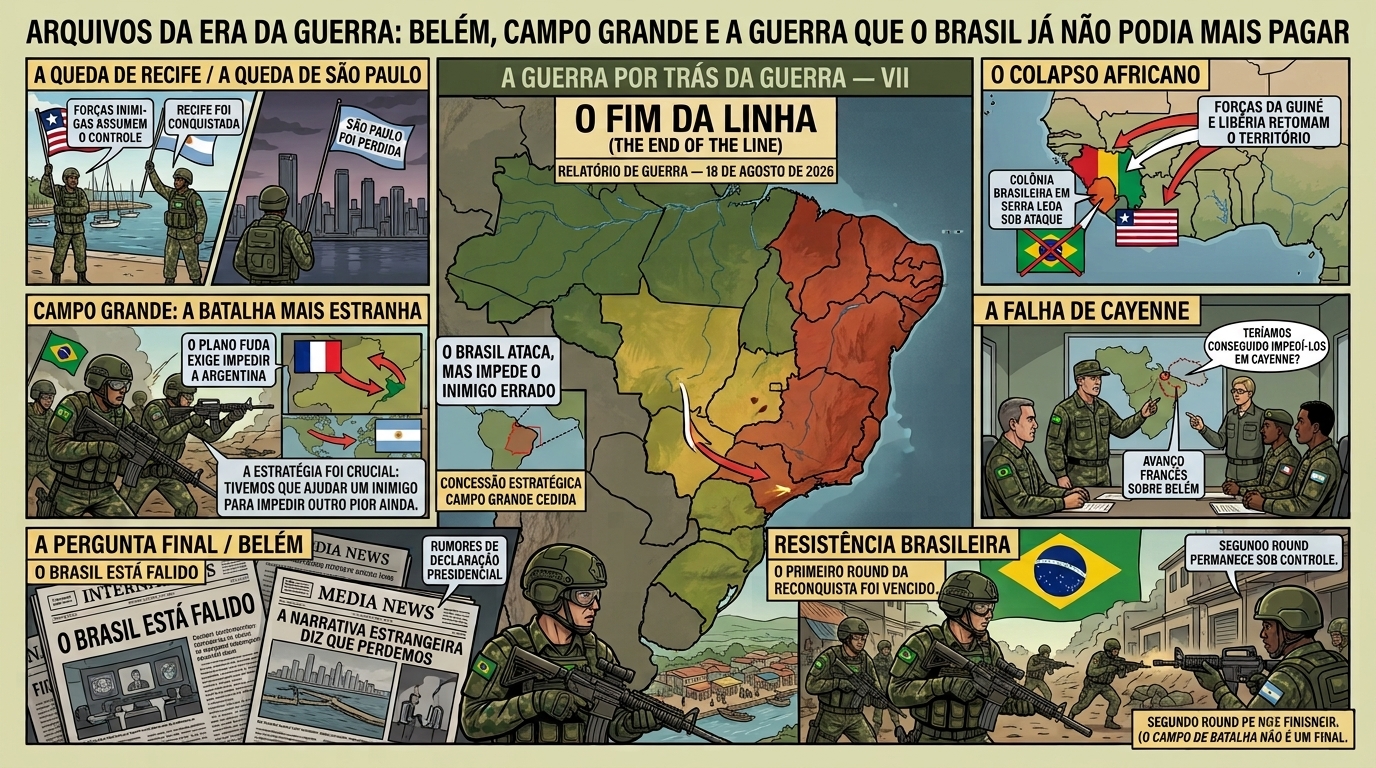
Belém, Campo Grande e a Guerra que o Brasil Já Não Podia Mais Pagar
RELATÓRIO DE GUERRA — 18 DE AGOSTO DE 2026
O relatório anterior questionava por que França e Argentina haviam repentinamente ficado em silêncio.
A resposta talvez estivesse escondida no próprio campo de batalha.
Enquanto o mundo observava o Brasil defender suas últimas posições, o país estava ficando sem algo mais valioso que território:
recursos.
O Brasil está, efetivamente, quebrado.
Semanas de guerra em múltiplas frentes consumiram suas reservas, efetivos e capacidade financeira. O país que antes defendia seis frentes simultaneamente agora luta para sustentar até mesmo os conflitos que considera essenciais.
E, ainda assim, de alguma forma, a guerra continua.
RECIFE CAI. SÃO PAULO CAI.
O colapso veio praticamente ao mesmo tempo.
A Libéria conquistou Recife.
A Argentina conquistou São Paulo.
Duas cidades que haviam resistido a ataques anteriores finalmente foram perdidas.
A vitória argentina foi imediatamente celebrada por sua mídia como mais uma prova da fraqueza brasileira.
A resposta brasileira, porém, foi diferente.
Não houve grande contra-ataque verbal.
Nenhuma declaração de vitória iminente.
Apenas mais uma frente desaparecendo do mapa.
E talvez essa tenha sido a resposta mais reveladora de todas.
O COLAPSO AFRICANO
A situação na África se deteriorou com a mesma velocidade.
As forças guineenses continuaram atacando as colônias brasileiras em Serra Leoa.
Eventualmente, o Brasil perdeu Serra Leoa.
A Libéria também recuperava territórios em suas antigas regiões, incluindo Northeastern Liberia, que o comando brasileiro já havia classificado como uma prioridade secundária.
O teatro africano, antes parte da expansão brasileira, havia se transformado em um campo de batalha que o Brasil já não conseguia priorizar.
O mapa estava diminuindo.
A conta da guerra, não.
CAMPO GRANDE: A BATALHA MAIS ESTRANHA DA GUERRA
Então veio a decisão mais confusa de toda a campanha.
O Brasil havia anteriormente atacado as forças francesas em Campo Grande, tentando recuperar o território ocupado pela França.
Mas a situação estratégica mudou.
O plano da FUDA exigia impedir que a Argentina assumisse o controle de Campo Grande.
E, de repente, as forças brasileiras encontraram-se envolvidas em uma manobra que poderia parecer completamente contraditória para observadores externos:
o Brasil precisava atacar, mas também precisava impedir que o inimigo errado vencesse.
Para quem observava o campo de batalha sem acesso às informações internas, a estratégia parecia absurda.
Para aqueles envolvidos na operação, tratava-se de impedir que a Argentina obtivesse uma posição estratégica.
Então veio o resultado.
O Brasil cedeu Campo Grande.
A posição francesa permaneceu parte da equação.
A Argentina não recebeu o prêmio que a estratégia da FUDA buscava negar.
Não foi uma vitória no sentido convencional.
Foi algo muito mais estranho:
uma concessão estratégica feita para evitar um resultado ainda pior.
A FALHA DE CAYENNE
E agora, velhos erros voltaram ao centro das discussões.
Entre comandantes e analistas militares brasileiros, a Falha de Cayenne tornou-se cada vez mais controversa.
A pergunta é brutalmente simples:
O Brasil poderia ter impedido o avanço francês sobre Belém desde o início?
Se a resposta for sim, então a queda de Belém não era inevitável.
Foi uma oportunidade perdida.
E isso torna a atual batalha pela reconquista ainda mais importante.
O Brasil já venceu o primeiro Round da operação para recuperar Belém.
O segundo Round permaneceu surpreendentemente controlado.
Para um país que perdeu Recife, São Paulo, Campo Grande e Serra Leoa, Belém tornou-se mais do que território.
Tornou-se um teste para saber se o Brasil ainda consegue reverter alguma coisa.
A GRANDE IRONIA
A narrativa internacional já chamou o Brasil de covarde.
Então o Brasil lutou em seis frentes.
Foi chamado de fraco.
Então segurou todas elas.
Foi considerado acabado.
Então sobreviveu.
Seus inimigos zombaram do silêncio brasileiro.
Então o silêncio tornou-se resistência.
O Brasil chegou inclusive a recuperar parte de sua reputação internacional simplesmente demonstrando que conseguia se defender diante de uma pressão esmagadora.
Mas existe uma cruel ironia.
O Brasil provou que conseguia sobreviver à guerra.
Não provou que conseguia pagar por ela.
Agora as reservas acabaram.
A infraestrutura está comprometida.
O governo enfrenta críticas internas crescentes.
E continuam circulando rumores de que a Presidência poderá eventualmente se dirigir à nação.
Ainda não existe confirmação.
Mas os rumores persistem.
A QUESTÃO PRESIDENCIAL
A mídia internacional foi ainda mais longe.
Alguns relatos agora afirmam que o governo do presidente Rafael já teria reconhecido internamente a derrota diante das forças francesas e argentinas.
Não existe confirmação oficial.
Mas o rumor, por si só, tornou-se politicamente explosivo.
Dentro do Brasil, as críticas crescem.
Fora do Brasil, a narrativa já foi escrita.
Segundo parte da mídia estrangeira:
O Brasil perdeu.
Segundo seus apoiadores:
O Brasil simplesmente chegou ao limite do que um país consegue suportar.
E segundo o campo de batalha?
A resposta continua inacabada.
A GUERRA POR TRÁS DA GUERRA
A guerra começou com a Libéria.
Depois veio a Argentina.
Depois a França.
Então vieram seis frentes.
Depois Belém.
Fortaleza.
Manaus.
Campo Grande.
Recife.
São Paulo.
África.
As reservas.
As alianças.
A diplomacia.
A propaganda.
Os espiões.
Os rumores.
E agora, talvez, o esgotamento.
O Brasil perdeu enormes quantidades de território.
Mas também obrigou seus inimigos a gastar enormes quantidades de recursos para conquistá-lo.
A aliança da FUDA continua envolvida.
A guerra global mudou o ambiente estratégico.
França e Argentina já não operam no mesmo mundo em que estavam quando a invasão começou.
E o Brasil, apesar de tudo, continua no campo de batalha.
A PERGUNTA FINAL
A pergunta já não é se o Brasil consegue vencer todas as frentes.
Não consegue.
Essa realidade já chegou.
A pergunta é se o Brasil consegue escolher quais perdas importam.
Campo Grande foi cedida.
Serra Leoa foi perdida.
Recife caiu.
São Paulo caiu.
Salvador sob incursão da Libéria.
Rio de Janeiro sendo atacado pela Argentina...
Mas Belém foi recuperada.
E talvez seja nisso que a guerra tenha se transformado:
Não uma luta para salvar tudo.
Uma luta para salvar alguma coisa.
O Brasil um dia comemorou provar que conseguia lutar uma guerra que acreditava ser impossível.
Agora enfrenta uma tarefa ainda mais difícil:
provar que perder uma guerra não significa necessariamente perder tudo.
A mídia internacional talvez já tenha escrito o final.
Os soldados brasileiros, porém, ainda estão escrevendo o próximo parágrafo.
A guerra continua.
A investigação permanece aberta.