The War Behind the War - Part VIII (Comic & History) [EN/PT]
Comic & History
We’re looking at the comic, followed by the History content
THE WAR BEHIND THE WAR — VIII
THE RETURN OF THE MAP
Belém Returns. Brasília Falls. And the Coalition Begins to Crack.
WAR REPORT — EMERGENCY TRANSMISSION
The previous report asked whether Brazil could survive losing everything.
Today, we can no longer guarantee that this report itself will survive.
Our communications remain active, but barely. French, Argentine and Liberian bombardments have crippled infrastructure across the country. Our newsroom is under international press protection, yet we can no longer guarantee the safety of our own reporters.
Some correspondents have disappeared.
Some transmissions never arrived.
Some of the story may already be buried beneath the rubble.
Still,
we are transmitting.
THE MAP MOVES AGAIN
The war has stopped behaving like a timeline.
Cities fall.
Cities return.
Fronts disappear.
New ones open before the previous reports reach the public.
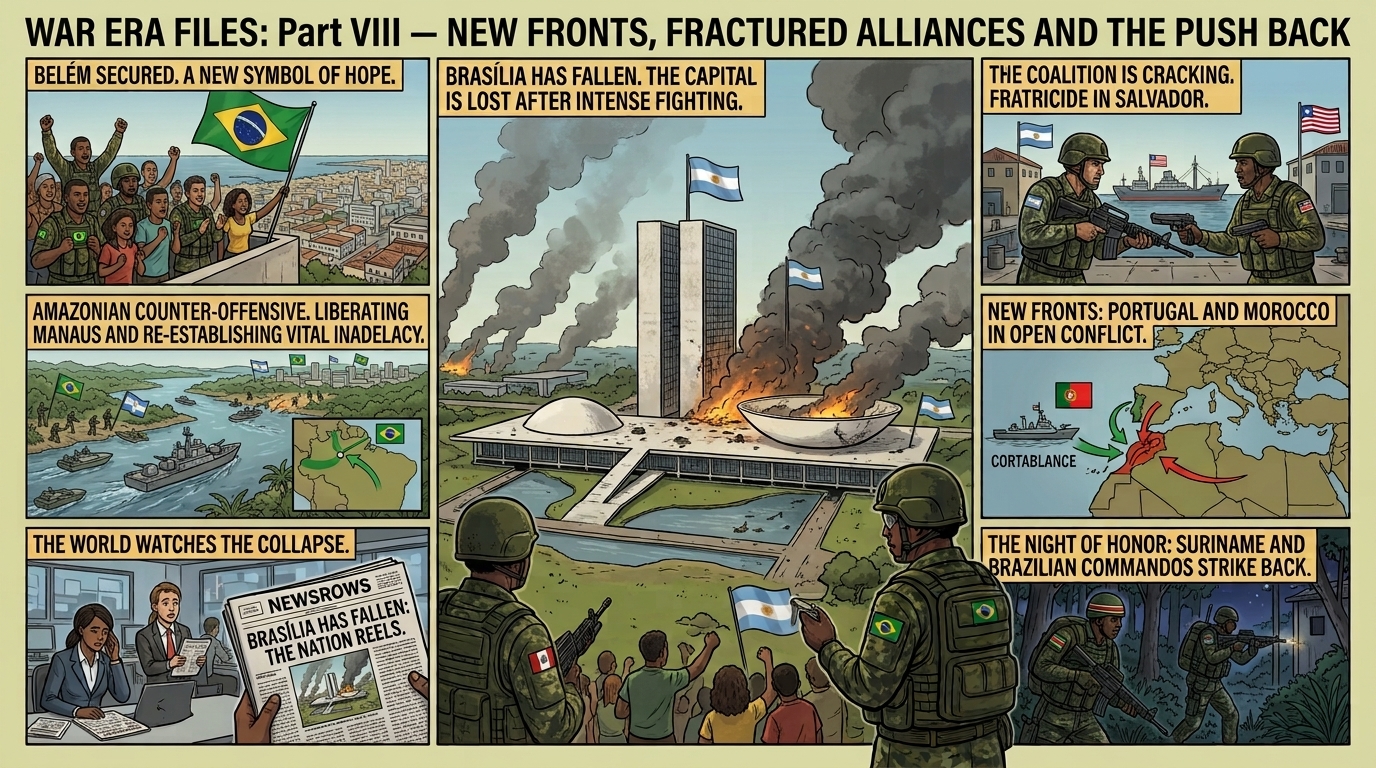
Yesterday, Belém returned to Brazil.
The city that became the greatest symbol of French expansion became, once again, the greatest symbol of Brazilian resistance.
President Rafael has quietly become one of the defining figures of this phase of the war. Whether praised or criticized, the reconquest of Belém marked the first undeniable sign that Brazil could still recover territory.
But victory did not last long enough for celebration.
BRASÍLIA FALLS
Argentina has now captured Brasília.
The capital that had survived repeated assaults finally fell.
Ironically, only hours earlier, Liberian forces had failed to break allied defenses there.
Now, the battlefield has produced something nobody predicted.
Argentina has opened attacks against Liberian forces in Salvador.
The defensive pact between the two countries has collapsed.
Former partners are now firing at each other.
The coalition surrounding Brazil has begun to fracture.
PERU CHANGES THE WAR
If one country has become indispensable to Brazil's survival, it is Peru.
Together with Brazilian forces, Peru helped restore Manaus.
Peruvian troops also recovered Campo Grande, reopening one of the war's most disputed theaters.
Now, Peruvian forces continue pressing toward São Paulo, refusing to let the southern front become a permanent Argentine victory.
Meanwhile, FUDA's influence continues expanding.
The bloc now controls Colombia, while Venezuela strengthens allied positions abroad, stabilizing operations in Puerto Rico and securing influence around Guinea-Bissau and Cape Verde.
The map is no longer shrinking only for Brazil.
It is moving for everyone.
THE SURINAME NIGHT
Military historians may eventually remember one particular night.
Suriname attacked Liberian forces defending Brasília.
Then struck Argentine forces in São Paulo.
The operation became one of the most celebrated allied actions of the campaign.
Brazilian circles now speak openly of a “Night of Honor.”
For a country that had already been counted out several times, Suriname reminded everyone that allies can change battles.
Sometimes before sunrise.
THE WAR OUTSIDE BRAZIL
The global conflict continues reshaping everything.
Germany prepares to enter the war.
Portugal has opened a new front against Morocco.
Russia shows signs of instability.
France may soon be forced to divide attention between South America and Europe.
For weeks, Brazil fought while the world watched.
Now the world has become too busy fighting itself.
THE CAYENNE CORRECTION
Then came perhaps the most symbolic decision yet.
Brazil has launched an offensive against Cayenne, French territory in South America.
Months ago, analysts argued that the Failure of Cayenne helped make Belém vulnerable.
Now, the same name returns.
Not as a mistake.
As a target.
Whether this changes the strategic balance remains unknown.
But psychologically, the message is unmistakable.
Brazil has stopped looking only inward.
It is striking back.
THE COUNTRY THAT REFUSED TO DISAPPEAR
Brazil remains financially exhausted.
Internal criticism continues growing.
Leaked conversations openly call for replacing the current leadership.
Rumors of political reorganization circulate.
Official diplomacy remains silent.
The Presidency still has not addressed the nation.
And yet
The army keeps moving.
The allies keep fighting.
The transmissions keep arriving.
Even the famous friendly-fire incident has become part of military folklore.
Exhausted Brazilian troops accidentally fired in the wrong direction
and somehow hit French and Argentine forces anyway.
Military doctrine has yet to explain it.
Luck has refused to comment.
THE FINAL QUESTION
Weeks ago, the world asked:
“Total Brazilian wipe?”
That question has become more complicated.
Brazil has lost Brasília.
It has regained Belém.
It has regained Manaus.
It has regained Campo Grande.
It has regained Recife and Fortaleza.
The coast remains fiercely contested.
The South remains under pressure.
The Northeast breathes again.
And now, the enemies themselves have begun fighting one another.
Perhaps the greatest surprise of this war is no longer that Brazil survived.
Perhaps it is that, after everything, the map has started moving back.
The investigation remains open.
The communications remain active.
And if this transmission reaches tomorrow,
we will continue reporting.
(Quadrinhos e História)
Vamos analisar os quadrinhos, seguidos pelo conteúdo de História.
A GUERRA POR TRÁS DA GUERRA — VIII
O RETORNO DO MAPA
Belém Volta. Brasília Cai. E a Coalizão Começa a Rachar.
RELATÓRIO DE GUERRA — TRANSMISSÃO DE EMERGÊNCIA
O relatório anterior perguntava se o Brasil conseguiria sobreviver perdendo tudo.
Hoje, já não conseguimos garantir que esta própria reportagem sobreviva.
Nossas comunicações continuam ativas, mas por muito pouco. Bombardeios franceses, argentinos e liberianos destruíram grande parte da infraestrutura do país. Nossa redação está sob proteção internacional da imprensa, mas já não conseguimos garantir a segurança da própria equipe.
Alguns repórteres desapareceram.
Algumas transmissões nunca chegaram.
Parte da história talvez já esteja soterrada.
Mesmo assim,
continuamos transmitindo.
O MAPA VOLTOU A SE MOVER
A guerra deixou de obedecer uma cronologia.
Cidades caem.
Cidades voltam.
Frentes desaparecem.
Outras surgem antes que a notícia anterior chegue ao público.
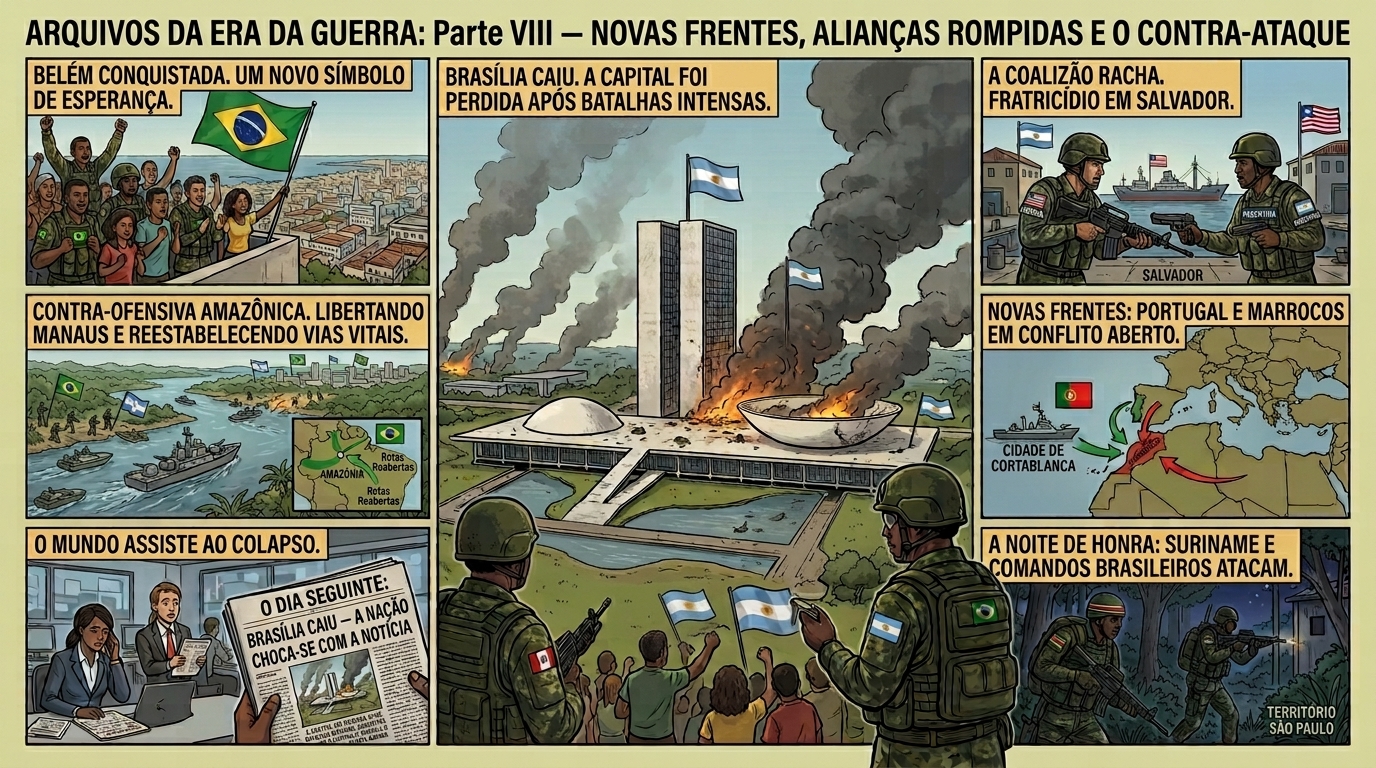
Ontem, Belém voltou a ser brasileira.
A cidade que simbolizou o avanço francês tornou-se novamente o maior símbolo da resistência brasileira.
O presidente Rafael tornou-se uma das figuras centrais desta fase da guerra. Independentemente das críticas, a retomada de Belém marcou o primeiro sinal inegável de que o Brasil ainda conseguia recuperar território.
Mas a vitória durou pouco demais para virar comemoração.
BRASÍLIA CAI
A Argentina conquistou Brasília.
A capital, que havia resistido a sucessivos ataques, finalmente caiu.
E o campo de batalha produziu algo que ninguém previa.
A Argentina passou a atacar forças liberianas em Salvador.
O pacto defensivo entre ambos foi rompido.
Antigos parceiros agora trocam tiros entre si.
A coalizão que cercava o Brasil começou a rachar.
O PERU MUDA A GUERRA
Se existe um país que se tornou indispensável para a sobrevivência brasileira, esse país é o Peru.
Ao lado do Brasil, ajudou a recuperar Manaus.
Também retomou Campo Grande, reabrindo um dos teatros mais disputados da guerra.
Agora, forças peruanas seguem pressionando em direção a São Paulo, recusando-se a aceitar o Sul como uma vitória definitiva argentina.
Enquanto isso, a influência da FUDA continua crescendo.
O bloco passou a controlar a Colômbia, enquanto a Venezuela fortalece posições aliadas em Porto Rico e amplia sua presença em torno de Guiné-Bissau e Cabo Verde.
O mapa já não encolhe apenas para o Brasil.
Ele voltou a se mover para todos.
A MADRUGADA DO SURINAME
Os historiadores talvez se lembrem de uma madrugada específica.
O Suriname atacou forças liberianas em Brasília.
Depois atingiu forças argentinas em São Paulo.
A operação tornou-se uma das ações aliadas mais celebradas de toda a campanha.
Nos círculos brasileiros, já existe até um nome informal para ela:
“A Madrugada da Honra.”
Para um país que já havia sido dado como derrotado várias vezes, o Suriname lembrou que aliados também mudam guerras.
Às vezes antes do amanhecer.
A GUERRA FORA DO BRASIL
O conflito mundial continua redesenhando o tabuleiro.
A Alemanha prepara sua entrada.
Portugal abriu uma frente contra Marrocos.
A Rússia demonstra sinais de instabilidade.
A França poderá ser obrigada a dividir recursos entre a Europa e a América do Sul.
Durante semanas, o Brasil lutou enquanto o mundo assistia.
Agora o mundo está ocupado demais lutando consigo mesmo.
A CORREÇÃO DE CAYENNE
Então veio talvez a decisão mais simbólica até agora.
O Brasil lançou uma ofensiva contra Cayenne, território francês na América do Sul.
Meses atrás, analistas diziam que a Falha de Cayenne ajudou a abrir caminho para a queda de Belém.
Agora o mesmo nome volta.
Não como erro.
Como alvo.
Ninguém sabe se isso mudará o equilíbrio estratégico.
Mas a mensagem psicológica é clara.
O Brasil parou de olhar apenas para dentro.
Começou a revidar.
O PAÍS QUE SE RECUSOU A DESAPARECER
O Brasil continua financeiramente exaurido.
As críticas internas crescem.
Conversas vazadas pedem uma nova liderança.
Rumores sobre reorganização política circulam.
A diplomacia continua em silêncio.
A Presidência ainda não falou oficialmente.
E, mesmo assim
O Exército continua avançando.
Os aliados continuam lutando.
As transmissões continuam chegando.
Até o famoso caso do fogo amigo virou folclore militar.
Tropas brasileiras exaustas dispararam na direção errada
e, por alguma explicação que a ciência ainda se recusa a fornecer, acertaram franceses e argentinos mesmo assim.
A doutrina militar ainda não explicou.
A sorte preferiu não comentar.
A PERGUNTA FINAL
Semanas atrás, o mundo perguntava:
“Total Brazilian wipe?”
Hoje essa pergunta ficou mais complicada.
O Brasil perdeu Brasília.
Mas recuperou Belém.
Recuperou Manaus.
Recuperou Campo Grande.
Recuperou Recife e Fortaleza.
O litoral continua ferozmente disputado.
O Sul permanece sob pressão.
O Nordeste voltou a respirar.
E agora os próprios inimigos começaram a lutar entre si.
Talvez a maior surpresa desta guerra já não seja que o Brasil sobreviveu.
Talvez seja que, depois de tudo, o mapa começou a voltar.
A investigação continua aberta.
As comunicações permanecem ativas.
E, se esta transmissão chegar até amanhã,
continuaremos informando o mundo.