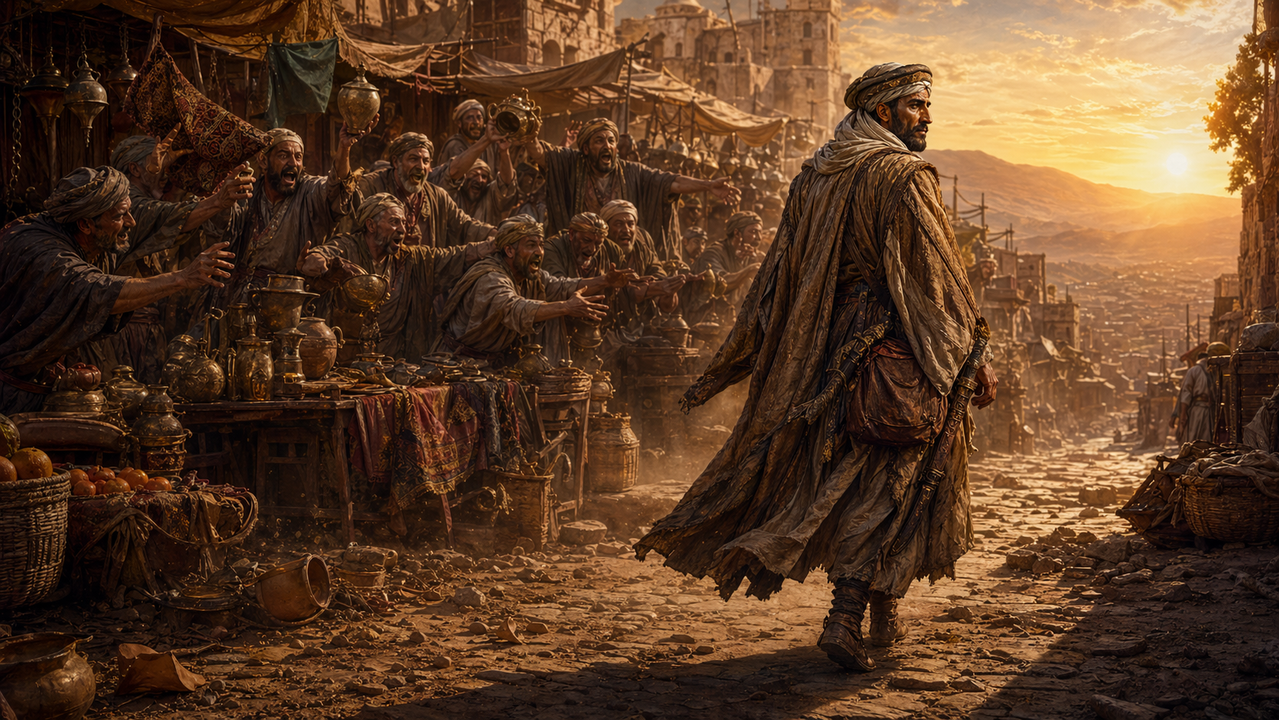
The Warrior Who Brought Facts to a Bargain
In the age when maps were mostly guesses and every kingdom claimed to be the center of the world, there lived a wandering warrior-trader named Darun.

Darun crossed deserts, seas, mountain gates, cursed valleys, and at least three realms that insisted they were “technically empires” because they owned two wells and a statue. He traded bronze, spices, cloth, blades, salt, stories, and occasionally insults, depending on the exchange rate.
He was a practical man.
If a sword was cracked, he said it was cracked.
If grain was rotten, he said it was rotten.
If a merchant demanded ten gold pieces for a sandal missing its partner, Darun would ask whether the other sandal had become king.
This made him deeply unpopular among a special breed of merchant: the ones who loved profit, hated honesty, and considered reality a hostile foreign power.
His first great headache came in an old Egyptian market, beneath painted columns and the merciless sun. A rich trader named Khemet-Ra, who wore enough gold to make poverty feel personally insulted, offered Darun a “rare ceremonial dagger.”
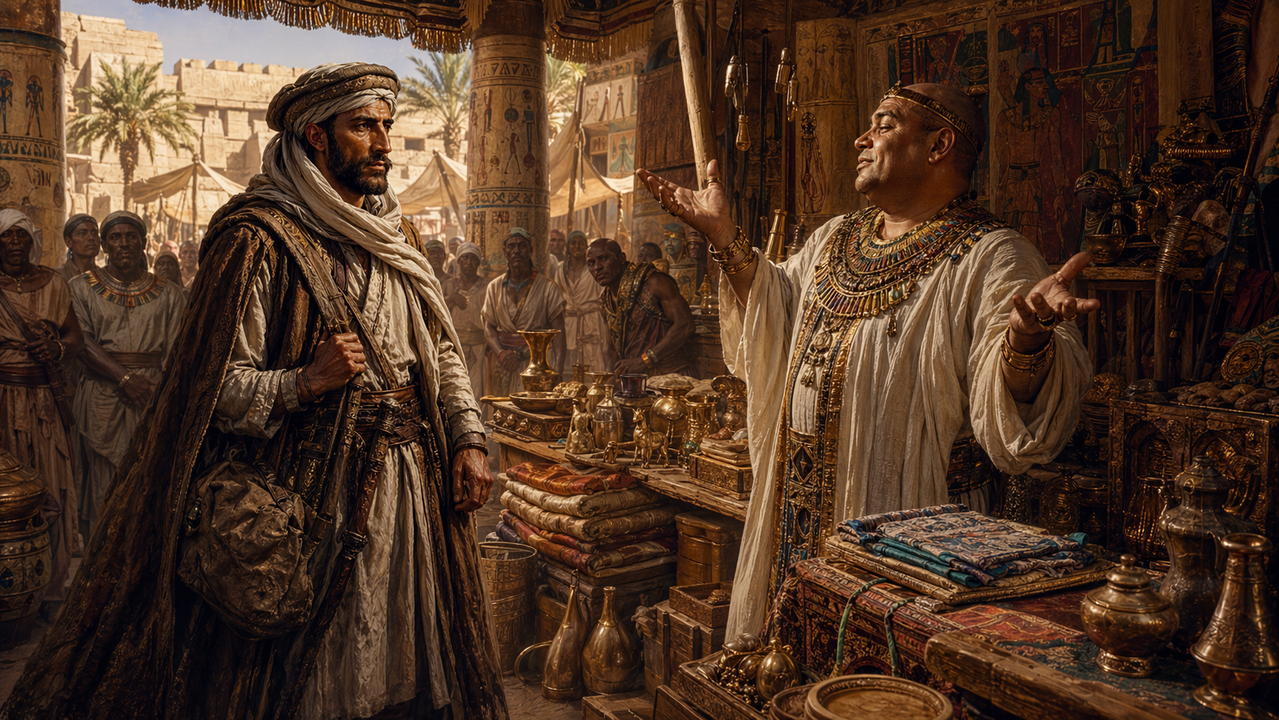
Darun picked it up.
“This is a kitchen knife,” he said.
Khemet-Ra gasped as if stabbed by truth itself.
“A sacred kitchen knife,” he corrected.
“The handle is loose.”
“It is designed that way, to remind the warrior that life is uncertain.”
“The blade is bent.”
“It curves toward destiny.”
“There’s onion on it.”
“A holy offering.”
Darun stared at him.
Khemet-Ra leaned closer and whispered, “Friend, friend, let us not bring real things into discussion. Real things make trade difficult.”
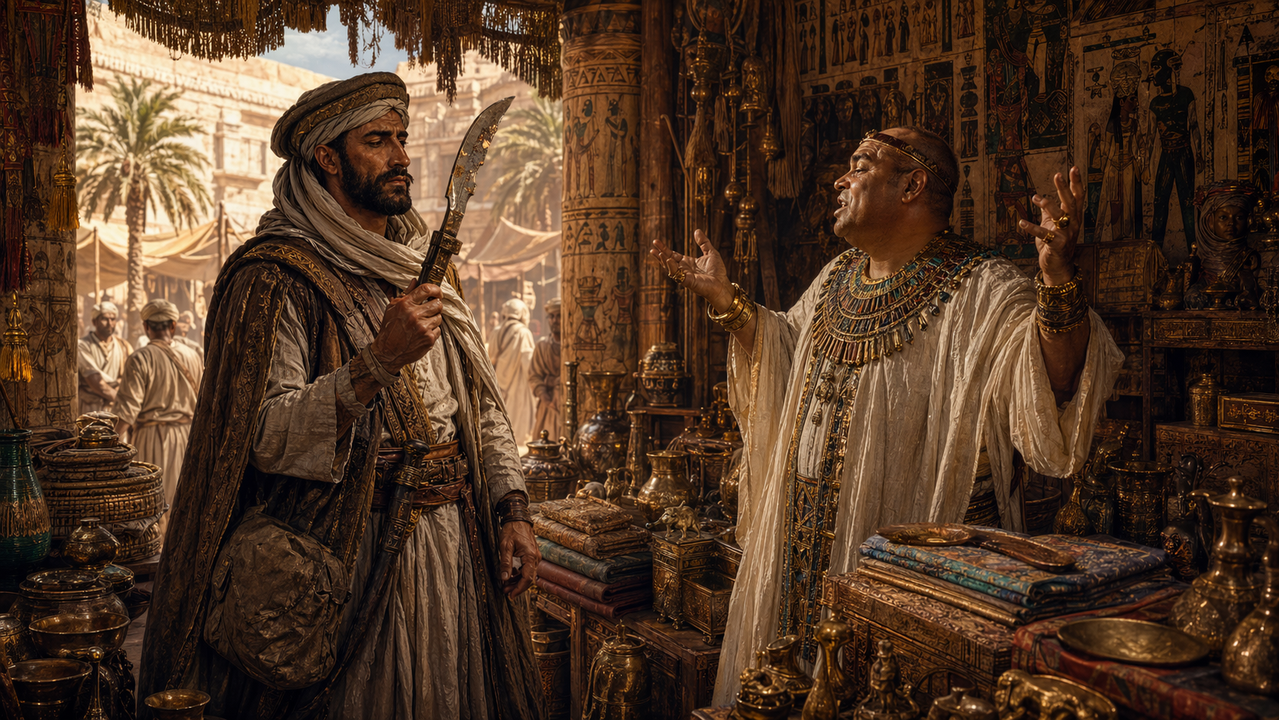
Darun realized then that some men did not negotiate with goods. They negotiated with fog.
Later, in the old streets of Jerusalem, he met another merchant, Ezra the Cloth-Keeper, who guarded his fabrics like they were royal children. Ezra offered Darun a piece of cloth “woven under moonlight by silent masters.”
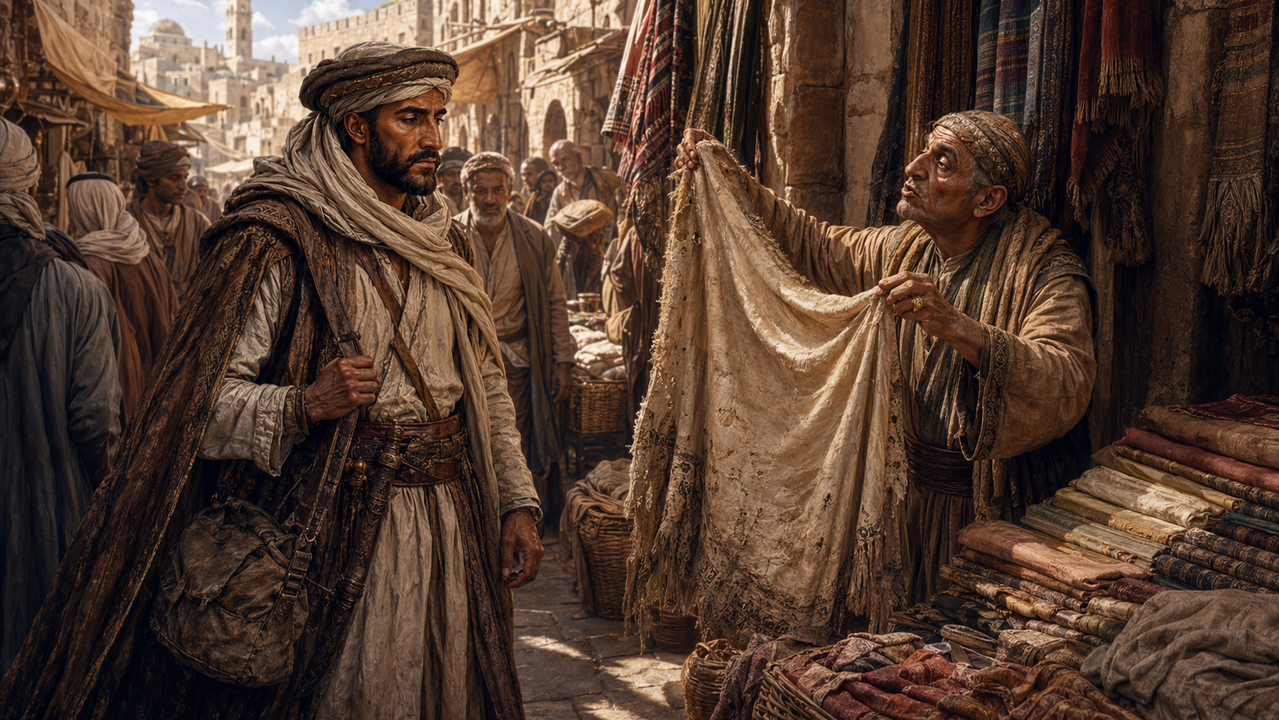
Darun touched it.
“This is torn.”
Ezra smiled. “Ventilation.”
“It is stained.”
“History.”
“It smells like goat.”
“Authenticity.”
Darun sighed. “You are asking eight silver coins for a rag.”
Ezra slammed his hand on the table. “Do not insult the rag. It has survived wars.”
“So has mud. I don’t pay taxes to mud.”
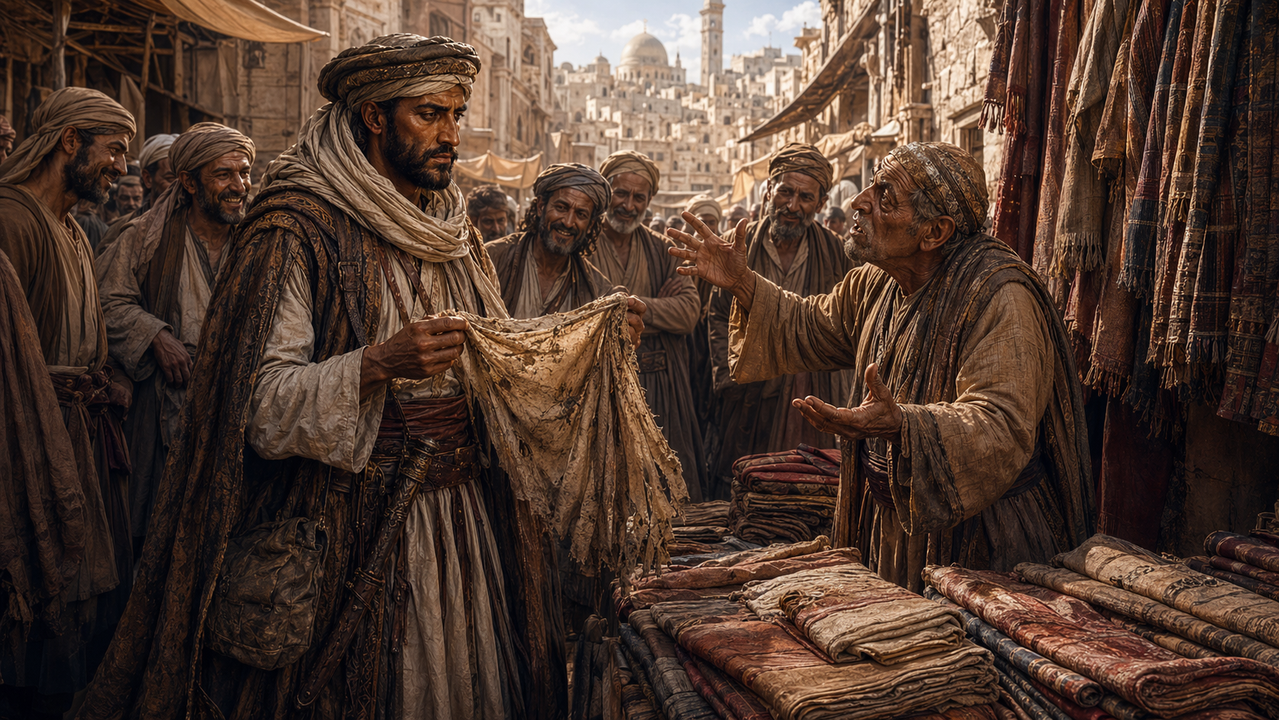
A crowd gathered, delighted. Nothing pleased ancient people more than watching two men argue over cloth while pretending civilization depended on it.
Darun tried again. “Listen. I am only saying the item is not worth what you claim.”
Ezra narrowed his eyes. “Ah. You bring truth.”
“Yes.”
“To a trade?”
“Yes.”
“In public?”
Darun nodded.
Ezra looked genuinely wounded. “What kind of barbarian are you?”
By sunset, both merchants had complained to the local trade council. The accusation was severe: Darun had “disturbed the natural flow of commerce by mentioning observable facts.”
He was summoned before the Council of Fair and Totally Honest Exchange, whose members were all merchants, which was like being judged for theft by a room full of foxes wearing chicken feathers.
The head councilman cleared his throat. “Darun, you stand accused of ruining negotiations.”
“I told the truth,” Darun said.
The room hissed.
One merchant covered his child’s ears.
The councilman frowned. “There it is again. That word. Truth. Very aggressive.”
Darun folded his arms. “A cracked sword is cracked. Rotten grain is rotten. A rag is a rag.”
Khemet-Ra stood up. “This man has no respect for tradition!”
Ezra stood beside him. “Or pricing imagination!”
Darun looked from one to the other. “You two argue like enemies but sell like brothers.”
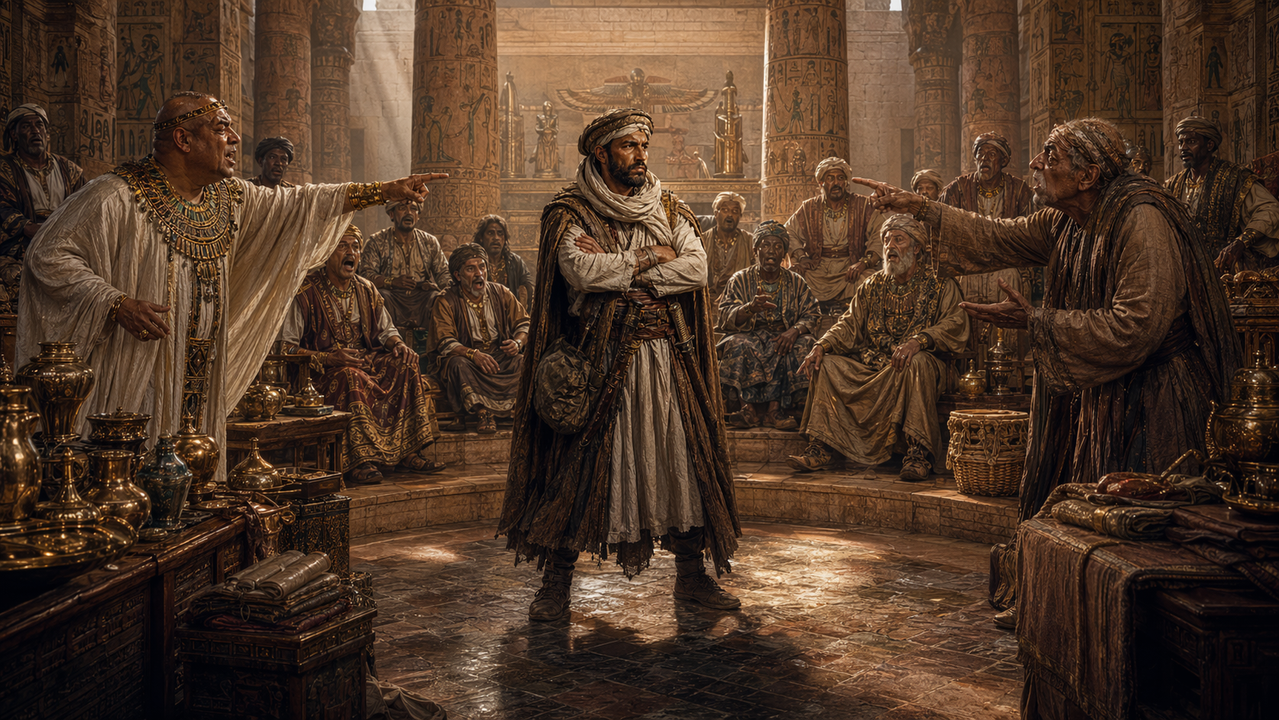
The room went silent.
That was worse than truth.
That was pattern recognition.
For three days, Darun was locked in the trade hall and forced to listen to lectures on “respectful bargaining,” which mostly meant accepting lies politely until everyone felt wealthy.
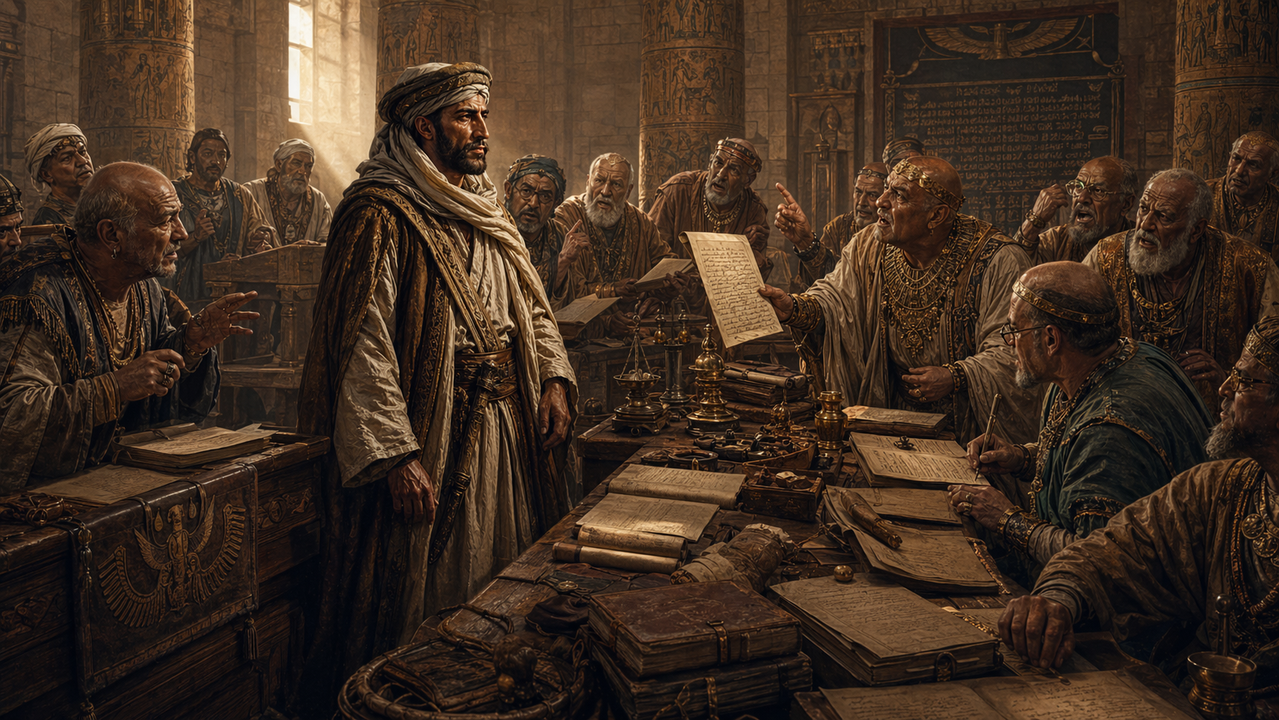
On the fourth day, he was released after agreeing never again to bring “real things” into a discussion unless properly wrapped in flattery, smoke, and at least two compliments about the merchant’s grandfather.
From then on, Darun became wiser.
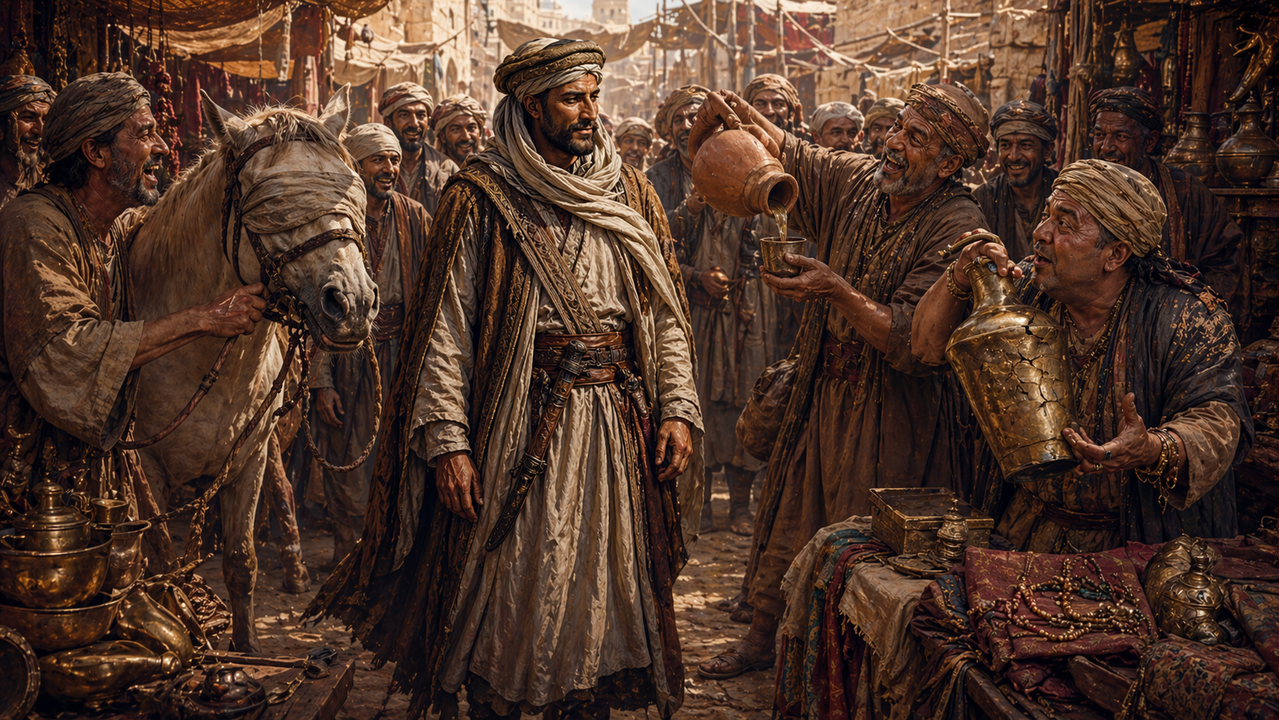
When a trader offered him a blind horse, he said, “What powerful inner vision.”
When someone sold him watered wine, he said, “A generous drink—already mixed with tomorrow’s regret.”
When a merchant asked too much for too little, Darun smiled and said, “Your price is brave. Not intelligent, but brave.”
And everywhere he traveled, people called him difficult.
Not because he cheated.
Not because he stole.
Not because he lied.
But because, in a world full of men selling kitchen knives as destiny and rags as heritage, Darun had committed the unforgivable crime:
He had noticed.