War Era Economics Guide
Hello and welcome to WarEra!
First of all this guide was originally written by https://app.warera.io/user/6969696041d32ac9dd035da8 but he allowed me to translate it. So credits to him, he did a great job!

This guide is dedicated exclusively to the economic aspect of the game and was created with the aim of helping you understand how resources, market, work and production work, avoiding common mistakes and waste in the first few days.
In WarEra a good economy is the basis of everything: army, companies, political power and long-term success. Here you will find practical advice and strategies designed for those who want to grow efficiently.
This guide doesn't make sense if you don't have a general overview of the game first.
https://app.warera.io/article/69ed08811c0a472f76f5944f
Index
1) Quick Incipit
2) Economic Skills
3) Work for Others
4) Companies and Working for Yourself
5) Market
6) Macroeconomics
7) War Economy
Fast Overview
The game as you may have noticed is 100% F2P, none of the features that I am about to explain to you are linked to a monetary value in the real world but will always and only require resources that you will find in the game. When I talk about money I always mean only the yellow coins in the game that you find at the top right.
Feel clearly free to skip the parts that you think you have already understood yourself, mechanics are simple you don't need a degree in economics to understand.
ECONOMIC SKILLS
The fundamental thing for skills at the beginning of the game (up to at least level 15) is to farm as much as possible and as quickly as possible; therefore, invest in economic skills. As we will see later, money is needed both to buy resources on the market and to expand your companies in both volume and quality.
Each level your account reaches grants you 4 skill points that can be invested to level up. Remember that it is much more important to extract every possible experience point from missions rather than farm money. Below you will find the missions screen.
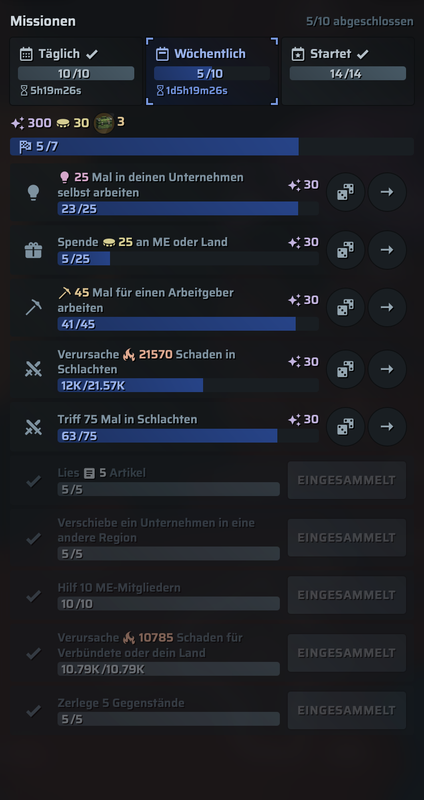
If you find among the daily or weekly missions a mission that you cannot complete, do not hesitate to reroll a mission even multiple times by spending money.
Experience > Money
This is the absolute rule of this game.
Below we find the economic skills, which I tend to divide into three categories:
Primary
Secondary
Advanced
Let’s start with the PRIMARY ones, which are production and energy. For the first 15 levels you should invest most of your skill points in these two skills.
Energy is the blue bar you see at the top, which allows you to work in other players’ companies every 10 points. It increases your energy storage by 10 points per level and increases your hourly energy recovery by 1 point.
Production, on the other hand, is the multiplier of your work, both when working for others and in your own companies. I will explain this in more detail with formulas in the work section.
The SECONDARY skills are no less important than the primary ones, but inevitably you will invest less in them, especially in the early stages of the game. They are Companies Limit and entrepreneurship.
Entrepreneurship is identical to energy but is used to work for yourself. You might ask why it is secondary and why you should invest less in it than in energy. Simply because it scales by 5 instead of 10, which means that each level will only give you 5 points of entrepreneurship storage and 0.5 points of hourly recovery.
Companies Limit is a key skill, perhaps the most important. I will explain it better in the Companies section.
The ADVANCED skill is management, which allows you to have more workers. Its usefulness depends on the market; generally, having more than 4 worker slots is pointless, but we will look at this in more detail in the Companies section.
WORKING FOR OTHERS
In the "Companies" section at the bottom right, you will find two key parts for your economy: the JOB section and the COMPANIES section.
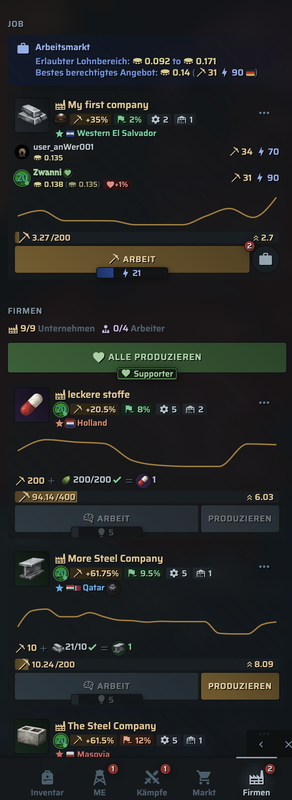
For now, let’s focus on the JOB section.
As you can see in the image above, you will find your job; in my case, 0.138 is the gross salary and 0.135 is the net salary, and below are the other offers/workers that your employer has for that company.
Every time you click work, 10 energy points will be deducted, and you will fill your employer’s yellow bar (PP, which stands for Production Points) with exactly your production * the country’s productivity bonus (0% in my case).
We will go into more detail about this bonus in the sections on Companies, Macroeconomics, and Strategic Resources.
The salary is determined by the formula WAGE PP (pre-bonus). In my case, I have 31 production, so approximately 31 0.135 = 4.185.
The Blue section above the Job is the job market, where you will find all posted offers sorted by gross salary.
ATTENTION: AS EMPLOYEES, YOU SHOULD CARE ABOUT THE NET SALARY, WHICH DEPENDS ON THE TAX RATE OF THE COUNTRY WHERE THE COMPANY IS BASED.
Pro Tip: Before leaving your job for a more profitable one, try contacting your employer to see if they can increase your pay. There is a bonus for employers called the "Fidelity Bonus," indicated with a heart, which increases from 1% to 10%.
One last important note: you cannot leave your job for 24 hours once you take it.
COMPANIES AND WORKING FOR YOURSELF
Your own companies are the true engine of your economy and in the long run should become your personal industrial complex.
Now let’s take a look together at the screen that appears after clicking on any of your companies; I will do so with my ‚More Steel Company‘
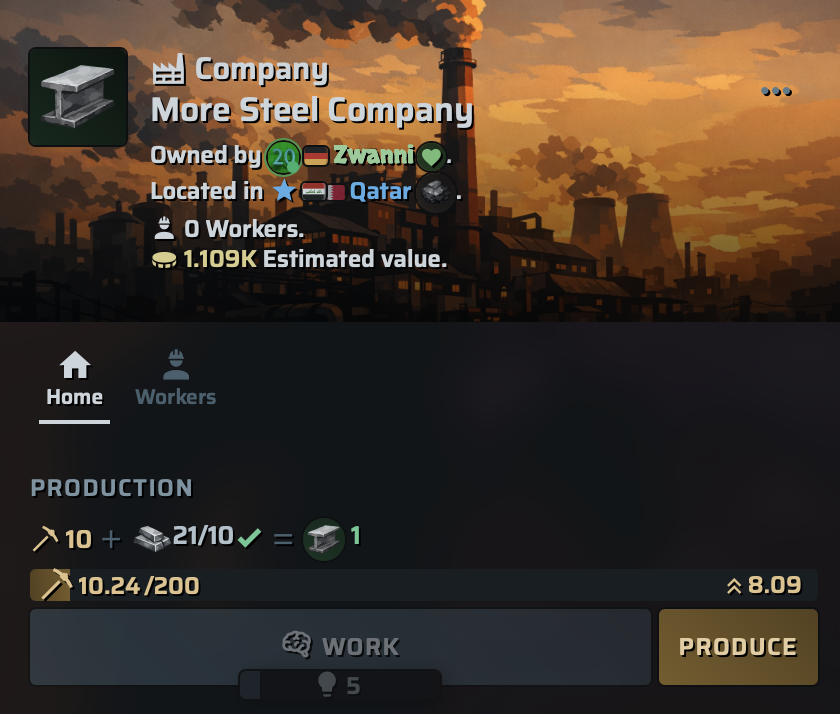
From top to bottom you will find:
Name
Ownership
Registered office (where you pay taxes)
Current number of employees
The company’s value, which depends on the upgrades that we will see in a moment
Below you will find the production (in this case 10 PP for 1 unit of Steel) and the storage bar, in this case 10.24 out of 200 (at the bottom you can see the automatic hourly production including bonuses, in my case 8.04).

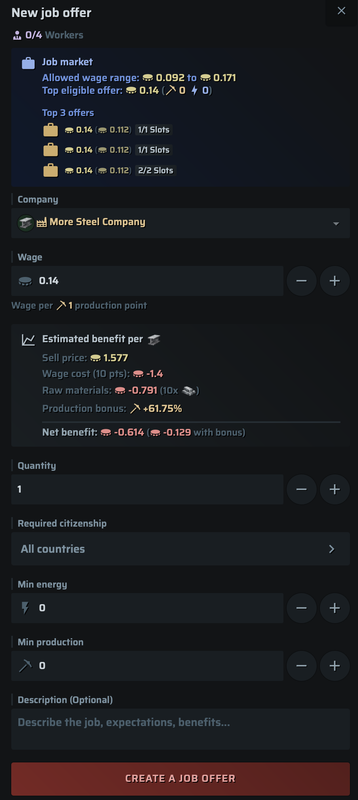
Scrolling further down, you will find the option to post a new job position, setting the wage (gross), the number of positions, and the requirements you would like your employees to meet.
You cannot fire an employee for 24 hours once hired.
Below the job offers you will find the statistics of your employees, including fidelity bonus, energy, and production. By clicking on the pencil icon next to the stats, you can modify the contract; if you lower the salary, they have the right to leave even before the standard 24 hours.
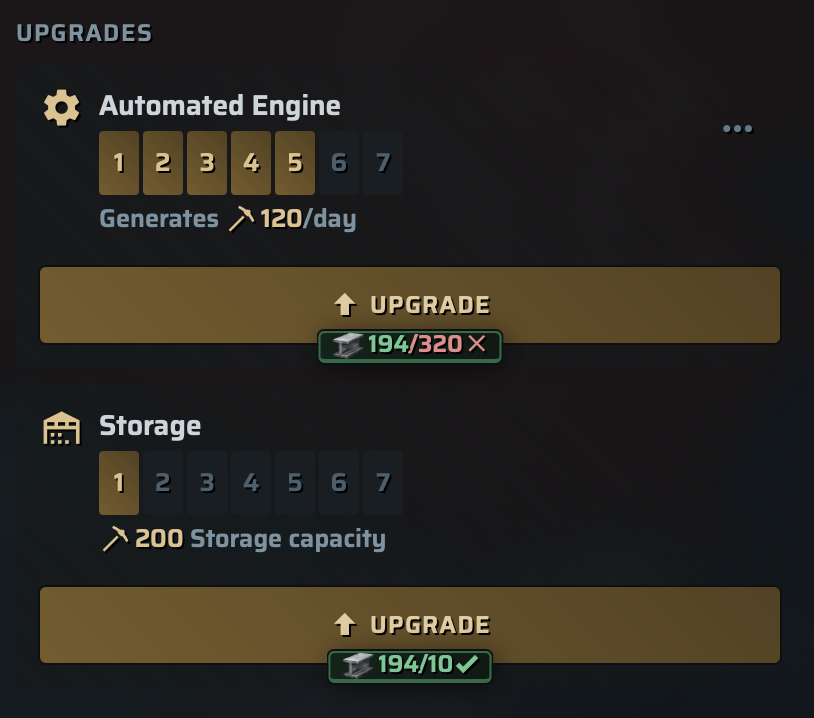
Further down you will find the upgrades:
Automated Engine (AE) is simply what the company produces on its own without any workers. You need to add the bonus, as already explained, to calculate the effective AE.
Storage is simply how many Production Points (PP) it can hold before production stops. To empty it, just go to the company and click “produce.” Do not level it up unless you plan to hire employees who will quickly fill it.
Pro Tip: The rule of thumb is to open a company, raise its AE to level 4, and then open another company.
Self Work is basically like having an employee who works for free for you—very simple.
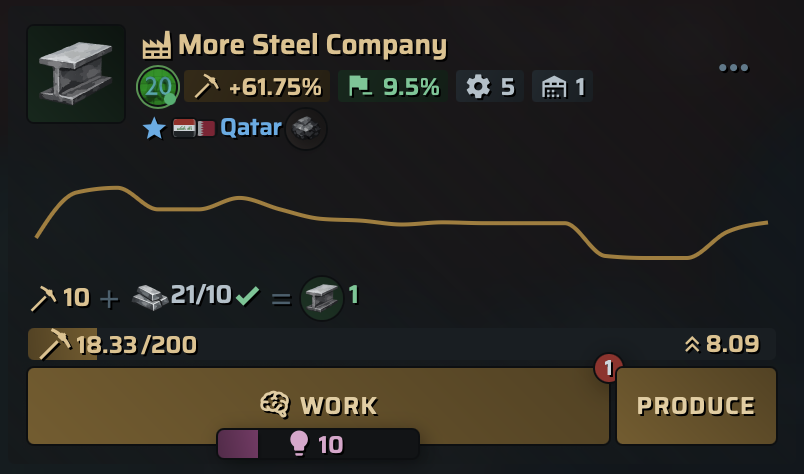
On the screen of your companies, you select one and work; after that, you produce and have your products that you can use to create other products or sell on the market.
THE MARKET
This part is very intuitive; if you want to skip it and discover it on your own, that’s perfectly fine.
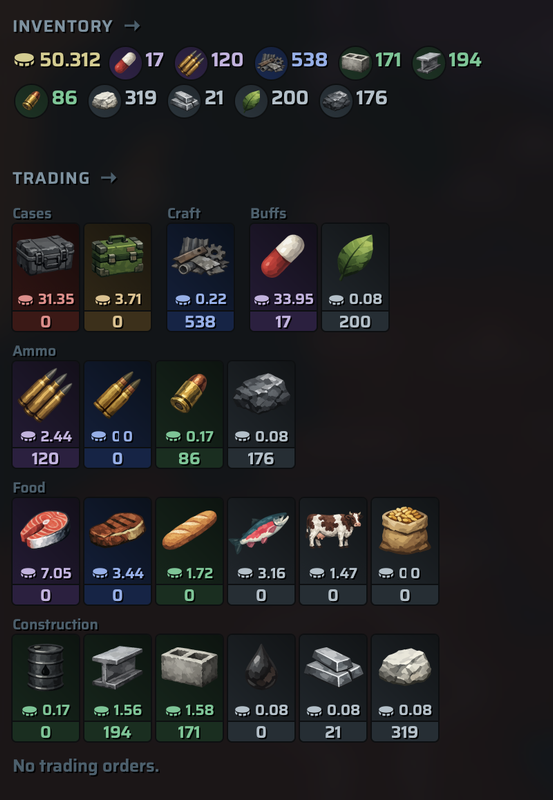
As soon as you click on the Market section at the bottom right, you will be catapulted into your inventory, complete with market prices and the purchase or sale offers you have placed. Let’s see how to buy some cement for our new company.
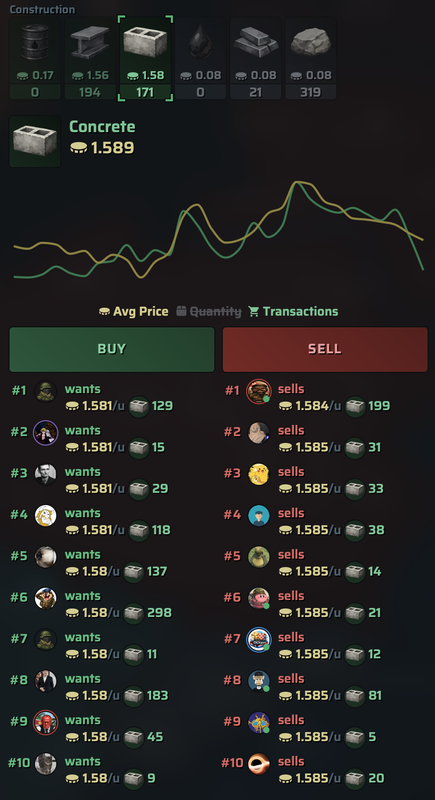
By clicking on trade and cement, you will see this list of purchase offers (the best at 1.581) and sale offers (the best at 1.584). Let’s try to buy some cement by clicking on BUY.
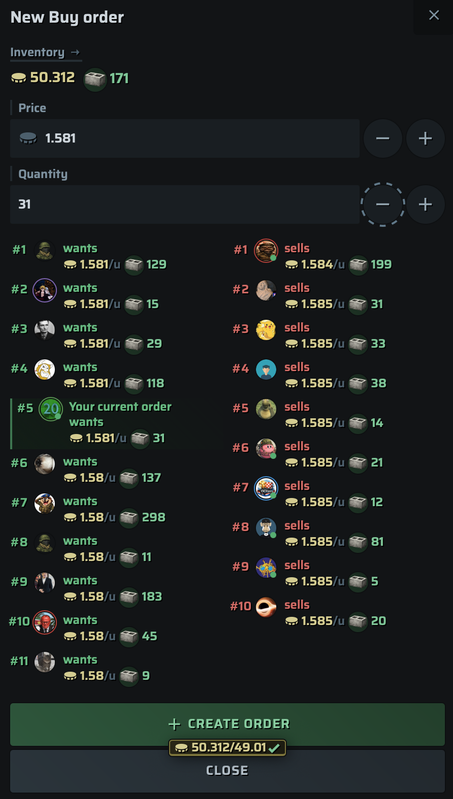
As soon as you click on BUY, this extremely intuitive screen will open. Here, you can also see the best offers. Set the price and quantity and you’re done. If a sale order at the same price exists or is added, the transaction will be successful.
Below the offers in the menu, you can also find the latest transactions for that product to get an idea of what the fair price is.
MACROECONOMICS
In this section, I will provide a very brief overview of the economy of the states. I will not talk about strategic resources here because I will dedicate a separate chapter to them.
By clicking on https://app.warera.io/country/6813b6d446e731854c7ac79c, its country sheet will appear, and we will focus only on the account page.
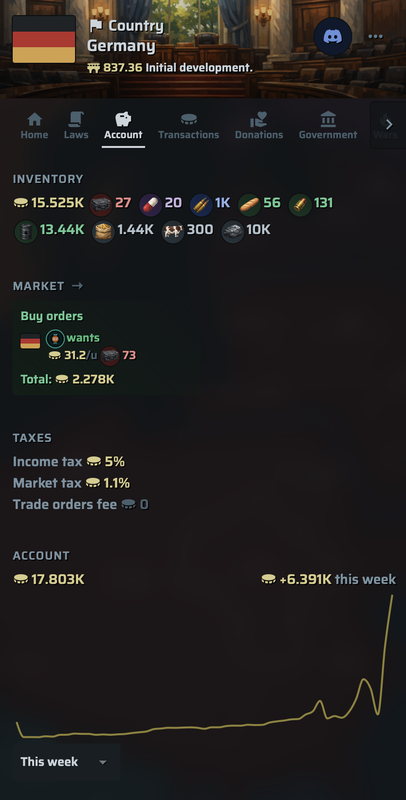
The development, which I will now call dev, (determined by the quantity and quality of the players in the state) can be found at the top and is divided into initial dev and total dev.
The initial dev is the one generated by the core regions, even if they are occupied.
The total dev, on the other hand, is the one generated only by the owned regions, including non-core regions.
The country receives the total dev every day in the form of coins.
Next, we have the inventory. Nothing special to say here, it is identical to that of a single player. States can perform trading operations.
A small note: the only resources needed by the states are oil (to maintain infrastructures) and steel (to perform upgrades).
Then we find the two tax rates:
Income Tax: the tax that companies in the territory pay on salaries.
Market Tax: applied only on the sale of equipment.
Lastly, we have the account (the balance sheet) with all income and expenses. Very straightforward and intuitive. The first source of income for most states is the donations from citizens.
WAR ECONOMY
I will say just a few words about this part because for those who are new, it is not very useful.
In any case, there are 5 resources in the war sector:
Crates: More or less, selling or opening them has an identical expected value, so if you want to indulge your gambling instincts, go ahead. Always keep an eye on the market; it is essential.
Equipment: They come in different rarities. For the early game, use only green and gray ones and sell the others to invest in your companies; it is the most efficient path.
Scraps: Essential for completing the “craft X item” missions. If you have a lot of them, you can easily sell them on the market, which you should always monitor.
Food: A fundamental resource to accumulate but almost useless until level 15. Always watch the market for a good deal.
Cocaine (or pills): An extremely expensive resource that increases your damage. My personal opinion: avoid it like the plague until level 18.
CONCLUSIONS
The economy in WarEra is not complicated, but it is punishing for those who improvise. Every wrong choice in the early levels (poorly invested skills, companies opened without strategy, underpaid jobs, or impulsive market purchases) severely slows growth and forces you into long and costly recoveries.
If there is one takeaway from this guide, it is that experience comes before money, and the economy must be built progressively: first the right skills, then work, then companies, and only after that optimization. Trying to “do everything at once” is almost always the worst path.
A good economic player is not the one who earns the most today, but the one who understands when to produce, when to sell, when to invest, and when to stop. Market, macroeconomics, and country bonuses matter as much as your individual choices, and learning to read them gives you a huge long-term advantage.
Finally, remember that WarEra is a social game: comparing notes with other players, using shared spreadsheets, and asking for advice before making major upgrades will save you time, money, and frustration. The economy is the foundation of everything else: army, politics, and war come later.
Build a solid foundation, and everything else will follow naturally.
I had to do this whole process again btw. because I didn’t have the 3 btc to publish this article and had to sell some ammo. I think I’m going broke…