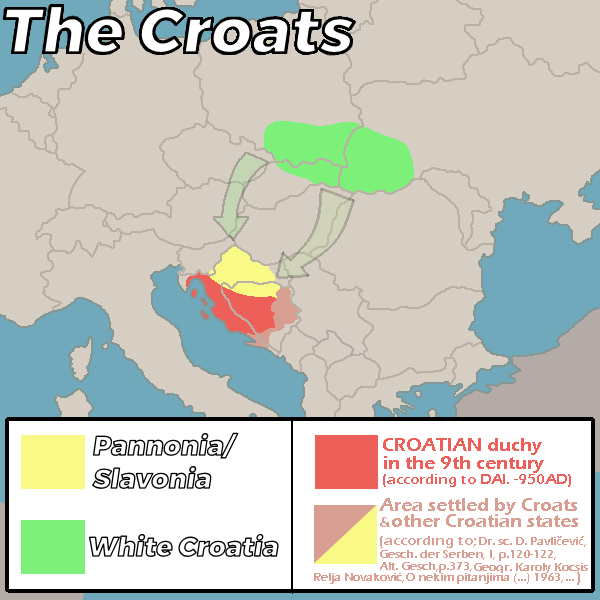
White Croatia - Cradle of Croats
White Croatia, a historical region in Central and Eastern Europe, represents the legendary cradle of the Croatian people. Unlike the coastal Adriatic nation known today, White Croatia was a proto-Slavic homeland situated inland, generally believed to have been located in the area of modern-day southern Poland, western Ukraine, and eastern Slovakia. Its name, "White", signifies a western origin in early Slavic nomenclature.
The connection to modern Croatia is not merely mythical but genealogical. In the 7th century, spurred by the Avar and Byzantine conflicts, a significant number of White Croats migrated southward to the Balkans. They settled in the region of Dalmatia, intermingling with the local Illyrian population and eventually forming the nucleus of the Principality of Dalmatian Croatia. This migration established the linguistic and cultural bedrock that would evolve into the modern Croatian state, bridging the Carpathian Basin with the Adriatic Sea.
Evidence of this migration is remarkably preserved in onomastics. Among non-Croatian Slavs, in Slovakia, the Czech Republic, Poland and Ukraine surnames like Horvat, Chorvat, and Hrvatsky are common. These are not merely coincidental; they are toponymic and ethnic markers. They indicate that the bearers’ ancestors were either Croats who stayed behind during the great migration or local Slavs who lived in proximity to the White Croatian polity, absorbing the name as a territorial identifier.
Physical artifacts anchor this history. Archaeological finds in the Vistula and Dniester basins—including Prague-type ceramic vessels with linear decorations, bronze temple rings worn as tribal markers, and cremation burial mounds match the material culture Byzantine chronicles attribute to the White Croats. Beyond relics, the memory lives in Slavic legends. The Greater Poland Chronicle recounts the Croats descending from the same Carpathian ancestors as the Czechs and Poles, while some Ruthenian versions of the Lech, Czech, and Rus myth explicitly name a fourth brother, Chorvat. Most vividly, Constantine VII's De Administrando Imperio preserves the migration saga of five brothers—Klukas, Lobelos, Kosentzis, Mouchlo, and Hrobatos—and two sisters who led their people southward. These tangible relics and enduring tales prove that White Croatia was no mere fable, but a real kingdom whose legacy directly shaped the Croatian identity we recognize today.