Dall’Italia alla Mongolia
Dal Rullino alla Steppa: Hixu e la Dal Rullino alla Steppa: Hixu e la Grande Via della Politica
Dal nostro inviato speciale - Hixu, la Tartaruga 12 Novembre 1943
L'Italia mi ha insegnato la resilienza tra le macerie, ma l'anima di un osservatore errante non si ferma mai a lungo nello stesso posto. Lasciare Napoli e la mia fidata Leica è stato difficile, ma il richiamo del vento freddo e della polvere mi ha spinto più a est, oltre le steppe sterminate, dritto nel cuore selvaggio della Mongolia.
Cercavo qualcosa che scansasse la semplice sopravvivenza o la cronaca della guerra: volevo capire il potere. Non quello delle armi, che ho visto distruggere troppo, ma quello della parola, delle alleanze e della strategia pura. In un mondo in cui le nazioni si scontrano, la politica è un'arte complessa, e la Mongolia ne custodisce una forma antica e purissima.
Il destino, però, ha uno strano senso dell'umorismo. Nel mezzo della vastità della steppa, tra il freddo che penetra il guscio e l'orizzonte senza fine, mi sono imbattuto in un gruppo inaspettato: una comunità di italiani che viveva lì da tempo.
Ironia della sorte, sono stati proprio questi viaggiatori italiani, ormai perfettamente integrati tra i nomadi e profondamente innamorati di questa terra, a farmi da maestri. Con la loro proverbiale espressività accostata alla solennità del luogo, mi hanno insegnato le sfumature della cultura locale, i segreti della diplomazia dei clan e le regole della complessa arte mongola. Mi hanno mostrato come muovermi con astuzia tra le alleanze della steppa, soppesando ogni parola prima di pronunciarla.
"Se vuoi capire la politica di questo posto," mi ripetevano la sera attorno al fuoco, "devi imparare a leggere la steppa con gli occhi di chi la rispetta, unendo il calore dell'intuito alla pazienza del vento."
Mentre affino le mie doti strategiche e mi esercito nelle dinamiche politiche grazie alle loro lezioni, non posso fare a meno di perdermi nella maestosità del paesaggio. A galoppo su uno Yak, con una tazza di latte di Yak e con il vento freddo che sferza il viso e l'erba dorata che si perde a vista d'occhio, la vastità della Mongolia ti costringe a rimpicciolire l'ego. Non c'è cemento, non ci sono confini tracciati con la violenza: solo un cielo blu infinito che abbraccia la terra.
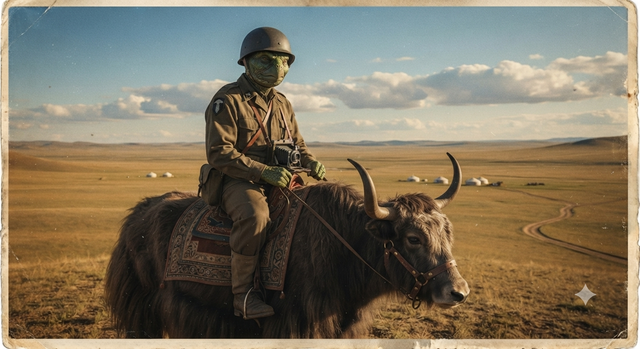

Ho riposto temporaneamente la macchina fotografica nello zaino. Adesso i miei strumenti sono la penna, il taccuino e gli insegnamenti sull'arte mongola che questi incredibili compagni italiani mi hanno trasmesso.
Hixu, passo e chiudo.
From the Roller to the Steppe: Hixu and the From the Roller to the Steppe: Hixu and the Great Path of Politics
From our special correspondent - Hixu, the Turtle November 12, 1943
Italy has taught me resilience among the rubble, but the soul of a wandering observer never stops for long in the same place. Leaving Naples and my trusted Leica was difficult, but the call of the cold wind and dust pushed me further east, beyond the endless steppes, straight into the wild heart of Mongolia.
I was looking for something that would avoid simple survival or the chronicle of war: I wanted to understand power. Not that of weapons, which I have seen destroy too much, but that of the word, alliances and pure strategy. In a world where nations clash, politics is a complex art, and Mongolia preserves an ancient and pure form of it.
Destiny, however, has a strange sense of humor. In the middle of the vastness of the steppe, between the cold that penetrates the shell and the endless horizon, I came across an unexpected group: a community of Italians who had lived there for a long time.
Ironically, it was precisely these Italian travelers, now perfectly integrated among the nomads and deeply in love with this land, who were my teachers. With their proverbial expressiveness compared to the solemnity of the place, they taught me the nuances of local culture, the secrets of clan diplomacy and the rules of the complex Mongolian art. They showed me how to move cunningly between the alliances of the steppe, weighing each word before pronouncing it.
"If you want to understand the politics of this place," they repeated to me in the evening around the fire, "you must learn to read the steppe with the eyes of those who respect it, combining the warmth of intuition with the patience of the wind."
While I hone my strategic skills and practice political dynamics thanks to their lessons, I can't help but lose myself in the majesty of the landscape. Galloping on a Yak, with a cup of Yak milk and with the cold wind whipping your face and the golden grass that is lost in sight of sight, the vastness of Mongolia forces you to shrink your ego. There is no cement, there are no boundaries drawn with violence: only an infinite blue sky that embraces the earth.
I temporarily put the camera in my backpack. Now my tools are the pen, the notebook and the teachings on Mongolian art that these incredible Italian companions have transmitted to me.
Hixu, I pass and close.